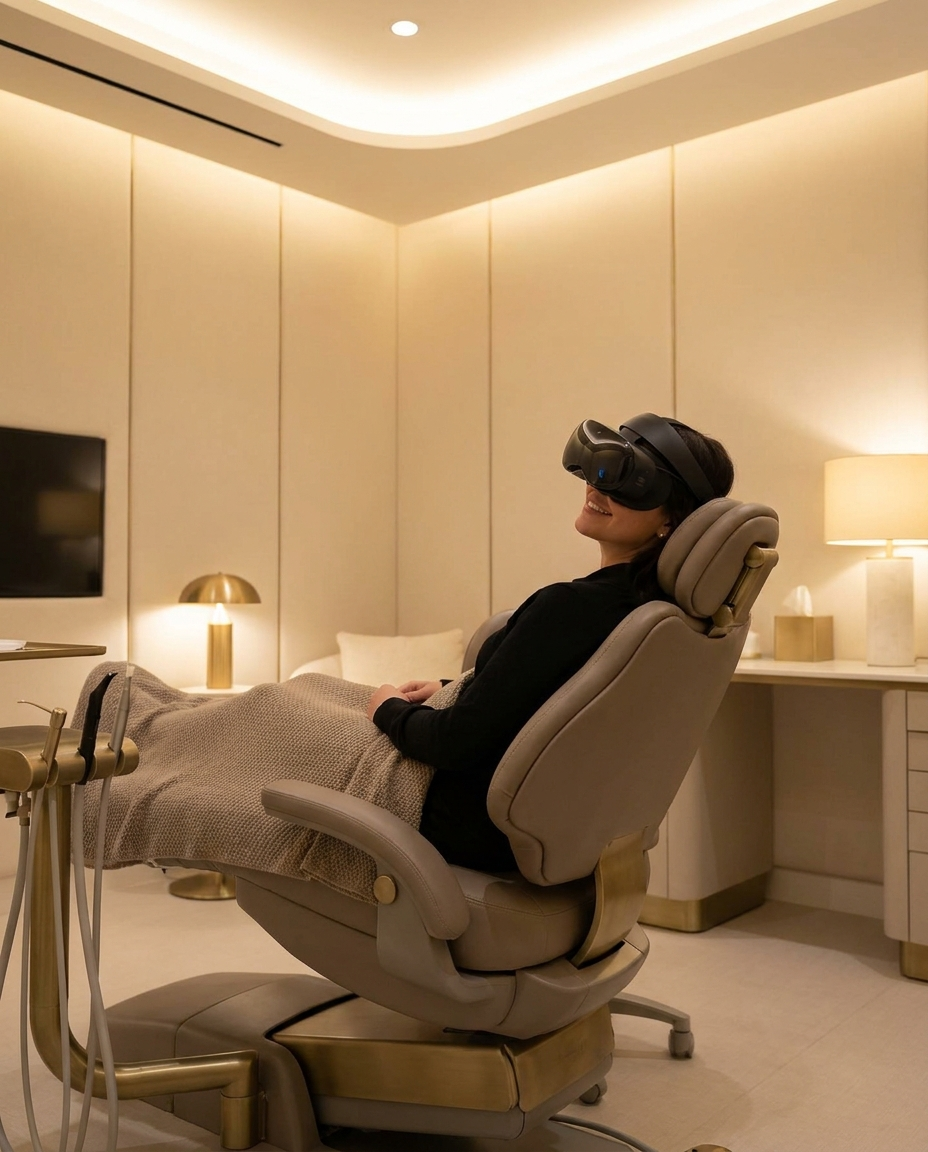
What if you could be somewhere else entirely? Not metaphorically — not in the gentle, imaginative sense of a guided meditation — but genuinely, visually, wholly somewhere else? Standing at the edge of a Norwegian fjord as the aurora slides overhead. Walking slowly through a Japanese bamboo forest in late afternoon light. Sitting on a deserted beach watching waves arrive from somewhere beyond the horizon. Our virtual reality distraction therapy makes this possible through high-resolution VR headsets delivering 360-degree immersive environments at frame rates smooth enough to feel like presence rather than video. The dental chair is still beneath you. Your clinician is still at work. But your visual and auditory world has been entirely replaced — and with it, the lion's share of the cognitive space that would otherwise be occupied by anticipation, monitoring, and the magnification of sensation that anxious attention reliably produces.
The Psychology of Distraction
Pain and anxiety are both substantially modulated by attentional resources. When the brain's cognitive capacity is genuinely occupied elsewhere — not just encouraged to wander, but actively immersed in a compelling alternative reality — the attentional bandwidth available for amplifying procedural sensation is measurably reduced. Multiple randomised controlled trials of VR distraction in medical and dental contexts have demonstrated significant reductions in pain scores, anxiety ratings, and the need for supplemental anaesthesia compared to standard care. The effect is not simply one of entertainment; it is a specific exploitation of the brain's finite capacity for simultaneous processing. You cannot fully be in a bamboo forest and fully be in a dental chair at the same time. We have made it remarkably easy to be in the forest.
Our Virtual Environments
Serenity Dental Spa has curated a library of VR environments chosen not for spectacle but for calm. There are no roller coasters or action sequences — every environment in our library has been selected for its capacity to induce the quiet awe response identified in neuroscience research as reliably activating the parasympathetic nervous system: wide open spaces, natural water, slow movement, vastness. A Maldivian lagoon at low tide. A midnight snowfield in Iceland. A slow drift through a deep-ocean reef, unhurried fish moving in pale blue light. A Japanese garden in early morning rain. A cloud-level perspective above the Alps at sunset. Environments are available in silence, with ambient natural sound, or with embedded binaural music. Patients choose at the start of their appointment and may switch between environments via a simple controller in the non-treatment hand. We update the library quarterly.
Comfort, Safety, and Fit
Our VR headsets are the lightest-weight clinical-grade units available, chosen specifically to avoid the pressure on the temples and bridge of the nose that consumer headsets can cause during long wear. They are sanitised between each use with a clinical-grade wipe system. For patients with motion sensitivity, we offer a curated still-environment selection — beautiful, immersive spaces without camera movement — that eliminates any risk of nausea. The headset does not cover the mouth, allowing clinical access throughout. Patients who need to signal discomfort use the squeeze ball in their hand. The clinician can communicate through the headset's audio at any time. Children as young as seven typically embrace VR distraction therapy; many previously treatment-resistant young patients have completed their first successful appointment entirely because of it. The forest, it turns out, is available to all of us.
Your Ritual, Step by Step
- 1 Choose your world from our curated environment library
- 2 Headset fitted lightly — your visual world transforms immediately
- 3 Squeeze ball in hand as you rest within your chosen landscape
- 4 Remove the headset at the end — appointment completed, almost without noticing