Drive on Light Captured From a Star
Astral Grid Dynamics turns rooftop yield into kilometres. Our solar-coupled chargers route surplus generation into your fleet or family vehicle, intelligently sequencing every electron for maximum range and minimum grid draw.
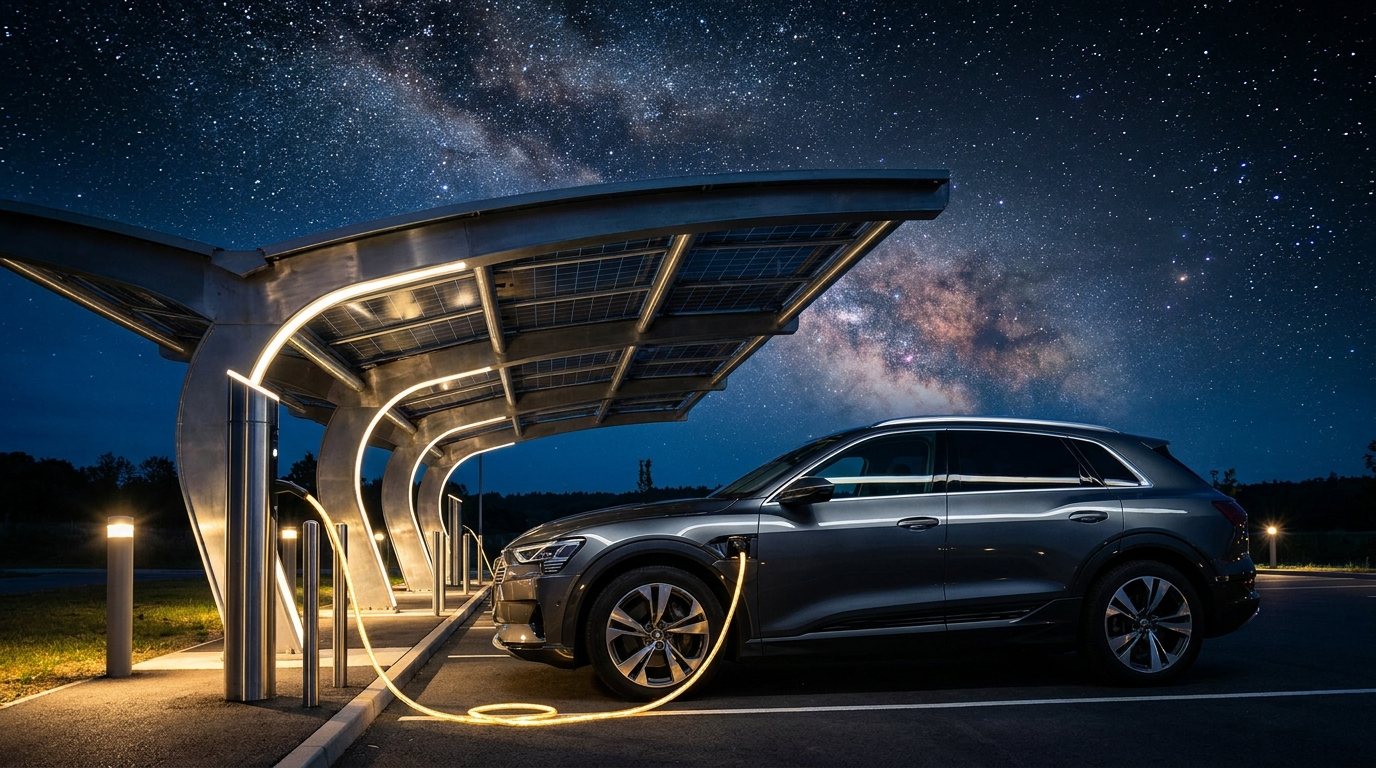
Every electric vehicle is a battery on wheels, and every roof is a collector of raw stellar power. Astral Grid Dynamics closes the loop between the two. Our EV charging systems are engineered to draw their energy from the same photons your panels harvest, so the kilometres you drive are quite literally distilled sunlight rather than coal-fired grid supply.
The result is transport that costs a fraction of petrol, emits nothing at the tailpipe, and shields you from volatile energy pricing. We treat charging not as an appliance but as the final stage of a yield pipeline that begins ninety-three million miles away.
Solar-coupled charging architecture
A standard charger simply pulls whatever the grid offers. Ours is smarter. Our controllers continuously read your live solar generation, household or site load, and battery state of charge, then modulate the charging current in real time to consume surplus production first. When the sun is abundant, the vehicle charges fast; when cloud reduces yield, the system tapers gracefully rather than dragging expensive power from the grid.
- Single-phase and three-phase chargers from 7kW to 22kW
- Dynamic load balancing to protect your main switchboard
- Solar-surplus diversion that prioritises self-generated energy
- OCPP-compliant hardware for future-proof interoperability
- Scheduled charging aligned to forecast peak yield windows
Macro-scale yield forecasting
For fleets and commercial depots, charging at random is a recipe for demand charges and wasted generation. We model your site's expected output hour by hour using historical irradiance data and predictive weather feeds, then schedule each vehicle to draw power when the array is at its strongest. This forecasting discipline can shift the overwhelming majority of charging into daylight hours, slashing both energy bills and peak-demand penalties.
The same intelligence allows us to stagger a row of chargers so a depot never trips its supply limit, sequencing vehicles through high-rate windows like trains through a station.
Vehicle-to-everything readiness
A modern EV is a mobile reservoir of energy, and the most advanced cars can now feed power back out. We install bidirectional-ready infrastructure so your vehicle can one day discharge into your home during an evening peak or support the grid during a stress event. Combined with stationary storage, this turns your driveway into a node in a larger energy constellation rather than a passive socket.
Every installation is delivered by accredited electricians, tested to Australian standards, and commissioned with a monitoring app that shows you exactly how much of each charge came from your own roof. Harnessing a star to move a vehicle was once the stuff of speculation. We make it your Tuesday commute.
EV Charging questions
In most cases, yes. With an adequately sized array and our surplus-diversion controller, daytime charging can run almost entirely on self-generated power. Adding a home battery extends solar charging into the evening, pushing solar-sourced kilometres well above ninety per cent for typical drivers.
Home single-phase chargers deliver around 7kW, adding roughly 40km of range per hour. Three-phase units up to 22kW can more than triple that where your supply allows. Actual speed also depends on your vehicle's onboard charger, which we assess during your site survey.
Not necessarily. Many clients charge successfully on daytime solar alone. A battery is recommended if you drive mostly at night or want to maximise self-consumption, since it stores midday surplus for after-dark charging and provides backup during outages.
Ready to deploy ev charging?
Tell us about your site and we will model the yield, returns and the fastest path to energised.