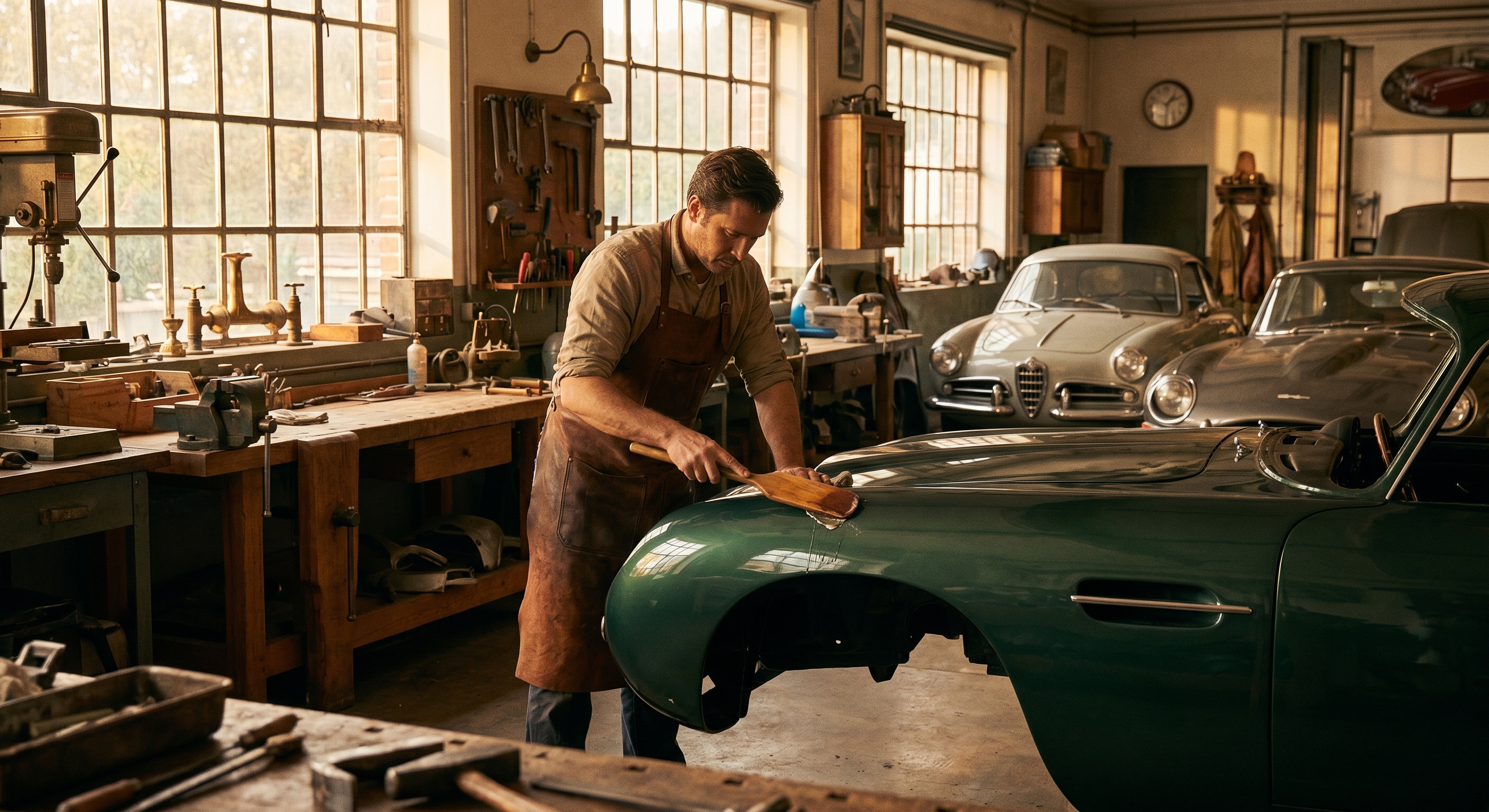
There is a quiet honesty to a body that has been finished in lead. Modern plastic fillers are fast and forgiving, and they have their place — but they are not how the great cars were built, and over decades they crack, shrink and let moisture creep beneath the paint. Lead loading, the traditional craft of fairing a panel with body solder, is slower and far harder to master. It is also permanent, and on a car worth restoring properly, permanence is everything.
Our metal finishers prepare each seam and low spot by cleaning back to bright metal, tinning the surface, then flowing on the solder and working it smooth with hardwood paddles and tallow while it is still plastic. Done well, the leaded area becomes part of the panel — it expands and contracts with the steel, resists corrosion, and gives the finished paintwork a depth and flatness that filler simply cannot.
Metal first, always
Before any loading is contemplated, the metal itself must be right. We believe in working the panel back to shape with hammer and dolly rather than burying a problem under a thick skim. A correctly finished panel needs only the thinnest possible lead — often just a whisper across a joint — because the steel beneath is already true. Where corrosion has taken hold, we cut it out and let in new metal rather than disguising it.
What we undertake
- Traditional lead loading of seams, joints and factory fill areas
- Hammer-and-dolly metal finishing to remove dents and restore contour
- Rust repair by cutting out and welding in correctly formed sections
- Panel alignment, gap-setting and door, bonnet and boot fit
- Preparation of bare, faired bodies ready for the paint shop
The right material for the car
Not every car was leaded everywhere, and we never apply a technique simply for its own sake. Some seams were always filled; some were not. Part of doing this work properly is knowing the difference, marque by marque, and finishing each car as its makers did. Where a body was originally bare aluminium, we metal-finish it accordingly. Where steel was leaded at the A-post or along the roof gutter, that is where the lead goes.
A foundation for the finish
However beautiful the eventual paintwork, it can only ever be as good as the surface beneath it. A panel that is true in the metal, faired in lead and prepared with patience reflects light in a single, unbroken plane — the look that separates a properly restored car from a merely shiny one. This is unglamorous, painstaking work that nobody sees once the colour goes on. We think it is among the most important work we do.