Commercial & Industrial
Power your bottom line
Warehouses, factories and offices burn power all day — exactly when the sun is highest. We engineer commercial arrays that attack demand charges, hedge energy prices and harden your operation against the grid.
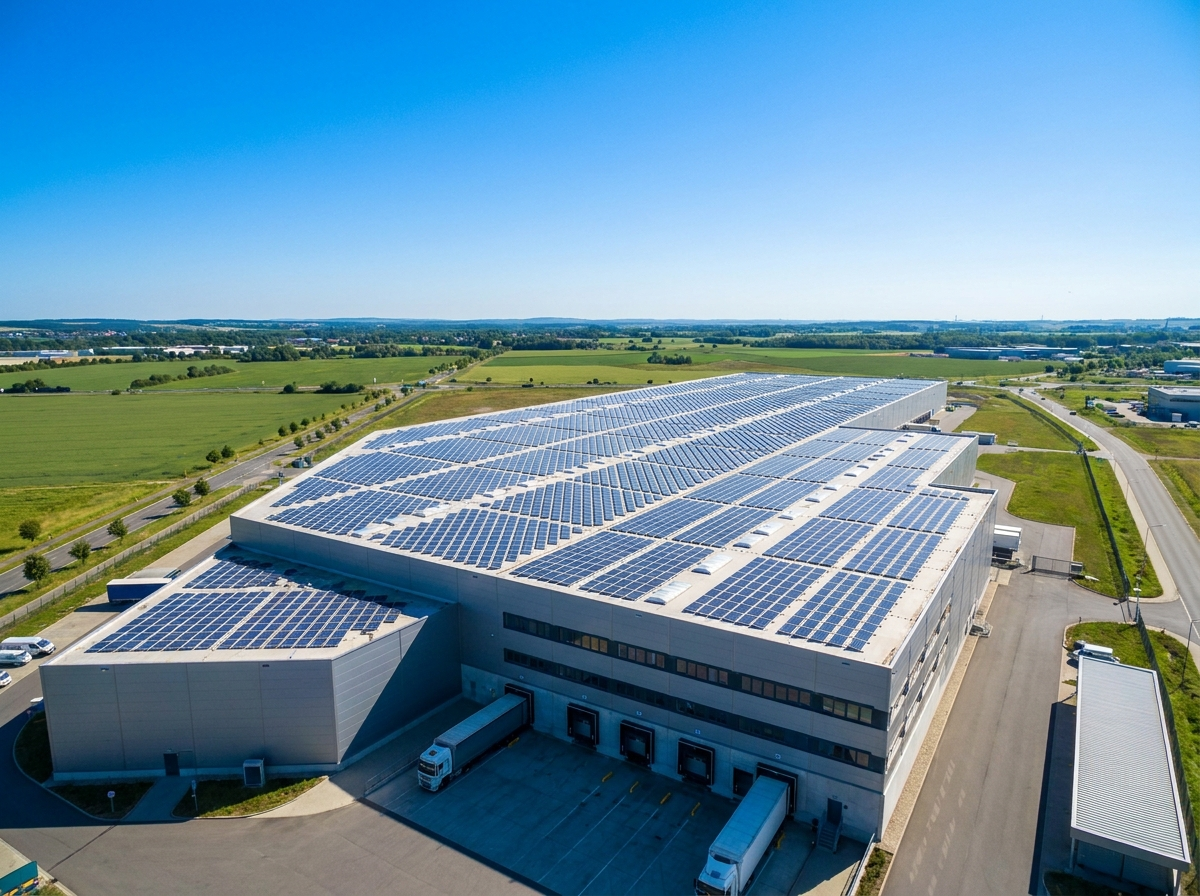
A warehouse, a factory, an office park — these buildings draw their heaviest load in the middle of the day, the exact hours the sun is hammering down on their wide, flat, mostly empty roofs. That is not a coincidence to ignore. It is leverage. A commercial array built on that roof turns your single largest fixed cost into a fixed asset, generating power right at the meter, right when your demand peaks, right when grid energy costs the most.
Demand charges are the silent killer on a commercial bill — penalties for your highest spike of usage, sometimes a third of the total invoice. Solar attacks that spike head-on, shaving the peak and hedging you against the rate increases that never stop coming. The result is an operation that costs less to run, carries a stronger balance sheet, and stands a little more independent from a grid you do not control.
Built to harden your operation
When the grid stumbles, your production line, your cold storage, your servers do not care about excuses. We engineer commercial systems for reliability first — robust racking, redundant inverters, and storage-ready architecture that keeps critical loads alive through outages. This is industrial-grade self-reliance: power you generate, control, and count on, instead of hoping the utility holds up during the next heat wave or storm.
Where commercial solar pays off
- Demand-charge reduction that targets your costliest usage peaks, not just total consumption
- Long-term price certainty that hedges against decades of utility rate inflation
- Accelerated depreciation and tax incentives that sharpen first-year economics
- Roof, carport, or ground-mount configurations sized to your actual load profile
- Storage and backup integration to keep critical systems running through grid failures
- Monitoring and reporting that proves the savings and supports your sustainability goals
Engineered around your load, not a brochure
We start with your bills, not a panel count. Twelve months of interval data tells us when you draw power, how hard your peaks hit, and where the demand charges are bleeding you. From there we model roof, carport, and ground-mount options against your real load curve, then size the array to the sweet spot where every kilowatt installed actually earns its keep. No oversold capacity feeding power back at a loss, and no undersized token system that barely dents the bill.
Reliability gets engineered in from the first line of the design. Commercial-grade inverters, robust racking rated for your wind and snow zone, and clean conduit runs that an electrician can actually service ten years from now. We coordinate the structural review, the utility interconnection, and the permitting so the project lands on schedule. When it energizes, you get a system built to run hard for 25 years with monitoring that proves the savings line by line.
The long-term math works
Commercial solar is one of the rare capital investments that starts returning cash almost immediately and keeps doing it for 25 years or more. Between demand-charge savings, energy offset, accelerated depreciation, and incentives, most of our commercial clients see payback in a handful of years — then bank decades of low-cost, self-generated power. It is a hedge against rate inflation, a depreciating asset that pays you, and a genuine competitive edge rolled into one rooftop.
Send us 12 months of utility bills and we will model your savings, payback, and demand-charge reduction at no cost — a clear, honest look at what owning your own power could do for your bottom line.
Common questions
Will an array disrupt our operations during install?
Rarely. Most commercial installs happen on the roof or in unused yard space with minimal interruption to your floor. We schedule around your shifts and stage the work so production keeps moving while the system goes in overhead.
How does solar actually lower demand charges?
Demand charges bill your single highest usage peak, which usually lands in sunny midday hours. By generating power right at that peak, solar shaves the spike the utility measures, cutting the charge even before it offsets your total energy use.
Can we add battery storage later?
Yes. We design every commercial system storage-ready, so adding batteries for peak shaving, backup power, or demand response is a planned upgrade rather than a costly rebuild of your electrical infrastructure.
Keep exploring
The paradigm shift
Ready to own your own power?
Book a free assessment and we'll design a rugged solar, storage or off-grid system around your home, your loads and your appetite for independence.