See decay forming, before you feel it
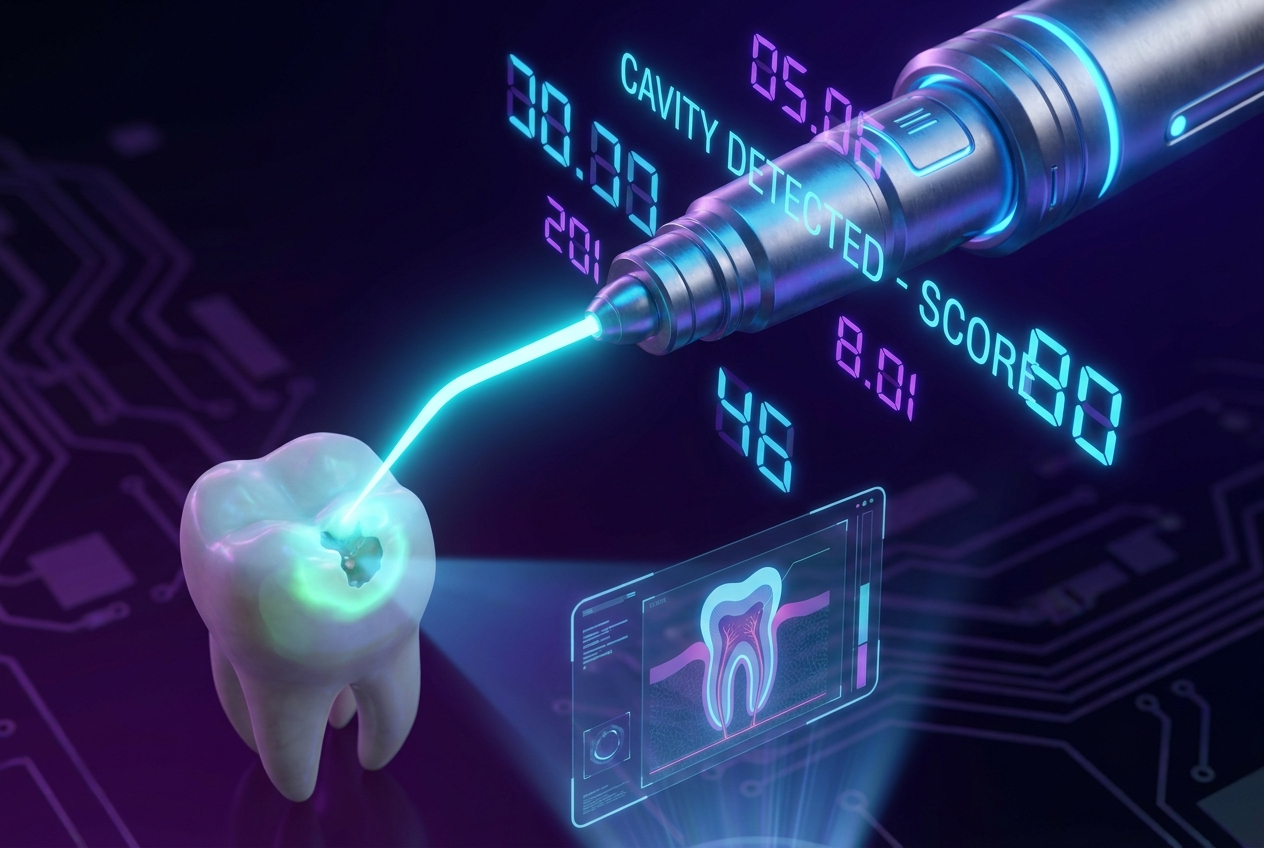
A pen-sized laser reads the fluorescence of your tooth enamel and turns it into a number. We catch decay at its earliest stage, with no radiation and no guesswork.
Traditional cavity hunting relies on a sharp metal explorer and a dentist's eye — methods that often miss decay until it has already tunnelled beneath the enamel. By then the damage frequently needs a filling that could have been avoided. NovaTech takes a different path: we measure your teeth with light.
Our laser fluorescence system, in the lineage of the DIAGNOdent platform, shines a harmless 655-nanometre laser onto each tooth surface. Healthy enamel reflects very little fluorescence, while bacteria and demineralised tissue glow far more brightly. The handpiece reads that glow and converts it into a clear numerical score, so detection becomes objective rather than a judgement call.
Why a number changes everything
A reading you can see removes ambiguity from your diagnosis. Low scores mean we watch and remineralise; rising scores mean we act early with the smallest possible intervention. Because we record each value, we can track a suspicious spot across visits and intervene only when the data tells us to — sparing healthy tooth structure.
What the scan gives you
- A radiation-free examination, safe to repeat as often as needed
- Quantified readings for every tooth, recorded over time
- Early detection in pits and fissures that X-rays often miss
- Objective evidence you can see on the screen, not just hear about
- Smaller, less invasive treatment when decay is caught early
Comfortable and fast
The whole scan is silent, contact-light and takes only minutes. There is no pressure, no scraping and nothing to numb. Many patients find it reassuring to watch their own readings appear in real time, and to leave knowing exactly which surfaces are stable and which need attention.
Early detection is the single most powerful way to keep dentistry minimal. Clinically, the earlier decay is found, the more conservative the fix — often just a fluoride or remineralising programme rather than a drill.
If it has been a while since your last check, or you simply want a clearer picture of your dental health, book a laser cavity scan and let the light do the looking.
Laser Cavity Detection questions
Not at all. The laser only reads reflected light from the tooth surface — there is no heat you can feel, no scraping and no need for anaesthetic. Most patients describe it as a quiet, gentle scan that takes just a few minutes.
It uses a low-power visible laser, not ionising radiation, so it can be repeated as often as needed. We still use X-rays where they add value, but fluorescence detection is excellent for chewing surfaces and lets us monitor early spots safely.
Often, yes. Laser fluorescence is particularly good at detecting decay hidden in the pits and fissures of back teeth, where early lesions can be invisible on standard radiographs until they have grown larger.
Ready to feel the difference?
Honest advice, transparent pricing and dentistry that finally feels like nothing — book your NovaTech consult today.