Implants placed with robotic precision
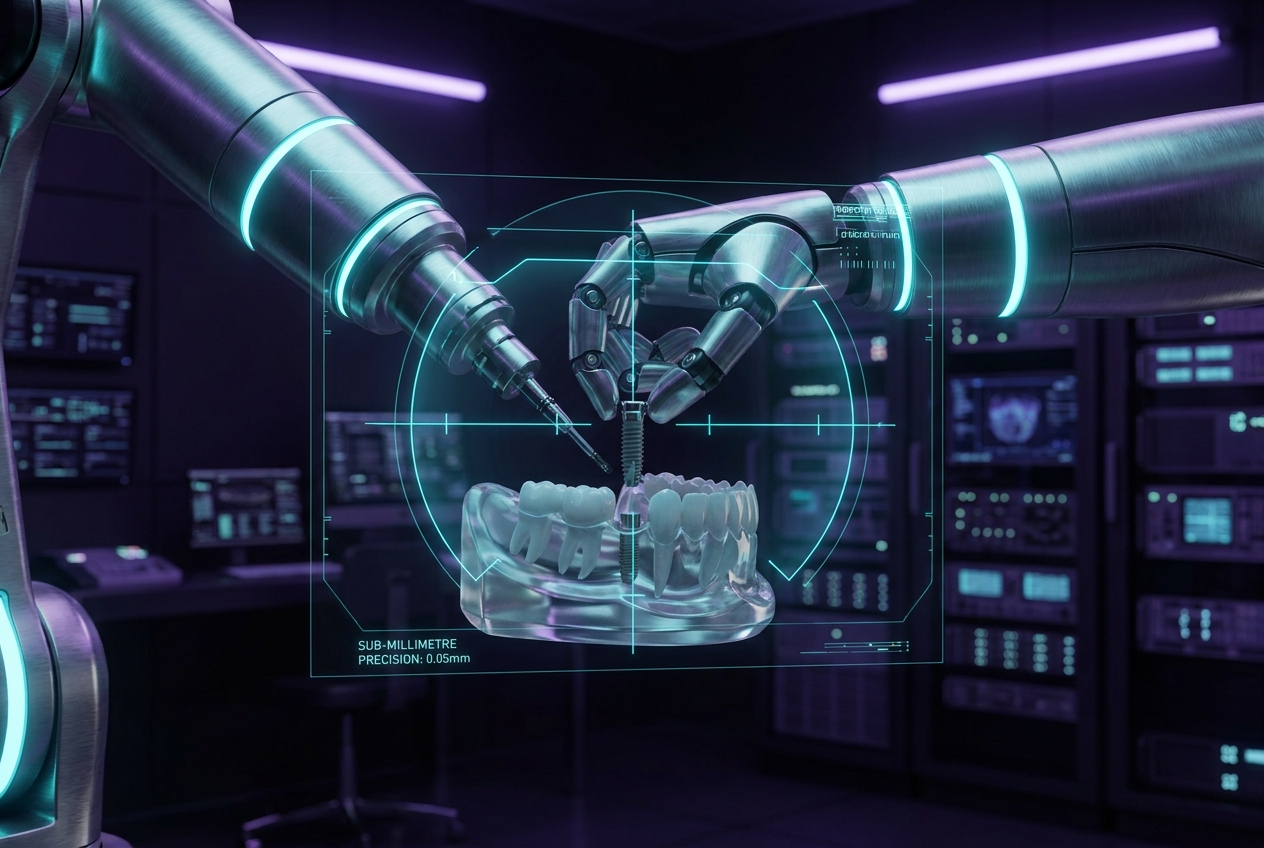
Robot-assisted navigation guides every implant to the exact position planned in 3D, with sub-millimetre accuracy. The result is safer surgery, smaller incisions and a more predictable outcome.
A dental implant is essentially a titanium anchor placed into the jawbone to support a replacement tooth, and its long-term success depends almost entirely on position. A few degrees of angle or a fraction of a millimetre of depth can be the difference between an implant that lasts decades and one that crowds a nerve or sits poorly for its crown. Robotic guidance makes that precision routine.
We start by combining a 3D cone-beam scan of your jaw with a digital scan of your teeth to build a complete virtual model. On that model we plan the ideal implant position to the millimetre — clear of nerves, sinuses and adjacent roots, and perfectly oriented for the final tooth. The robotic system, in the lineage of haptic guidance platforms like Yomi, then carries that plan into surgery.
How robotic guidance works
During the procedure the system tracks the position of your jaw and the surgical handpiece in real time. As your surgeon works, the robotic arm provides physical guidance — gently constraining the drill to the planned angle and depth — so the implant goes exactly where it was designed to go. The surgeon stays in control throughout; the robot simply enforces the plan.
What robotic surgery offers
- Sub-millimetre accuracy matched to your 3D surgical plan
- Greater safety margins around nerves and sinuses
- Often smaller, flapless incisions and less swelling
- Real-time tracking that adapts if your jaw moves
- A predictable position ready for the final crown
Safer, smaller, more predictable
Because the path is planned and physically guided, the surgery can frequently be performed through a smaller opening, sometimes without lifting a gum flap at all. Less disturbance to the tissue is associated with reduced swelling and a more comfortable recovery for many patients, and the accuracy reduces the risk of complications near critical structures.
Precision also pays off later. An implant placed exactly as planned makes the restorative phase far simpler, so your final crown sits naturally and bears your bite forces correctly — both of which clinically support a long, healthy lifespan for the implant.
Replacing a missing tooth is a long-term investment, and accuracy protects it. Book a robotic implant consultation and let us plan your treatment down to the millimetre before we ever begin.
Robotic Implant Surgery questions
No. Your surgeon performs the surgery and stays fully in control at all times. The robotic system provides navigation and physical guidance to keep the drill aligned with the 3D plan, much like advanced assistance rather than autonomous operation.
Often, yes. The precision frequently allows smaller, sometimes flapless incisions, which is associated with less swelling and a smoother recovery for many patients. The procedure itself is carried out under local anaesthetic with sedation options available.
Implant position determines how well it integrates, how it avoids nerves and sinuses, and how natural the final crown looks and functions. Guiding placement to within a fraction of a millimetre improves safety and supports a long-lasting, predictable result.
Ready to feel the difference?
Honest advice, transparent pricing and dentistry that finally feels like nothing — book your NovaTech consult today.