
Driver assistance, calibrated to the millimetre
Your EV's cameras and radar must be aimed with extreme precision to keep you safe. After any repair that disturbs them, we recalibrate to factory specification.
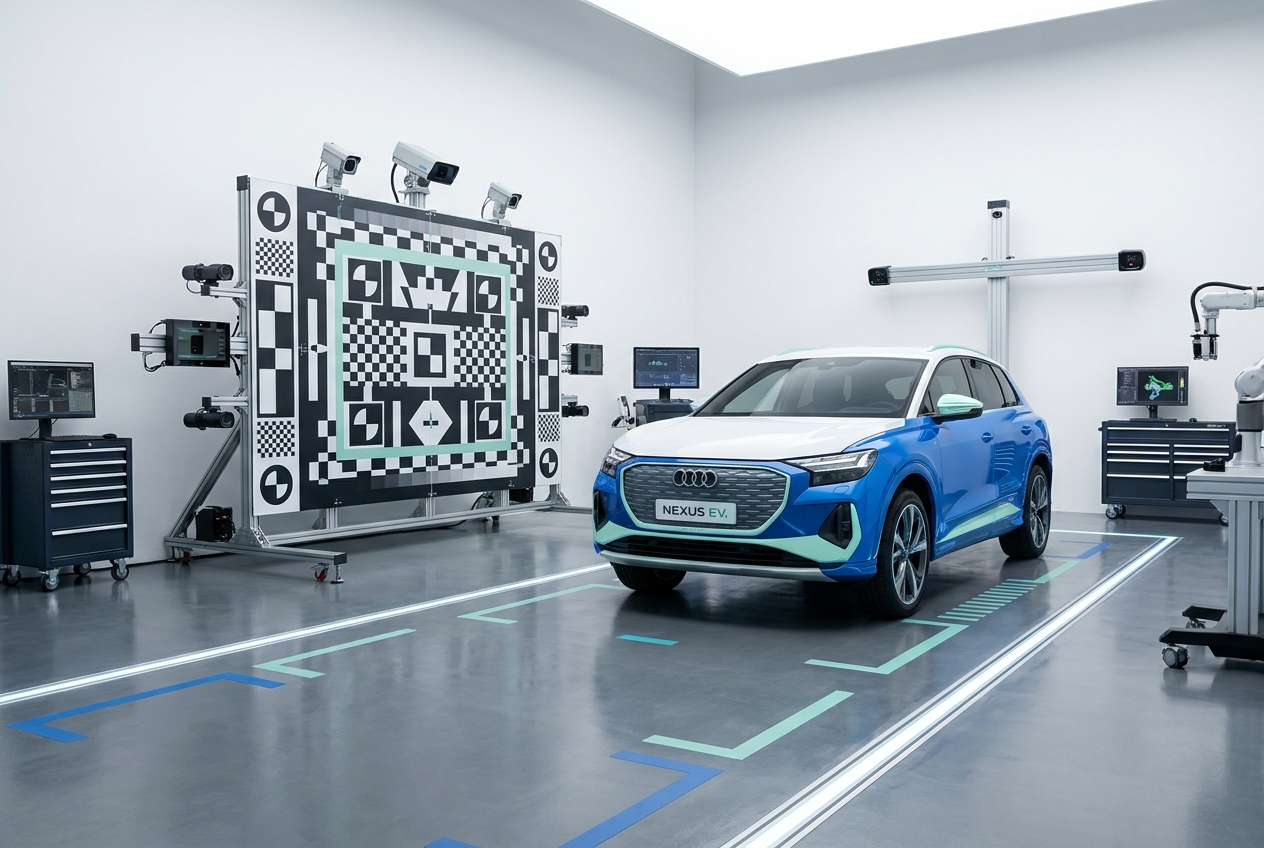
Modern electric vehicles are bristling with advanced driver-assistance systems — automatic emergency braking, lane keeping, adaptive cruise control, blind-spot monitoring and more. Every one of them depends on a suite of cameras, radar units and sensors reading the world with extraordinary precision. These sensors are aimed to within fractions of a degree, because a tiny misalignment at the bumper translates into metres of error far down the road. When they are even slightly out, the systems meant to protect you can brake late, wander in the lane or fail to see a hazard at all.
Many everyday events knock these sensors out of alignment, and most owners never realise it. A windscreen replacement moves the forward camera. A minor bumper bump shifts the radar. A wheel alignment, a suspension repair or even a change of tyre size can alter the geometry the systems rely on. After any of these, the manufacturer requires a formal recalibration — and skipping it leaves you driving with safety systems that quietly believe the road is somewhere it is not.
When you need recalibration
- After a windscreen replacement (forward camera)
- Following any bumper, grille or panel repair
- After suspension, steering or wheel-alignment work
- When changing tyre or wheel sizes
- After a collision, however minor
- When assistance systems behave erratically or warn of a fault
Static and dynamic calibration
Proper calibration is exacting work that cannot be done by eye. Some systems require static calibration, using precisely positioned manufacturer targets on a level, controlled floor with the vehicle set to an exact reference. Others require dynamic calibration, driven on the road under specific conditions while the system relearns. Many vehicles need both. We have the equipment, the targets, the space and the trained technicians to perform either procedure to specification — and the documentation to prove it was done correctly.
Safety you can verify
Driver-assistance systems are only as trustworthy as their calibration, and a miscalibrated system can be worse than none at all because you instinctively rely on it. After we recalibrate, we verify each system is reading accurately and provide a record confirming the work — valuable for your peace of mind, your insurer and your vehicle's history. If you have recently had a windscreen, a repair or alignment work done elsewhere and were not offered calibration, your systems may well be out right now.
Don't trust your safety to misaimed sensors. Book an ADAS calibration and we will return your driver-assistance systems to exact factory accuracy.
ADAS Sensor Calibration questions
Almost certainly. The forward-facing camera sits on the windscreen, and replacing the glass moves it. Manufacturers require recalibration afterward for the safety systems to work correctly.
Often you can't tell by feel, which is the danger. Any repair near a sensor warrants calibration, and erratic behaviour from assistance systems is a clear sign.
It depends on the vehicle and whether static, dynamic or both procedures are required. Most calibrations are completed within a few hours, and we will give you a clear estimate when you book.
Let's read your EV the right way
Honest, data-backed diagnostics and precise repairs from a high-voltage certified team — book with The EV Tech Center today.