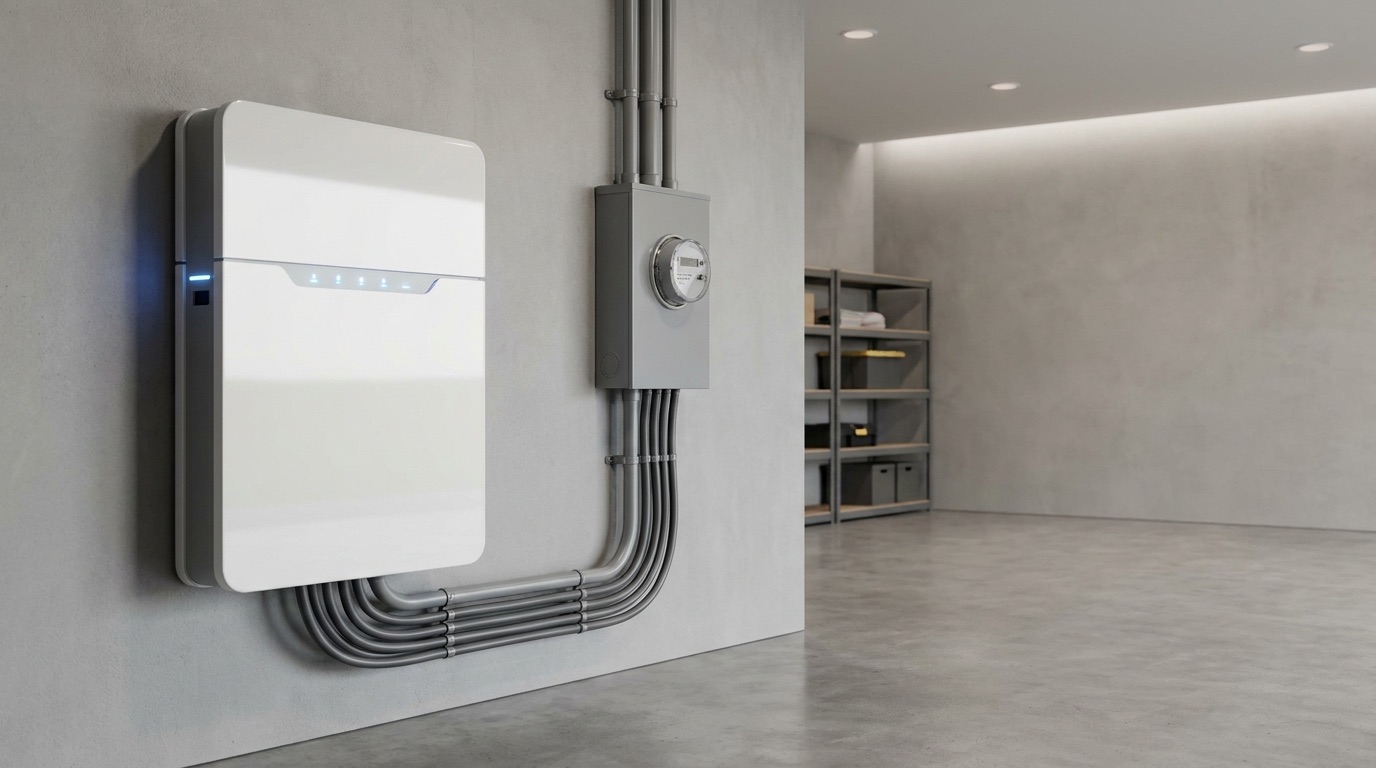
A step-by-step framework for matching battery capacity to your actual usage, tariff structure, and resilience goals without overpaying for headroom you will never use.
Battery sizing is where most home energy projects go wrong, in both directions. Oversize and you pay for kilowatt-hours that sit idle, dragging down your return for a decade. Undersize and you import expensive grid power every evening, defeating the purpose of storing your own generation. The right answer is rarely the biggest battery the installer can sell you. It is the one that matches your load profile, your tariff, and your tolerance for an outage. This framework walks through the four questions that determine that number.
Start With Your Load Profile, Not Your Panel Size
The single most useful input is your interval consumption data, the half-hourly or hourly record your meter already collects. It tells you not just how much energy you use but when. A household that consumes 20 kilowatt-hours a day but uses most of it at noon, when the panels are producing, needs far less storage than a household with the same total that runs everything after sunset.
Pull twelve months of data so you capture seasonal swing. Then isolate the evening and overnight block, roughly from when generation tapers to when it resumes. That figure, your nightly self-supply target, is the foundation everything else builds on.
The Core Sizing Calculation
Once you know your nightly draw, the usable capacity you need follows directly. Work in usable kilowatt-hours, not nameplate, because most lithium systems reserve a portion of capacity to protect cell longevity.
- Identify your average evening-to-morning consumption, for example 10 kWh.
- Add a buffer for cloudy days and variability, typically 20 to 30 percent.
- Divide by depth-of-discharge if quoting nameplate, since a 13.5 kWh battery may offer only about 13 kWh usable.
- Cross-check against your inverter's continuous power rating so the battery can actually deliver peak loads.
For the example above, a 10 kWh nightly draw plus a 25 percent buffer lands near 12.5 kWh usable. A single mainstream home battery covers that comfortably, while a household drawing 18 kWh overnight would need two units or a larger modular stack.
Let Your Tariff Do the Arithmetic
A battery only saves money on the gap between what you pay to import and what you would have earned exporting. Under a flat tariff with a generous feed-in rate, the economic case for storage is weak, because you are essentially trading a known export credit for a smaller import saving. Under a time-of-use tariff with a steep evening peak, the case is strong.
The most valuable kilowatt-hour a battery stores is the one that displaces peak-rate grid power. If your peak window runs from 3 pm to 9 pm at a high rate, size the battery to carry your load across that entire window first, and treat overnight backup as a secondary goal. Tariff arbitrage, not total autonomy, is where the dollars are.
Backup and Resilience Are a Separate Question
Resilience sizing follows a different logic from daily cycling. Here you are not optimising return; you are buying insurance against an outage. The right capacity depends on which circuits you want to keep alive and for how long.
- Essential-only backup, covering lights, fridge, internet, and phone charging, may need just 2 to 4 kWh per day.
- Whole-home backup including air conditioning or electric cooking can demand 15 kWh or more per day.
- Multi-day resilience requires either a much larger bank or a battery sized to recharge from solar each day.
- Confirm the system supports islanding, since not every grid-tied battery can run during a blackout.
A common and sensible pattern is to size the battery for daily tariff arbitrage and accept that, in an outage, it will run only essential circuits rather than the whole house. That keeps cost proportionate while still delivering meaningful resilience.
Account for Degradation and Future Load
Lithium batteries lose capacity over time, typically warranted to retain about 60 to 70 percent after ten years or a defined number of cycles. Sizing to the edge today means falling short later, so a modest margin protects performance across the warranty period. Equally, anticipate new loads. If an electric vehicle or a heat pump is on the horizon, your overnight consumption will climb, and a modular system you can expand later is often wiser than a fixed unit sized exactly for today.
The discipline that ties this together is simple: size to your evening load, validate against your tariff, decide separately how much resilience you are buying, and leave room for degradation and growth. A battery chosen that way pays for itself on the metrics that matter, rather than impressing on a spec sheet and disappointing on the bill.