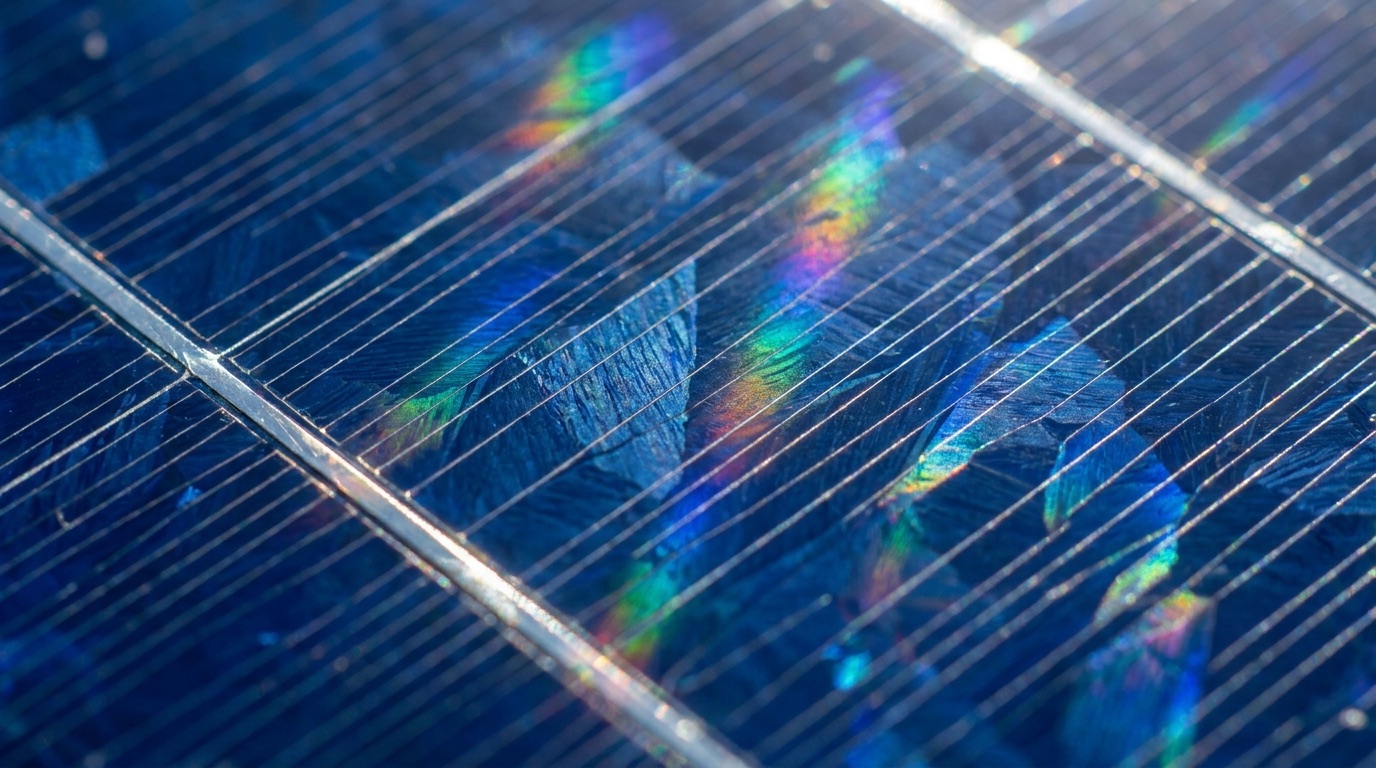
A clear, technical walk through how today's photovoltaic cells convert sunlight into usable power, and where the remaining efficiency gains are hiding.
Every conversation about solar performance eventually circles back to one number: efficiency. It is the fraction of incoming sunlight a panel turns into electricity, and for decades it was the industry's stubbornest constraint. A standard silicon module in 2010 converted roughly 15 percent of the light striking it. The best commercial modules shipping today clear 23 to 24 percent, and laboratory tandem cells have crossed 33 percent. The headline "99 percent" you sometimes see refers not to total conversion but to light capture, the share of usable photons a panel manages to absorb rather than reflect or waste. Understanding the difference between capturing light and converting it is the key to understanding modern solar.
The Physics of a Single Photon
A solar cell works because certain materials release electrons when struck by light of sufficient energy. Silicon has a bandgap of about 1.1 electronvolts, meaning any photon carrying at least that much energy can knock an electron loose and contribute to current. Photons with less energy, deep in the infrared, pass straight through without doing useful work. Photons with far more energy, in the ultraviolet and blue range, do free an electron, but the surplus energy is lost as heat rather than electricity.
This single mechanism explains the famous Shockley-Queisser limit of roughly 33 percent for a single-junction silicon cell. It is not a manufacturing flaw; it is thermodynamics. Beating it requires stacking materials with different bandgaps so each layer harvests a different slice of the spectrum, which is exactly what tandem and multi-junction architectures do.
Where the Light Goes Before It Is Captured
Before conversion can even begin, a panel has to get the light inside the cell. A bare silicon wafer is highly reflective and bounces back about 30 percent of incoming sunlight. Modern modules claw that loss back through a stack of optical tricks layered on the front surface.
- Anti-reflective coatings tuned to visible wavelengths cut surface reflection from roughly 30 percent to under 3 percent.
- Textured pyramidal etching on the wafer surface scatters light at angles that keep photons bouncing inside the cell rather than escaping.
- Passivated rear contacts, the basis of PERC technology, reflect unabsorbed infrared back through the silicon for a second pass.
- Encapsulant and low-iron glass minimise absorption losses in the layers above the active cell.
Together these measures push optical capture toward the high nineties. That is the 99 percent figure in context: it describes how little light is now wasted at the front door, not how much electricity comes out the back.
Stacking Bandgaps: The Tandem Revolution
The most consequential development of the last five years is the perovskite-silicon tandem cell. A thin perovskite layer with a wider bandgap sits atop a conventional silicon cell. The perovskite harvests high-energy blue and green light efficiently, while the silicon beneath captures the red and infrared that passes through. Each layer operates near its own thermodynamic sweet spot, and the combined device sidesteps the single-junction ceiling entirely.
Certified tandem efficiencies now exceed 33 percent in the lab, and pilot production lines are targeting 28 to 30 percent commercial modules. The remaining engineering challenge is durability, since perovskites historically degraded under heat and moisture, but encapsulation and compositional tuning have extended tested lifetimes dramatically.
Real-World Losses That Datasheets Hide
Nameplate efficiency is measured under standard test conditions: 25 degrees Celsius, 1000 watts per square metre, and a fixed spectrum. Reality rarely cooperates. A panel on a hot roof can run 30 degrees hotter than ambient, and silicon loses roughly 0.3 to 0.4 percent of output for every degree above 25. Soiling, partial shade, wiring resistance, and inverter conversion each shave off a further slice.
- Temperature losses: typically 5 to 12 percent on a hot afternoon.
- Soiling and dust: 2 to 5 percent in dry or agricultural environments.
- Inverter and wiring losses: 2 to 4 percent across the system.
- Mismatch and shading: highly site-dependent, from negligible to severe.
The practical takeaway is that capturing light and keeping it captured are different disciplines. The most efficient panel on paper is not always the best performer on a real roof. When you evaluate a system, look past the nameplate to the temperature coefficient, the optical design, and how the array is configured to manage shade and heat. Those details, far more than a fraction of a percent on the datasheet, determine how much energy you actually harvest across the life of the installation.