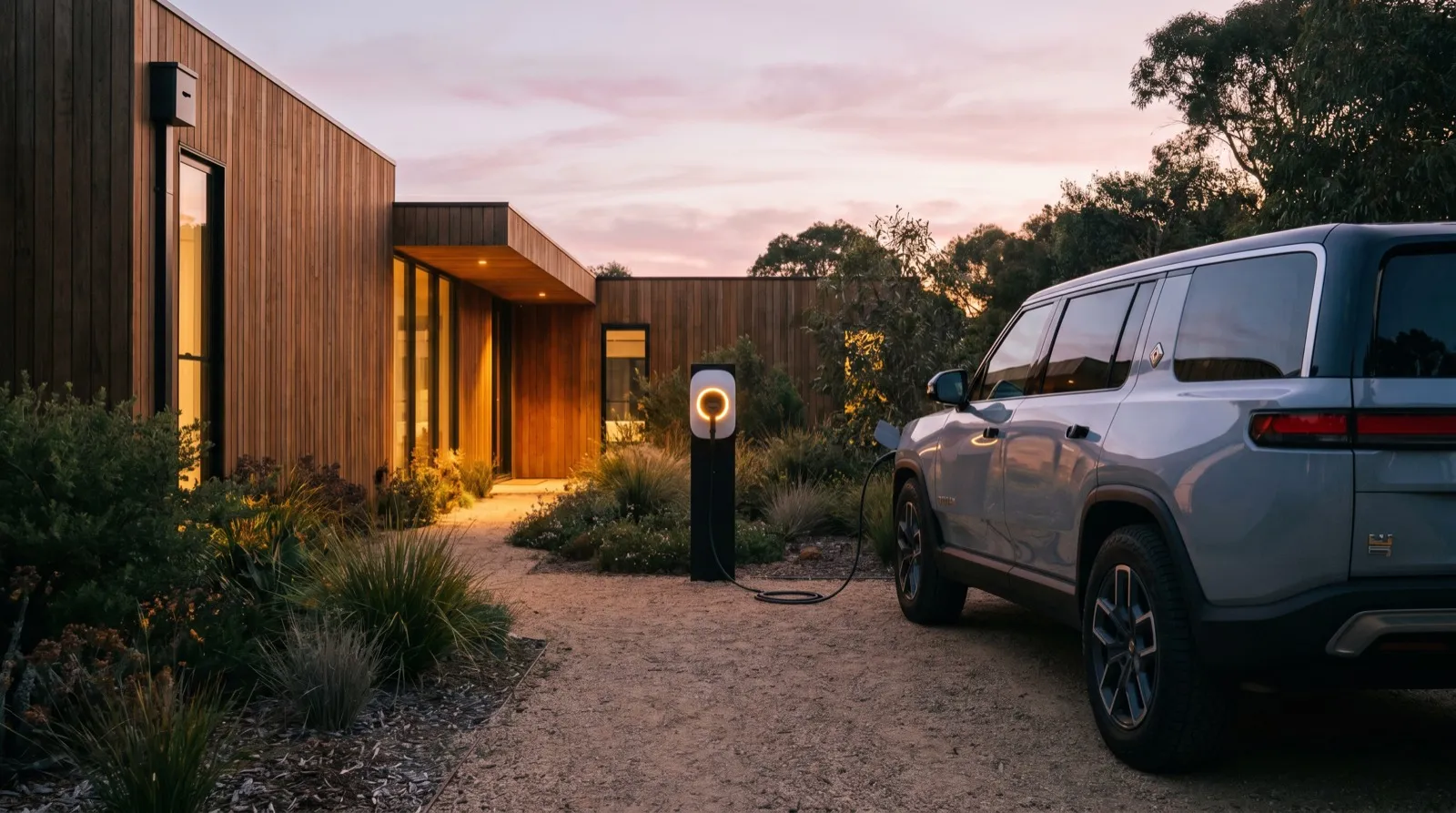
Owning an electric vehicle changes your relationship with fuel in a way that takes a few weeks to fully appreciate. Instead of planning detours to petrol stations, you plug your car in at home in the evening and wake up to a full battery every morning. For most people, home charging is where over 80 percent of their EV charging happens, and setting it up correctly makes an enormous difference to convenience, cost, and safety.
The Three Levels of Charging
EV charging is typically described in three levels. Level 1 uses a standard 10-amp household power point. It is the slowest option, adding roughly 10 to 15 kilometres of range per hour. For most EVs and most Australian driving patterns, Level 1 alone is not sufficient for daily top-ups unless you drive very little and charge overnight consistently.
Level 2 charging uses a dedicated 240-volt circuit, typically 15 to 32 amps, and a hardwired or plug-in charging station called an EVSE, or Electric Vehicle Supply Equipment. This is the standard choice for home installation. A 7.4kW Level 2 charger adds roughly 40 to 50 kilometres of range per hour, meaning most vehicles charge from low to full overnight comfortably. Level 3, or DC fast charging, is a commercial technology not suited to residential installation.
What a Home EVSE Installation Involves
Installing a Level 2 EVSE requires a licensed electrician. The work typically includes assessing your switchboard's available capacity, running a dedicated circuit from the switchboard to your garage or carport, installing a weatherproof enclosure and the EVSE unit itself, and potentially upgrading your switchboard if the existing capacity is insufficient. In many Australian homes, particularly those with solar and battery systems already in place, the electrician will also discuss how to integrate EV charging with your existing energy setup.
- Choose an EVSE with a minimum output of 7.4kW (32 amps on a single-phase supply) for comfortable overnight charging.
- Look for a unit with built-in Wi-Fi and scheduling so you can programme charging during off-peak tariff periods, typically overnight.
- If your home has rooftop solar, a solar-integrated EVSE or smart energy management system can prioritise charging your car from excess solar generation rather than the grid.
- Ensure the EVSE carries the required Australian safety certifications, including SAA or RCM marking.
- Confirm your electrician checks the switchboard earth, ensures the circuit is protected by a safety switch, and provides a Certificate of Compliance on completion.
Managing Costs
The operating cost of charging an EV at home depends almost entirely on when you charge and what electricity tariff you are on. Many Australian energy retailers offer time-of-use tariffs where off-peak rates apply overnight, sometimes as low as 15 to 20 cents per kilowatt-hour. An EV that costs 20kWh per 100km to operate effectively becomes very inexpensive transport at those rates.
If you have rooftop solar, directing surplus daytime generation into your EV can reduce your charging cost close to zero on sunny days. A quality EVSE with solar integration or a compatible home energy management system handles this automatically, sensing surplus generation and adjusting charge rate accordingly. It is one of those intersections of technology that, once you have it running, feels almost too sensible to not have done sooner.
One Final Thought
Home EV charging is one of the most genuinely satisfying electrical upgrades available to Australian homeowners right now. If you are considering making the move to an electric vehicle, or have recently done so, a professionally installed EVSE is the single best investment you can make to complement it. We are happy to walk you through options suited to your specific home, vehicle and energy setup.