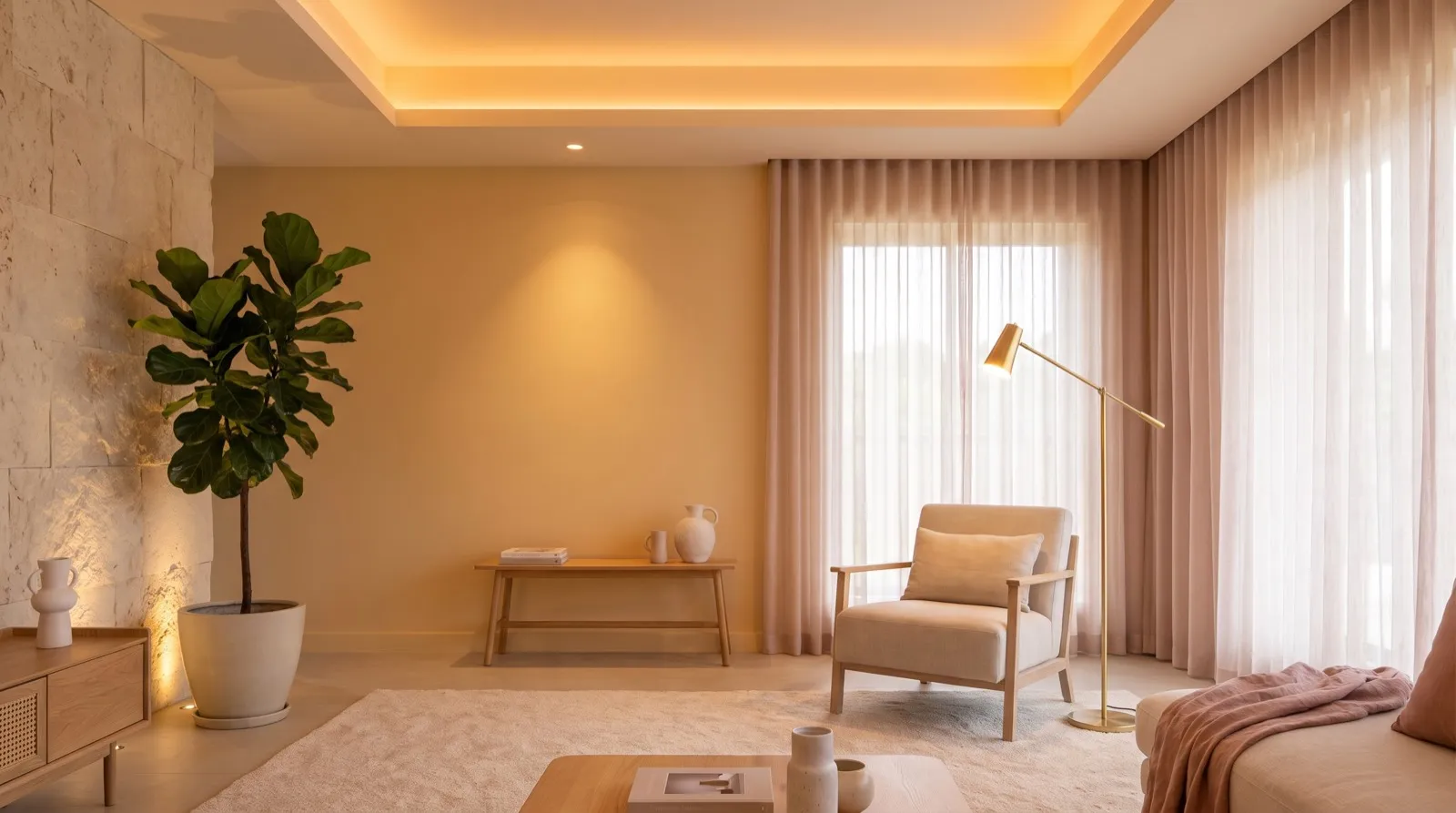
Walk into a room that feels instantly right and you will almost always find that someone has thought carefully about layers. Not paint layers or textile layers, though those matter too, but layers of light. The secret behind every beautiful hotel lobby, every restaurant that makes you linger, every living room that somehow always feels like the right place to be, is a deliberate combination of three distinct types of illumination working quietly together.
The Three Layers Explained
Ambient lighting is the foundation. It fills a space with general, diffused brightness so you can move around safely and comfortably. Think ceiling pendants, downlights set to a gentle level, or a wide-spreading chandelier. Ambient light should never feel harsh or clinical. Its job is to set the mood before anything else happens in the room.
Task lighting layers over the top. It is brighter, more directional, and placed precisely where focused activity happens: above a kitchen bench, over a reading chair, underneath a kitchen cabinet, or across a bathroom vanity. Good task lighting reduces eye strain and lets you work or read without squinting, but it should never flood the entire room with intensity.
Accent lighting is the most expressive of the three. It draws the eye to things worth noticing: a piece of art, an architectural feature, a collection of ceramics, a textured stone wall. Spotlights, picture lights, uplights in a corner, and LED strip concealed behind a joinery reveal all fall into this category. Used well, accent lighting gives a room its personality.
Why All Three Layers Matter
Spaces lit with only one source, typically a single overhead fitting, tend to feel flat, uninviting, or oddly tense. The light has nowhere to breathe. Shadows fall in the wrong places, faces look washed out under a harsh downlight, and the room loses all sense of depth and warmth. Layering solves this by creating contrast, by giving the eye somewhere to rest and somewhere to travel.
Practical Steps for Your Own Home
- Start with ambient: ensure every room has a dimmable base layer you can bring down to around 30 percent in the evening.
- Add task lighting in kitchens, home offices, bathrooms and reading nooks before spending money on decorative fixtures.
- Choose accent lighting for one focal point per room rather than trying to highlight everything at once.
- Connect all three layers to a dimmer or smart switch so you can shift the mood without changing a single globe.
- Use warmer colour temperatures (2700K to 3000K) in living and sleeping areas to encourage relaxation as the day winds down.
A Note on Dimming
Layered lighting only reaches its full potential when every circuit is dimmable. A fixed-brightness ambient layer undermines everything. Invest in quality TRIAC or ELV dimmers, ensure your LED globes are labelled as dimmable, and if you are building or renovating, ask your electrician to run separate circuits for ambient, task and accent from the start. It is far less expensive to plan this during the build than to retrofit it later.
The most beautifully layered homes we visit are rarely the most expensive. They are the ones where someone took the time to think about how the light would feel at seven in the morning, at two in the afternoon, and at nine at night, and designed accordingly. That kind of intentional thinking is something we love to help our clients with, room by room.