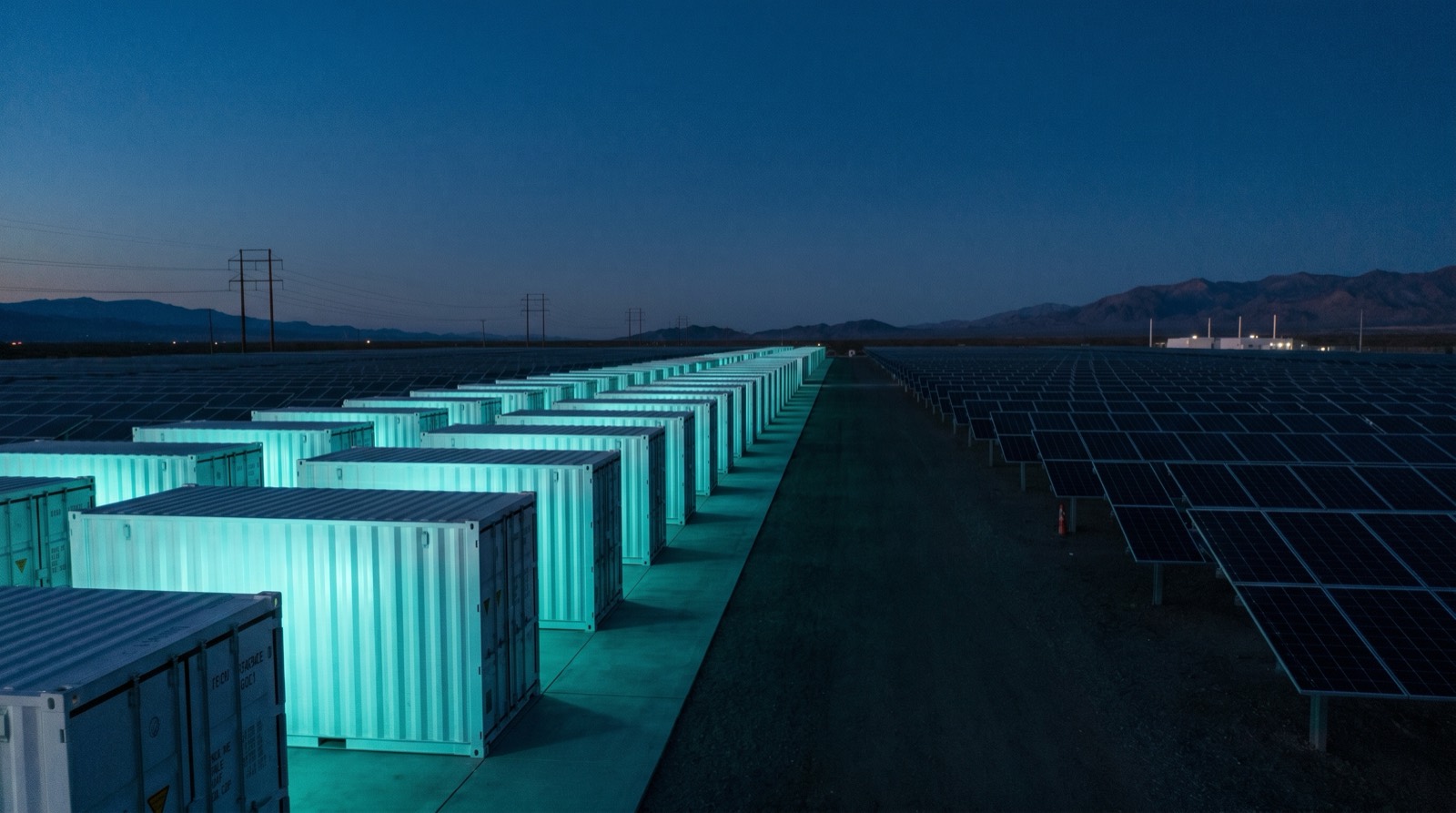
Battery storage converts variable solar generation into a dispatchable, time-shiftable asset—but only a system sized against real price and load data earns its keep. OmniYield engineers storage from residential to grid scale, selecting chemistry, power and energy ratings, and dispatch logic to monetize the specific value streams available at your site. We model storage as an optimization problem: maximizing the value extracted per cycle while managing degradation so the asset delivers its full design life.
Chemistry, sizing, and degradation
Lithium iron phosphate (LFP) has become the default for stationary storage on the strength of its cycle life, thermal stability, and safety margin over NMC chemistries. We size storage along two independent axes—power (kW, how fast it can charge or discharge) and energy (kWh, how much it can store)—because demand-charge management is power-limited while energy arbitrage is energy-limited. Depth of discharge, operating temperature, and C-rate all drive calendar and cycle degradation, so we specify a usable energy window and thermal management strategy that preserves capacity across a 10-to-15-year service life.
Round-trip efficiency and dispatch
Every stored kilowatt-hour incurs a round-trip loss through the inverter and cells; quality LFP systems achieve 90–95% AC round-trip efficiency, and this figure directly determines arbitrage profitability. The dispatch controller is where economic value is actually realized: it must decide, in real time, whether to charge from solar, charge from the grid at off-peak prices, discharge to serve load, or discharge to shave a demand peak. We configure dispatch logic against your tariff and forecast solar so the battery is always working the highest-value opportunity available.
Our storage designs are specified and verified against measurable performance criteria:
- AC round-trip efficiency of 90–95% measured at the point of connection
- LFP cells rated for 6,000+ cycles to 80% retained capacity under defined depth-of-discharge
- Independent power (kW) and energy (kWh) sizing matched to demand and arbitrage value
- Active thermal management to hold cells in their optimal temperature band
- Tariff-aware dispatch controller with backup-reserve and export-limit logic
Value stacking and demand management
A single battery can serve multiple value streams, and a well-designed system captures several simultaneously. For commercial sites, demand-charge reduction is often the dominant return—discharging precisely during the billed peak interval to lower the maximum kW. Layered on top are energy arbitrage (charging at off-peak or surplus-solar prices and discharging at peak), increased solar self-consumption, and backup resilience during outages. Where market access exists, the same asset can bid into frequency-control and ancillary-services markets. We model each stream and configure the controller to prioritize them without conflict.
Integration, safety, and warranty
Storage integration must satisfy electrical, fire, and grid-compliance requirements. We engineer AC- or DC-coupled architectures depending on whether storage is retrofit or paired with new solar, configure anti-islanding and grid-support functions, and meet fire-separation and ventilation standards for the installation. Systems are commissioned with capacity testing to confirm delivered usable energy against specification, and warranties are structured around retained capacity and throughput so the asset's degradation is contractually accountable over its life.