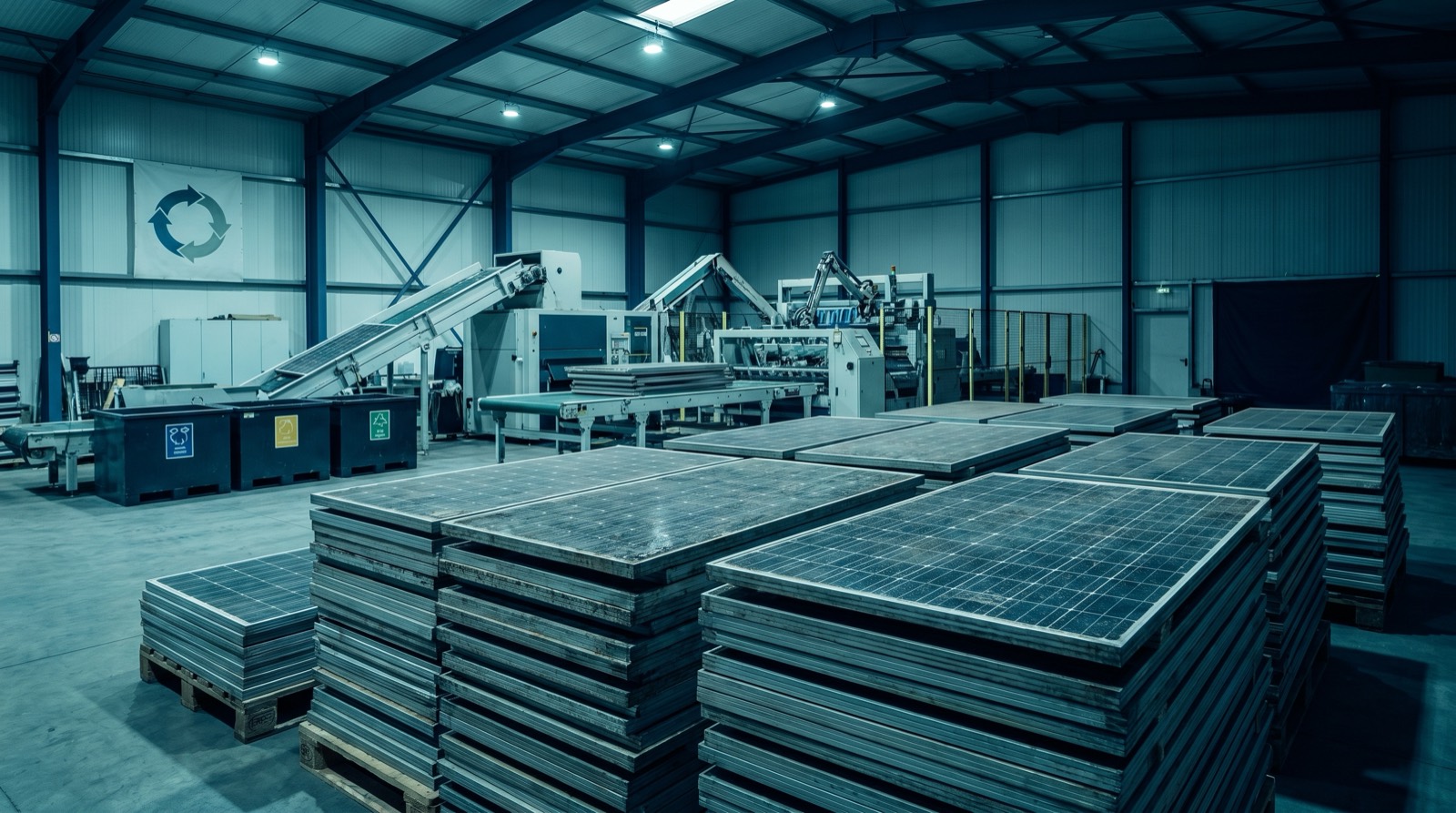
The first utility-scale arrays are now reaching end of life, and the volume of decommissioned modules will rise sharply through the next decade. Treating these as waste is both an environmental failure and an economic one: a crystalline silicon module is roughly 95 percent recoverable by mass.
Material composition and value
A standard module is approximately 76 percent glass, 10 percent polymer, 8 percent aluminium frame, 5 percent silicon, and 1 percent metals including copper and silver. While silver is a fraction of a percent by weight, it represents a disproportionate share of recoverable value, and reclaiming it at 99.9 percent purity is central to the economics.
Naive recycling that shreds modules into mixed cullet destroys this value. Our processing partners use thermal and chemical delamination to separate the laminate stack, preserving glass clarity and isolating metals for refinement.
Decommissioning and chain of custody
We coordinate safe de-energization, removal, and palletized transport under documented chain-of-custody, which is increasingly a regulatory and ESG-reporting requirement. Each consignment is tracked from array to processing facility, with mass-balance reconciliation confirming recovered tonnage against intake.
- Site decommissioning and safe module de-energization
- Palletized logistics and breakage-minimizing transport
- Thermal and chemical delamination processing
- High-purity glass, aluminium, silicon, and silver recovery
- Chain-of-custody and mass-balance certification
Circular-economy reporting
Recovery is documented to support extended producer responsibility obligations and corporate circularity targets. Clients receive a recovery certificate quantifying reclaimed mass by material stream, landfill diversion rate, and the embodied-carbon avoidance relative to virgin material production.
Recovered silicon and silver re-enter manufacturing supply chains, displacing energy-intensive primary extraction. Reclaiming aluminium alone avoids roughly 95 percent of the energy required to smelt it from bauxite, making closed-loop recovery a measurable contributor to lifecycle carbon performance, not a disposal afterthought.