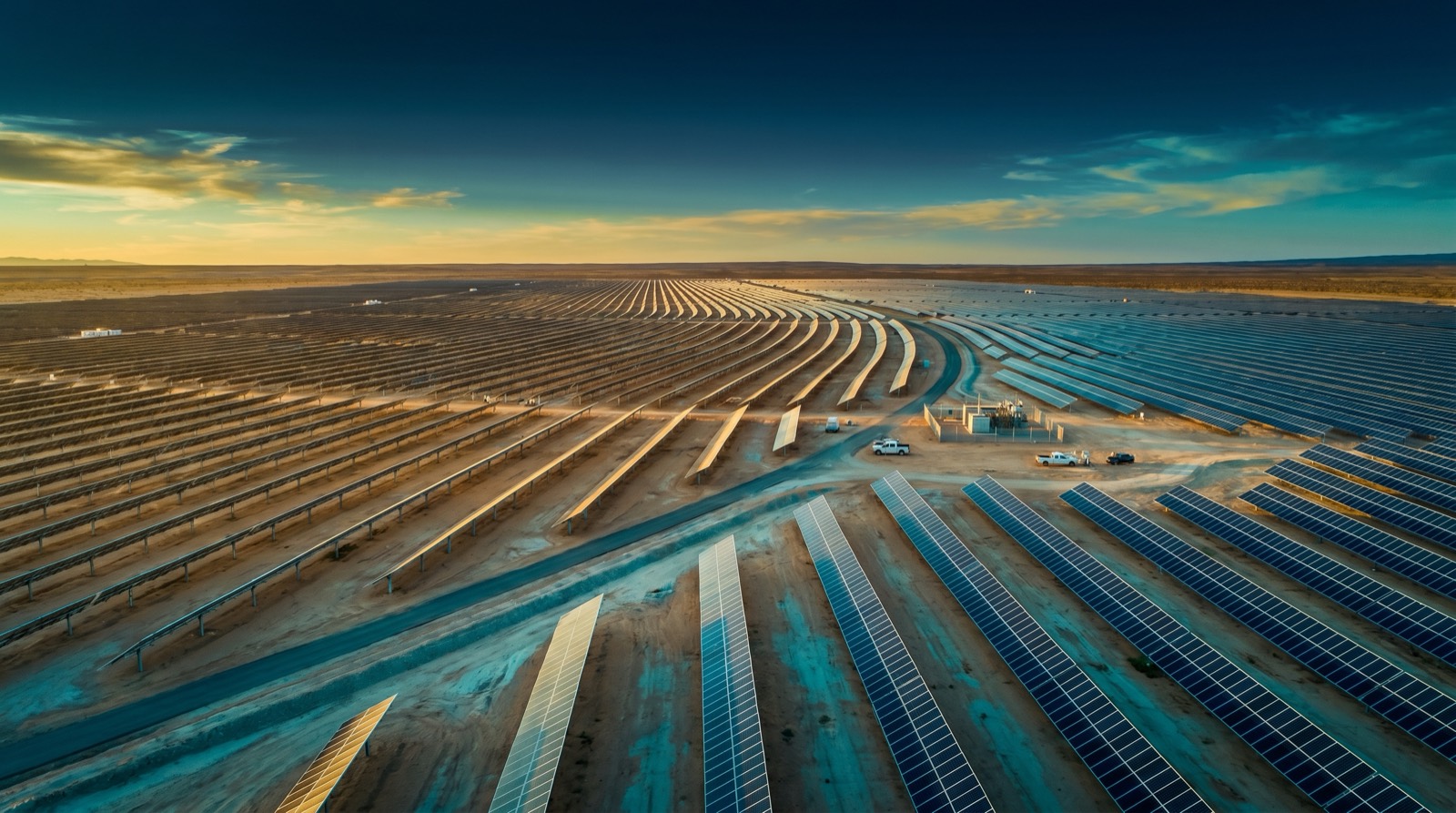
Utility-scale solar is now the lowest-cost source of new bulk generation in most markets, with auction-cleared LCOEs frequently below forty dollars per megawatt-hour. Delivering that economics is an engineering and development discipline: resource assessment, land and grid securement, tracker and inverter selection, interconnection studies, and a revenue model that survives lender due diligence. OmniYield develops and engineers grid-connected farms from site identification through to commissioning, structuring each project to a bankable P90 production standard.
Resource assessment and energy yield
Bankability starts with the resource. We combine long-term satellite irradiance datasets with on-site pyranometer measurement campaigns to characterize global horizontal and plane-of-array irradiance, inter-annual variability, and soiling and snow losses. From this we produce P50, P75, and P90 energy yield estimates—the exceedance probabilities that lenders size debt against. Single-axis horizontal tracking typically lifts annual yield 15–25% over fixed-tilt by following the sun east-to-west, raising capacity factor into the 25–29% range in strong-resource regions and flattening the midday generation peak.
Plant engineering and topology
Plant design balances energy capture against capital and balance-of-system cost. We optimize the DC/AC ratio—typically 1.3–1.5 for tracking plants—so that the inverter and grid connection are economically loaded while inter-row spacing minimizes self-shading and backtracking losses. Central versus string inverter architecture, medium-voltage collection design, transformer placement, and DC cable sizing are all modeled against lifetime loss and cost. Bifacial modules are evaluated for the rear-side gain achievable over the project's ground albedo.
Our utility-scale engineering is governed by the metrics that determine project finance viability:
- P90 energy yield with characterized inter-annual variability for debt sizing
- Single-axis tracking with backtracking control to eliminate row-to-row shading
- DC/AC ratio of 1.3–1.5 optimized against inverter clipping and grid-connection cost
- Capacity factor of 25–29% in high-irradiance regions with tracking and bifacial gain
- Availability target of ≥98% across inverter, tracker, and balance-of-plant systems
Interconnection and grid integration
Grid connection is the single largest schedule and cost risk in utility-scale development. We manage the connection process end to end: network capacity screening, feasibility and full connection studies, fault-level and harmonic analysis, and the system-strength and reactive-power obligations imposed at the connection point. Plant controllers are configured for active and reactive power dispatch, frequency and voltage ride-through, and ramp-rate control so the asset meets grid-code requirements and can participate in dispatch and ancillary-services markets.
Revenue stacking and asset returns
A modern solar farm earns from multiple stacked revenue streams, and the financial model must capture all of them. We model merchant spot exposure, contracted offtake through corporate or utility PPAs, renewable energy certificate (REC/LGC) revenue, and—where co-located storage is viable—energy arbitrage and frequency-control ancillary services. Marginal-loss factors, negative-price risk during midday oversupply, and curtailment are modeled explicitly, because they materially affect realized revenue. The result is a financeable model with a defensible equity IRR and a clear view of the project's exposure to evolving market conditions.