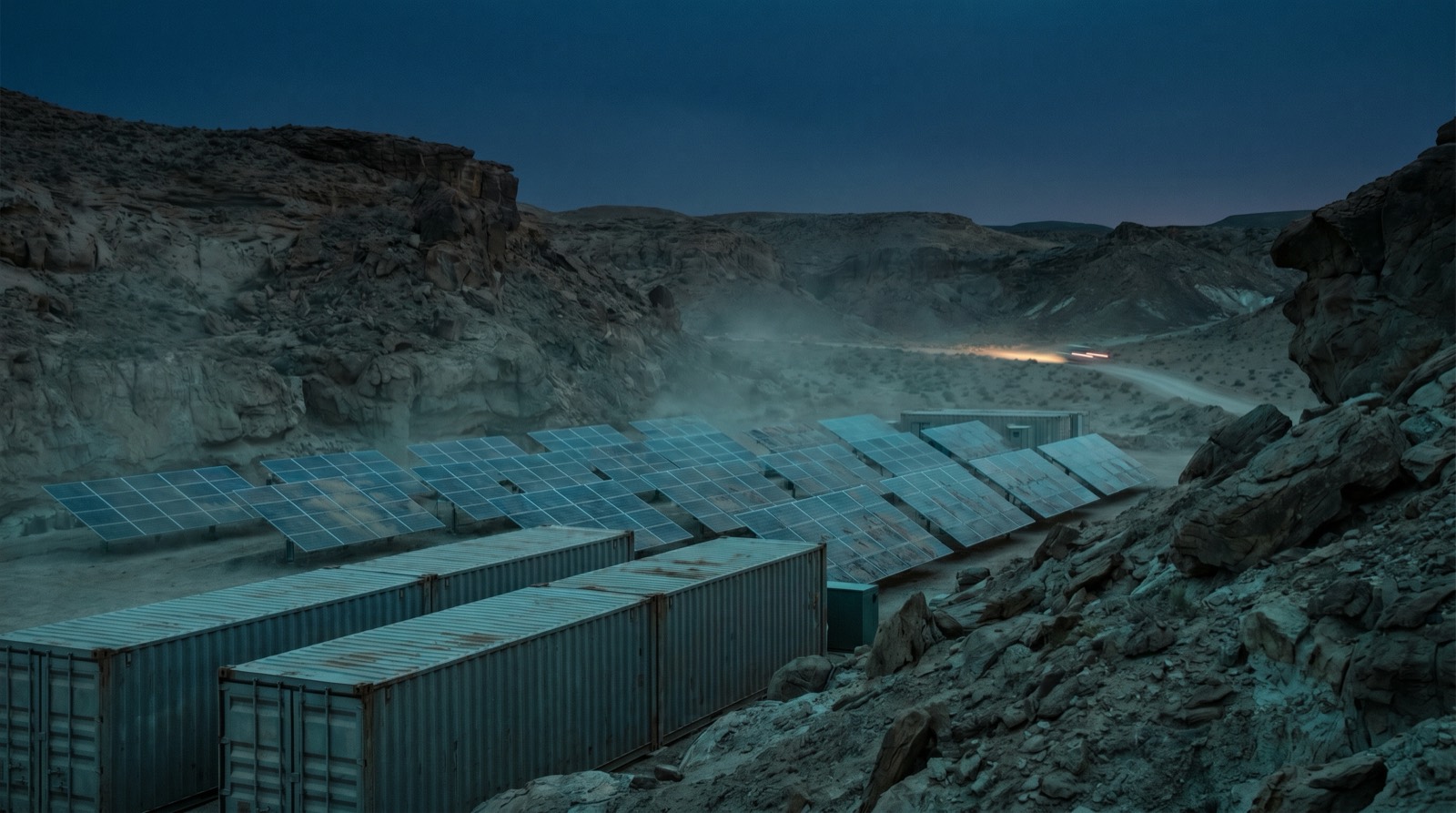
When grid interconnection is distant, slow, or prohibitively expensive—remote operations, islands, telecom sites, critical facilities—a microgrid is the rational path to reliable power. OmniYield designs islandable systems that pair PV generation with battery storage and grid-forming inverters to deliver clean, stable, frequency-regulated power 24/7.
Generation, storage & autonomy sizing
Sizing is a probabilistic exercise, not a rule of thumb. We analyze the load profile against multi-year solar resource data and run loss-of-load-probability modeling to size the PV array (in kWp) and battery (in usable kWh) for a defined autonomy reserve—typically 24 to 72 hours through low-irradiance periods. Oversizing wastes capital; undersizing strands the load. We solve for the lowest lifecycle cost at the required reliability.
Lithium iron phosphate (LFP) storage anchors most designs for its cycle life, thermal stability, and round-trip efficiency near 96%, meaning only ~4% of stored energy is lost in the charge-discharge cycle—a decisive figure when every kWh is generated on site.
Grid-forming control & power quality
An off-grid system has no utility reference to follow, so grid-forming inverters must establish voltage and frequency themselves and ride through sudden load steps—a motor start, a compressor inrush—without collapsing. Our controllers manage generation dispatch, state of charge, and any backup generator in a single hierarchy, holding power quality to grid standards.
- Loss-of-load-probability sizing for defined autonomy hours
- LFP battery storage with ~96% round-trip efficiency and long cycle life
- Grid-forming inverters establishing voltage and frequency reference
- Hybrid diesel/PV/storage dispatch optimizing fuel displacement
- Remote SCADA monitoring with predictive maintenance alerts
Hybrid operation & lifecycle economics
Few remote sites go fully solar overnight. Hybrid architectures keep a right-sized generator for deep-deficit periods while solar-plus-storage carries the base load, typically displacing 60-80% of diesel consumption. That cuts fuel logistics, runtime hours, and maintenance—the largest hidden costs of remote generation—while slashing emissions.
We underwrite against levelized cost of energy over the asset life, factoring battery degradation, replacement schedules, and avoided fuel and logistics. For sites currently burning diesel at high delivered cost, a hybrid microgrid frequently reaches payback well inside its design life while raising availability toward 99.99%.