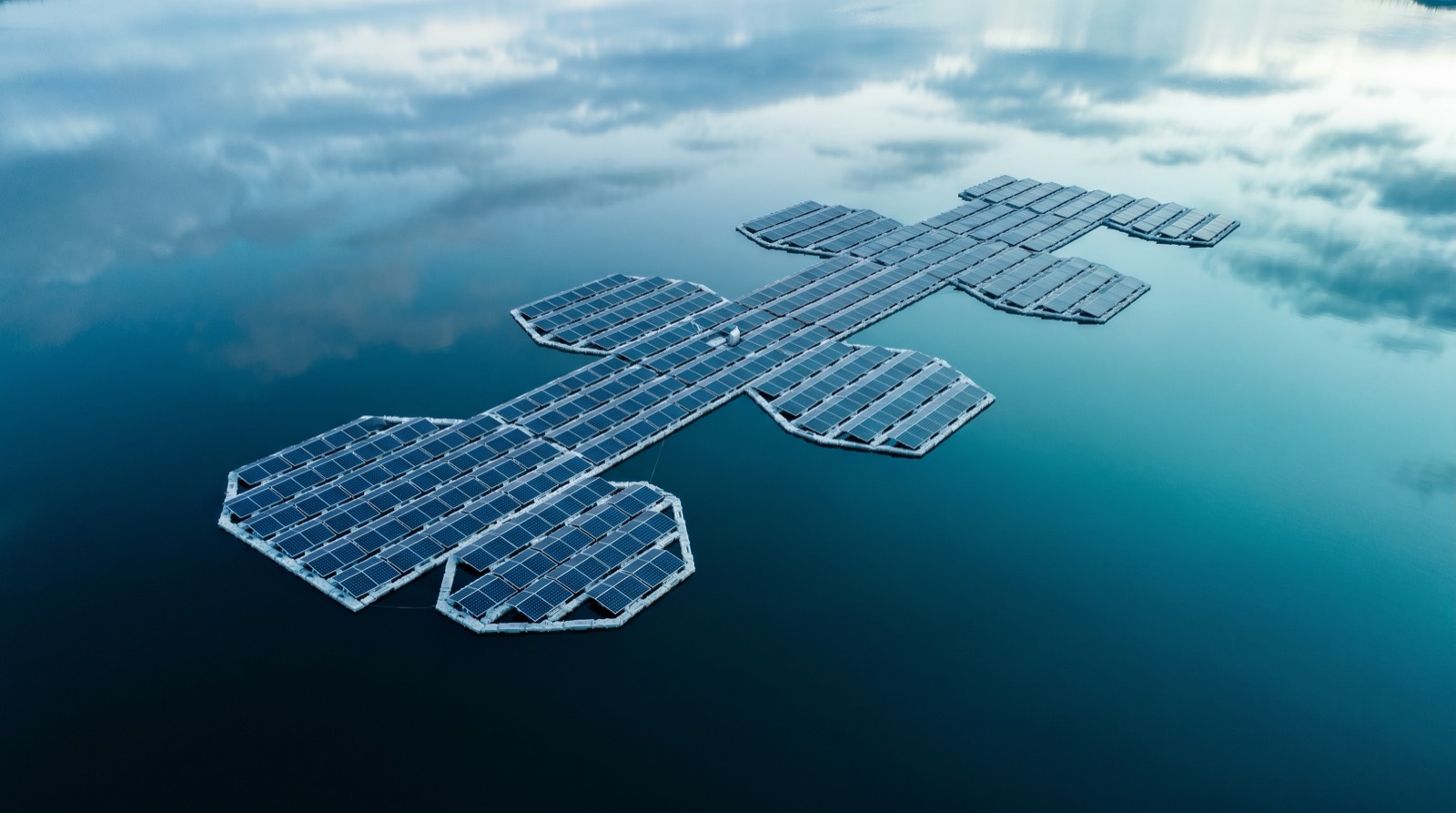
Floating photovoltaics (FPV) resolve two constraints at once: land scarcity and panel thermal derating. By siting arrays on water, generation occupies a surface that would otherwise sit idle, while the water body itself improves the physics of the installation.
The cooling advantage
Crystalline silicon modules lose roughly 0.4 percent of output per degree Celsius above 25 degrees. The evaporative microclimate above a water surface keeps module temperatures meaningfully lower than equivalent ground-mounted arrays, lifting energy yield by 5 to 15 percent depending on climate and array configuration.
This thermal benefit compounds over the asset life. A sustained yield uplift directly lowers LCOE and improves IRR without any change to module technology or capital intensity per watt.
Water conservation and co-location
Covering a portion of a reservoir suppresses evaporation by up to 70 percent in the shaded footprint, a material benefit for water utilities and agricultural storage in arid regions. Reduced light penetration also inhibits algal blooms, improving raw water quality and lowering downstream treatment load.
- Bathymetric survey and anchoring-system engineering
- High-density HDPE float and mooring design
- Water-surface cooling yield modeling
- Evaporation-suppression and water-quality assessment
- Hydro-dam co-location and grid interconnection
Engineering for the marine environment
FPV demands rigorous mooring design responsive to water-level variance, wind loading, and wave action. We specify UV-stabilized HDPE floats, marine-grade balance-of-system components, and slack-managed anchoring that accommodates seasonal drawdown without stressing the array.
Co-location with existing hydroelectric dams is especially compelling: shared grid interconnection lowers connection cost, and FPV generation complements hydro by preserving reservoir head during sunny periods. Deployment density typically reaches around one megawatt-peak per 1.2 hectares of surface, all without consuming a single hectare of productive land.