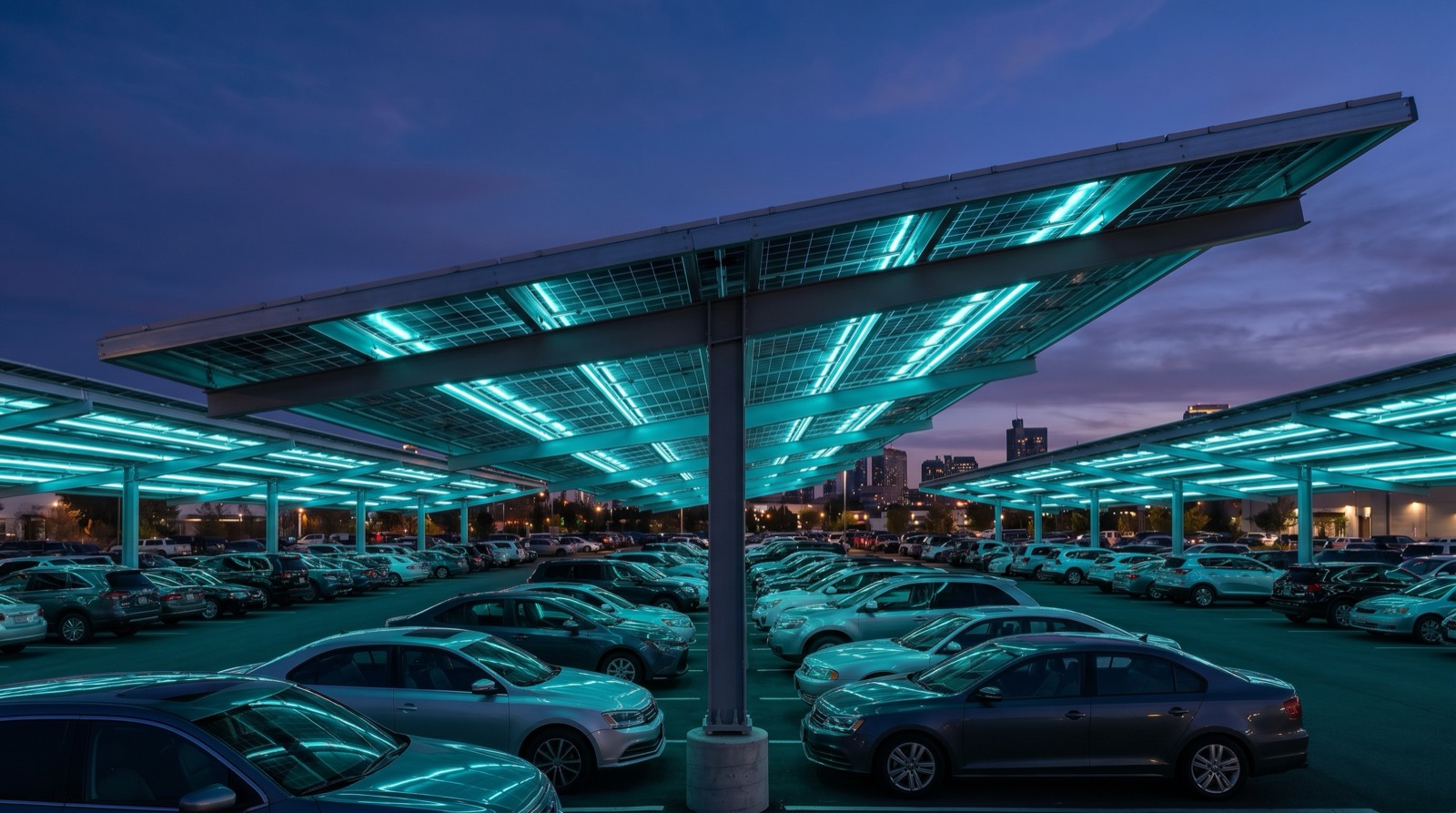
Solar carports invert the economics of surface parking. Rather than leasing or paving inert asphalt, the canopy structure carries a structurally rated PV array elevated above vehicle traffic, generating energy at the point of consumption while eliminating the land-acquisition cost that burdens greenfield ground-mount projects. For commercial, retail, and institutional sites with large existing lots, the marginal cost of generation is confined to steel, foundations, and balance-of-system rather than real estate.
Structural and electrical engineering
Our canopy designs are wind- and snow-load rated to local building codes, with single-cantilever, T-frame, and double-cantilever geometries selected against bay layout and drive-aisle clearance. Module density typically lands between 11 and 14 kWp per standard double-bay, yielding 1.2 to 1.5 MWp across a 400-space lot. We specify string inverters or distributed MLPE based on shading topology, and size conductors to NEC 690 with rapid-shutdown compliance integrated at the module level.
Tilt orientation is optimized against the site's latitude and the load profile rather than peak annual yield alone. A west-skewed array sacrifices a few percent of total kWh but shifts generation into the late-afternoon demand window, improving coincidence with commercial peak load and the demand charges that dominate many tariffs.
- Galvanized or weathering-steel frames rated to ASCE 7 wind and snow loads
- 11–14 kWp per double-bay with bifacial module options for albedo gain
- Integrated EV charging conduit and DC-coupled storage provisioning
- Rapid-shutdown and arc-fault protection per NEC 690.12
- Glare analysis and FAA Part 77 review for airport-adjacent sites
Demand charges and self-consumption
The financial case rarely rests on the energy charge alone. On commercial tariffs, demand charges levied on the highest 15-minute kW interval can constitute 40 to 60 percent of the bill. A canopy array aligned to the afternoon peak shaves that interval directly, and pairing the array with even a modest DC-coupled battery lets us discharge against the monthly peak with deterministic dispatch logic, compounding the demand-charge reduction beyond what generation alone achieves.
Self-consumption is the highest-value use of every kWh produced. Behind-the-meter energy offsets the full retail rate, including delivery and rider charges, whereas exported energy is typically compensated at the lower wholesale or net-metering rate. We size arrays to maximize the self-consumed fraction against the site's baseload, treating export as a secondary credit rather than the primary revenue line.
EV charging and future load
Carports are the natural host for EV infrastructure. Co-locating Level 2 and DCFC ports under the canopy lets on-site generation directly supply charging load, reducing the net grid draw that would otherwise trigger costly service upgrades. We provision conduit and panel capacity at construction to accommodate phased charger rollout, avoiding the trenching and switchgear retrofits that make later electrification expensive.