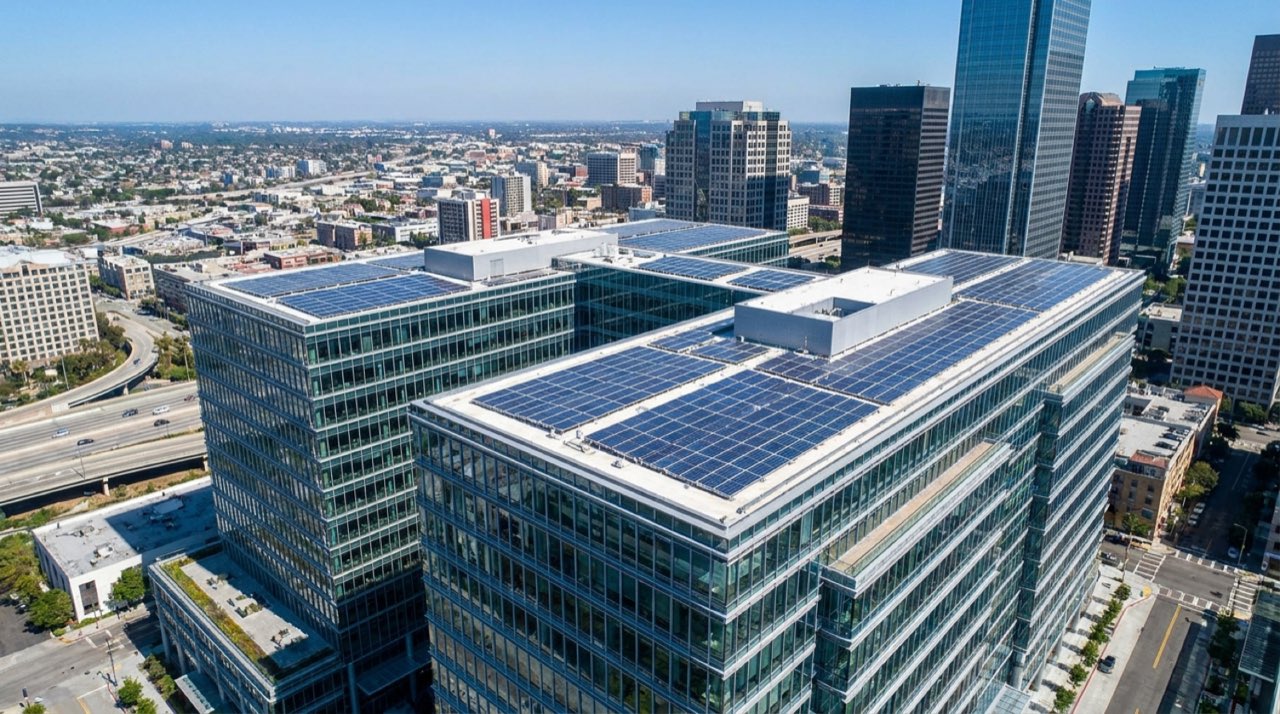
Most commercial solar conversations start and end with the power bill. A business pays, say, $140,000 a year in electricity, a solar system offsets 40 percent of that, and the annual saving is quoted as $56,000. It is a clean story and the number is real — but it captures perhaps half the financial picture. For medium and large commercial sites, the more sophisticated levers are demand charge reduction, federal tax treatment, large-scale generation certificate revenue, and increasingly the hard-dollar cost of carbon reporting obligations. When you model all of these together, the business case for commercial solar in 2026 is substantially stronger than the headline bill reduction suggests.
This article works through each layer of the commercial solar business case in plain terms, including where the numbers are compelling, where caution is warranted, and how ownership structure affects the outcome. The intent is to give financial decision-makers the framework to evaluate a proposal properly, not just accept the payback period printed on page one of a sales deck.
Demand charges: the underestimated saving
Most commercial electricity tariffs include a demand charge component — a monthly fee based on your peak kilowatt draw during the billing period, often calculated from a 15 or 30-minute interval peak. Demand charges can represent 30–50 percent of a commercial energy bill and they are largely invisible unless you know to look for them on the invoice. A 500 kW commercial site with a demand charge of $18 per kW per month is paying $9,000 per month — $108,000 per year — purely in demand fees, before a single unit of energy is billed.
Solar generation can reduce peak demand by shifting load or directly offsetting daytime consumption at the moment of peak draw. When this is combined with battery storage or load management controls that flatten morning and afternoon peaks, demand charge savings can rival the energy offset saving in dollar terms. We have modelled commercial installations where demand charge reduction alone paid for the system within seven years, independent of any energy cost saving. This is rarely included in basic solar payback models and is almost always worth commissioning a dedicated demand analysis before finalising system size and configuration.
Depreciation and instant asset write-off
Commercial solar assets are depreciable under the Australian tax system. For most businesses, a solar system qualifies as a plant and equipment asset and attracts the instant asset write-off provisions where applicable, or accelerated depreciation schedules under the general small business pool or Division 40 rules for larger entities. As at 2026, the instant asset write-off threshold for eligible businesses has been through several changes in recent years; your accountant should confirm current applicability, but the principle is that a business acquiring a $400,000 solar system may be able to write off a substantial portion of that capital cost in the year of purchase, generating a tax benefit that directly reduces the net cost of the asset.
- Immediate deduction for eligible assets under the current write-off provisions reduces effective capital cost in year one
- Division 40 depreciation applies to solar panels, inverters, mounting systems, and battery storage as plant and equipment
- GST input tax credits are claimable on purchase for GST-registered businesses, recovering 1/11th of system cost
- Interest on commercial finance for solar is generally tax-deductible, improving cash flow on financed installations
- Combined, tax treatment can reduce the real after-tax cost of a $400,000 system by $80,000–$140,000 depending on entity structure and tax position
The tax benefit does not change the gross capital outlay, but it accelerates cash recovery and improves the IRR of the investment materially. A project that looks marginal at a pre-tax payback of nine years may show a post-tax payback of six years once depreciation benefits are factored in correctly. This is a calculation that belongs in the financial model, not a footnote.
Large-scale generation certificates and PPAs versus ownership
Commercial systems over 100 kW are eligible to create Large-scale Generation Certificates (LGCs) under the federal Renewable Energy Target framework administered by the Clean Energy Regulator. Each LGC represents one megawatt-hour of eligible renewable generation and can be sold to liable entities — primarily large electricity retailers — who must surrender them to meet their annual targets. LGC spot prices in 2026 have been trading in the $30–$45 per MWh range. For a 500 kW system generating around 700 MWh per year, LGC revenue can add $21,000–$31,500 annually to the investment return.
Ownership structure matters significantly here. Under a Power Purchase Agreement (PPA), where a third-party developer owns the solar system installed on your roof and you purchase the output at a contracted rate, the LGCs typically remain with the system owner, not the host business. This is a material point of negotiation. Businesses that want LGC revenue — whether to monetise directly or to retire them as evidence of renewable consumption for Scope 2 reporting purposes — generally need to own the system outright or negotiate explicit LGC assignment in the PPA terms. Understand this distinction before signing a PPA.
ESG, Scope 2 reporting, and the real cost of carbon
For businesses subject to the Australian Securities and Investments Commission's mandatory climate reporting rules — which now apply to large entities and are being phased in across medium-sized businesses through 2026–2028 — Scope 2 emissions from purchased electricity are a disclosed liability. Companies with emissions-intensive operations, customers requiring supply chain decarbonisation evidence, or aspirations to meet Net Zero commitments are facing a direct financial cost of grid electricity that does not appear on the energy bill: the cost of the carbon it represents. Renewable energy generation on-site, or the retirement of LGCs, provides an auditable mechanism to reduce reported Scope 2 emissions.
For a listed company or one with major institutional customers, the reputational and procurement value of documented Scope 2 reduction can exceed the energy bill saving within five years.
Tenant and landlord structures
A persistent barrier for commercial solar in leased premises is the split incentive problem: the landlord owns the roof and bears the capital cost; the tenant pays the electricity bill and receives the saving. This is a solvable problem with the right lease structure but it requires active negotiation. Embedded network arrangements, where the building owner installs solar and on-sells power to tenants at a contracted rate below the local retailer's tariff, can generate a yield for the landlord while delivering bill savings to tenants. Some building owners are now including solar-ready provisions or embedded network rights in new commercial leases as a differentiation strategy and as preparation for NABERS energy rating requirements.
- Embedded network: building owner installs solar, on-sells to tenants below retail — both parties benefit
- Green lease provisions: tenant and landlord share costs and savings under a formally documented agreement
- Capital contribution models: tenant contributes to installation cost in exchange for a discounted electricity rate and LGC rights
- Roof licence arrangements: tenant funds the system on a landlord-owned roof with licence rights for the lease term
The full commercial solar business case in 2026 is a multi-variable model: energy bill reduction, demand charge savings, tax treatment and depreciation, LGC revenue, and the increasingly quantifiable value of Scope 2 reduction. When built correctly, with site-specific consumption data and proper financial modelling, many commercial installations that appear marginal on a simple bill-offset basis show internal rates of return of 15–22 percent over a 15-year asset life. At Zenith Solar Tech, every commercial proposal includes a detailed financial model covering all revenue and cost levers, not just the headline bill saving. If you are evaluating a proposal that does not, ask for it.