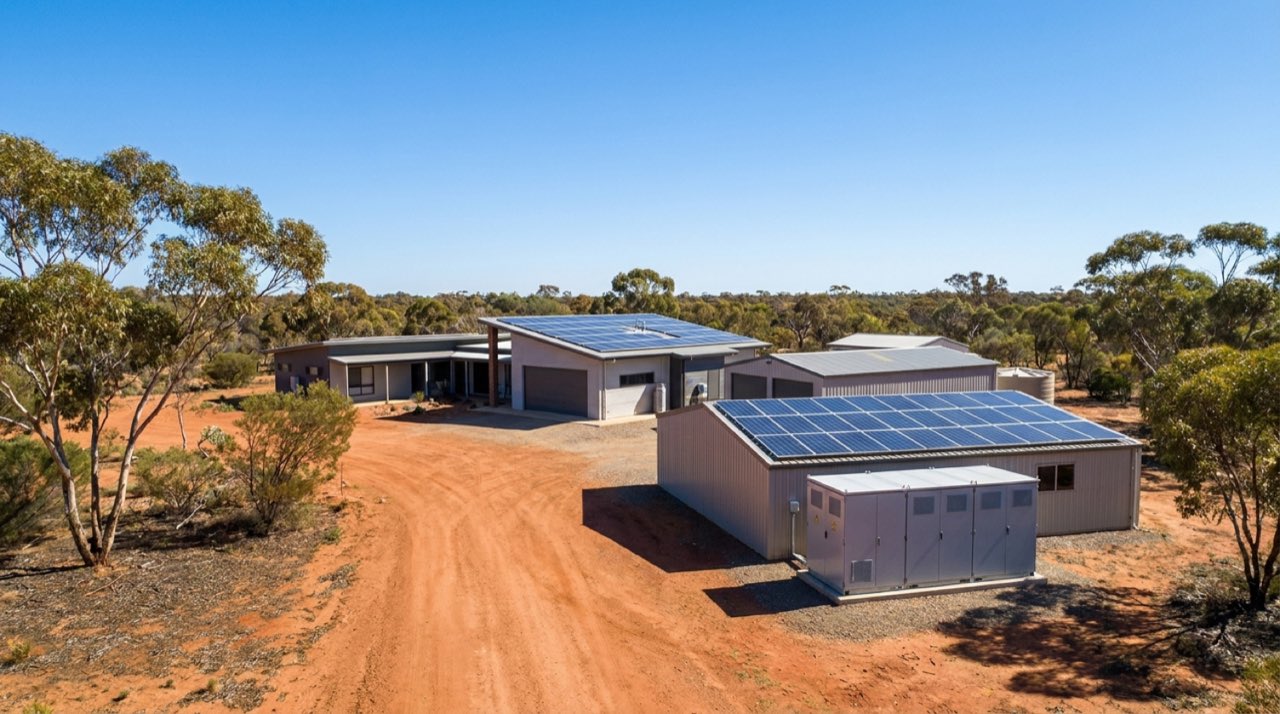
Australia has more off-grid and edge-of-grid properties than almost any other developed nation, and the economics of serving them with solar-battery-generator hybrid systems have shifted fundamentally. The capital cost of lithium storage has fallen more than eighty percent over the past decade, while diesel prices have moved in the opposite direction. A remote property that was running a diesel generator for twelve to sixteen hours a day in 2015 at significant fuel and maintenance cost can now operate with ninety-plus percent solar and battery coverage, using the generator only as a rarely-dispatched backup during extended low-irradiance periods.
Standalone power systems (SPS) in Australia are designed to AS/NZS 4509 and, where relevant, the technical requirements of the state-based SPS incentive programs that have replaced historical grid extension subsidies in Queensland, Western Australia and South Australia. Zenith's design team holds CEC accreditation for standalone system design and installation, and we have commissioned systems from small remote homesteads to multi-building farm complexes and island communities. The engineering process is the same regardless of scale: load analysis first, solar array and storage sizing second, generator integration third.
Autonomy days: the number that matters most
Autonomy days is the duration your battery bank can supply your average daily load without any solar input — effectively your buffer against cloudy weather. For a property in coastal Queensland with consistent irradiance, two to three days of autonomy is typically sufficient. For a high-latitude Tasmanian farm facing sustained winter overcast, four to five days may be warranted. We use long-run Bureau of Meteorology irradiance data for your specific location combined with hour-by-hour load modelling to land on an autonomy target that is defensible, not arbitrary. Oversizing storage is wasteful; undersizing forces excessive generator run-hours and defeats the economics.
The generator integration is where many off-grid designs fall short. A generator that is oversized relative to battery charge current will spend most of its run-time at low load, which accelerates engine wear and increases fuel consumption per kilowatt-hour delivered. We specify generator capacity to match the battery bank's maximum charge rate, so every run cycle is productive and the engine operates in its efficient range. Auto-start controllers allow the generator to dispatch automatically when state-of-charge drops below a set threshold, requiring no manual intervention from the property owner.
What a complete standalone power system includes
- Roof or ground-mounted solar array oriented and tilted for maximum annual yield at the site's latitude
- LFP battery bank sized to the autonomy target, housed in a weather-rated enclosure appropriate for ambient conditions
- Hybrid inverter-charger with generator auto-start control and grid-forming capability to power reactive loads
- Backup diesel or LPG generator sized to the battery charge rate, not the peak load
- Comprehensive protection: fusing, surge protection, earth leakage and AS/NZS 4509 compliant switchgear
- Remote monitoring platform with state-of-charge, generator run-hours, solar yield and fault alerting accessible via satellite internet where no cellular coverage exists
Microgrids for communities and commercial sites
A microgrid extends the standalone power system concept to multiple loads sharing a common distribution network, with a centralised energy management system coordinating generation, storage and demand. Pastoral stations with multiple dwellings and sheds, island resorts, remote Aboriginal communities transitioning off diesel, and mining camps on the edge of network coverage are all candidates. The engineering complexity increases with the number of nodes, the diversity of loads and the need to manage protection coordination on a privately-owned network, but the economic case is often compelling: diesel generation at remote sites regularly costs sixty to one hundred cents per kilowatt-hour when fuel delivery, storage and maintenance are fully accounted for. Solar and storage at scale can bring that below twenty cents.
For properties on the edge of the grid rather than fully off it, edge-of-grid systems present a different design challenge. Grid supply exists but is unreliable — voltage fluctuations, long outage durations and poor power quality are common in radial distribution feeders at the end of long rural lines. A solar-battery system can be designed to operate grid-connected normally, islanding seamlessly during outages and supplementing poor-quality grid supply with clean inverter output. This architecture does not require disconnecting from the grid permanently; it simply makes the grid connection optional rather than essential.
Ongoing maintenance for a well-designed standalone system is modest: an annual inspection of connections and protection settings, periodic cleaning of array surfaces, battery health checks via the monitoring platform, and generator servicing to the manufacturer's schedule. We offer annual service agreements that include all of the above, with fault response from our regional teams. In our experience, the properties with the lowest lifetime cost of ownership are those that invest in the right system from day one and maintain it properly, rather than those that save on upfront specification and compensate with fuel and reactive repairs.
Frequently asked
Is a standalone power system eligible for any Australian government incentives?
Yes, in several jurisdictions. Queensland's Standalone Power System program offers subsidies for eligible rural customers as an alternative to expensive grid extension. Western Australia has a similar program administered through Western Power. South Australia offers rebates through its Home Battery Scheme that can be applied to off-grid configurations. Federal small-scale technology certificates (STCs) also apply to the solar component of any system installed by an accredited designer, reducing upfront cost.
How long will an off-grid battery bank last and what happens at end of life?
LFP battery banks in correctly designed off-grid systems typically deliver ten to fifteen years of service before capacity falls below eighty percent of nameplate, at which point the autonomy target can often still be met with a modest capacity addition rather than a full replacement. End-of-life LFP cells are non-toxic and are collected by most Australian battery recycling programs at no charge. We specify manufacturers who have Australian collection networks as a condition of our procurement.
Can I still connect to the grid later if I start with a standalone system?
Technically yes, though it rarely makes economic sense for genuinely remote properties once the system is operating well. For edge-of-grid properties, the hybrid inverter-charger architecture we use is designed to operate grid-connected or standalone, so connecting or reconnecting to the grid requires only a DNSP application and switchgear reconfiguration rather than new hardware. We design systems with this flexibility as standard where grid extension remains a future possibility.