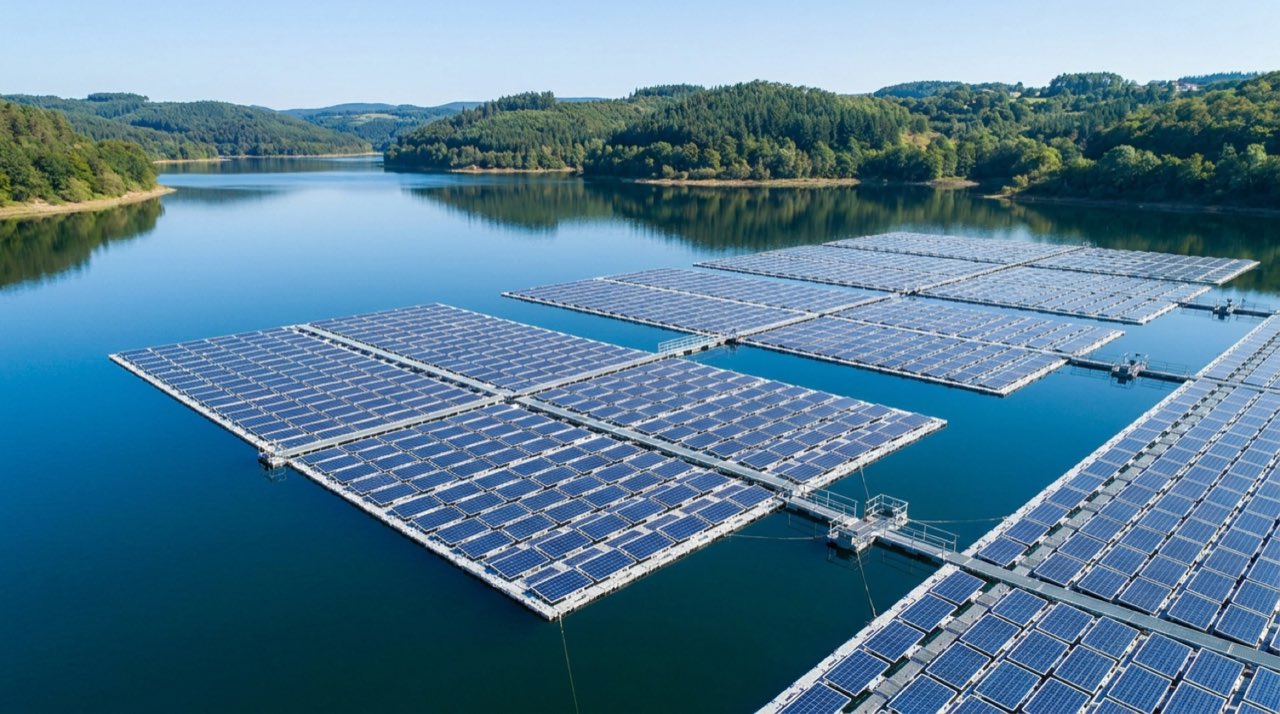
Australia loses enormous volumes of water to evaporation every year. Open storage reservoirs, irrigation ponds, mining-process dams and water-utility basins all experience surface evaporation that is both a direct financial cost and a water-security risk in a drying climate. Floating solar panels shade the water surface and measurably reduce that loss — peer-reviewed studies consistently demonstrate evaporation reductions of 40–75% beneath covered sections — while simultaneously generating clean electricity from a surface that would otherwise produce nothing. It is a genuine dual-use outcome, not a marketing claim.
The performance advantage of floating PV over equivalent land-based arrays compounds that benefit. Water surfaces provide natural convective cooling that holds panel temperature lower than rooftop or ground-mounted installations, and cooler panels convert sunlight more efficiently. Independent studies across multiple climate zones have measured generation gains of 5–15% relative to land-based reference systems at the same location. In the high-insolation, high-temperature environment of inland and northern Australia, that yield premium is material over a 25-year asset life.
Engineered for Australian water bodies
Floating solar in Australia operates in conditions that differ substantially from the European and Southeast Asian markets where most floatovoltaic technology originated: higher UV radiation, wider temperature cycling, variable water levels from seasonal rainfall and irrigation draw-down, and the wind and wave loading of large open-water bodies. Zenith specifies floats, pontoons, module mounting systems and cable management assemblies tested and rated for Australian conditions. Anchoring and mooring designs are engineered site-specifically, accounting for bed composition, water-level variation range, wind exposure and any navigation or water-quality requirements imposed by the site operator or regulator.
What a Zenith floating system covers
- Bathymetric survey and water-body assessment, including bed composition and level-variation history
- Hydrodynamic and wind-load modelling to size mooring, anchoring and float structure
- Floating platform supply: HDPE floats or galvanised aluminium pontoons, UV-stabilised to 25 years
- Marine-rated DC cabling, waterproof combiner boxes and shore-based inverter station
- Anchor and mooring design certified by a structural engineer to AS 4997 and relevant marine standards
- Evaporation modelling and water-saving report for water-utility and agricultural applications
Applications across agriculture and water utilities
Irrigation dams are the most common Australian floating-solar application. A farm drawing from a large earthen storage dam can cover 20–40% of the surface with floating panels, recover the capital cost through electricity savings and avoid the opportunity cost of occupying productive agricultural land with ground-mounted arrays. Water-utility reservoirs in peri-urban areas face a different set of requirements: water-quality protection, access for maintenance craft and regulatory oversight, but they carry the same economic logic — large flat water surfaces, high-value electricity and genuine water-security benefits that regulators increasingly recognise.
Mining and industrial sites represent a rapidly growing segment. Process water storage dams are often large, well-surveyed and located at sites with significant power costs. Floating solar feeds directly into behind-the-meter consumption, reducing diesel or grid dependency, and the panels reduce algal growth by limiting light penetration — an incidental benefit that reduces water-treatment load at some sites. Zenith has delivered floatovoltaic feasibility studies across all three sectors and brings engineering drawings, structural certifications and environmental documentation ready for the approval processes each sector requires.
Frequently asked
How much of the water surface needs to be covered to make floating solar viable?
Typical coverage ratios range from 15% to 35% of total surface area, balancing evaporation savings, yield and any water-quality or navigation requirements. Partial coverage still delivers proportional evaporation and generation benefits, and coverage can be staged as budget allows.
Does floating solar affect water quality?
Shading from floating panels generally suppresses algal growth by limiting photosynthetically active radiation at the water surface, which is a benefit for potable-water storages. Materials in contact with water are selected to be non-leaching and food-safe where drinking-water catchments are involved, and a site-specific water-quality impact assessment is included in our feasibility process.
What happens to the system if the water level drops significantly?
Mooring and anchoring systems are designed for the full range of seasonal water-level variation recorded at each site, typically with an additional safety margin. The floating platform rises and falls with the water surface, maintaining optimal panel angle and cable management throughout the operating range.