Commercial and industrial electricity costs in Australia have risen sharply over the past decade, and network tariffs increasingly penalise peak demand as well as raw consumption. A well-engineered behind-the-meter solar system attacks both levers at once: it displaces daytime grid energy during the hours when tariffs are highest and, where your load profile allows, shaves the demand peaks that trigger the most expensive network charges. The economics have never been more compelling — commercial solar is now routinely returning payback periods of four to seven years even without battery storage, and considerably faster when demand management is factored in.
At Zenith we begin every commercial engagement with your interval meter data, not a site visit. Twelve months of half-hourly consumption records reveal your real load shape: when you peak, how long peaks last, and how much solar generation can realistically displace rather than export. We overlay that data against your network tariff, the capacity and orientation of your roof or ground area, and any operational constraints around install timing or panel placement. The output is a business case with numbers you can take to a board or a bank, not a brochure with generic savings claims.
From warehouses to factory floors
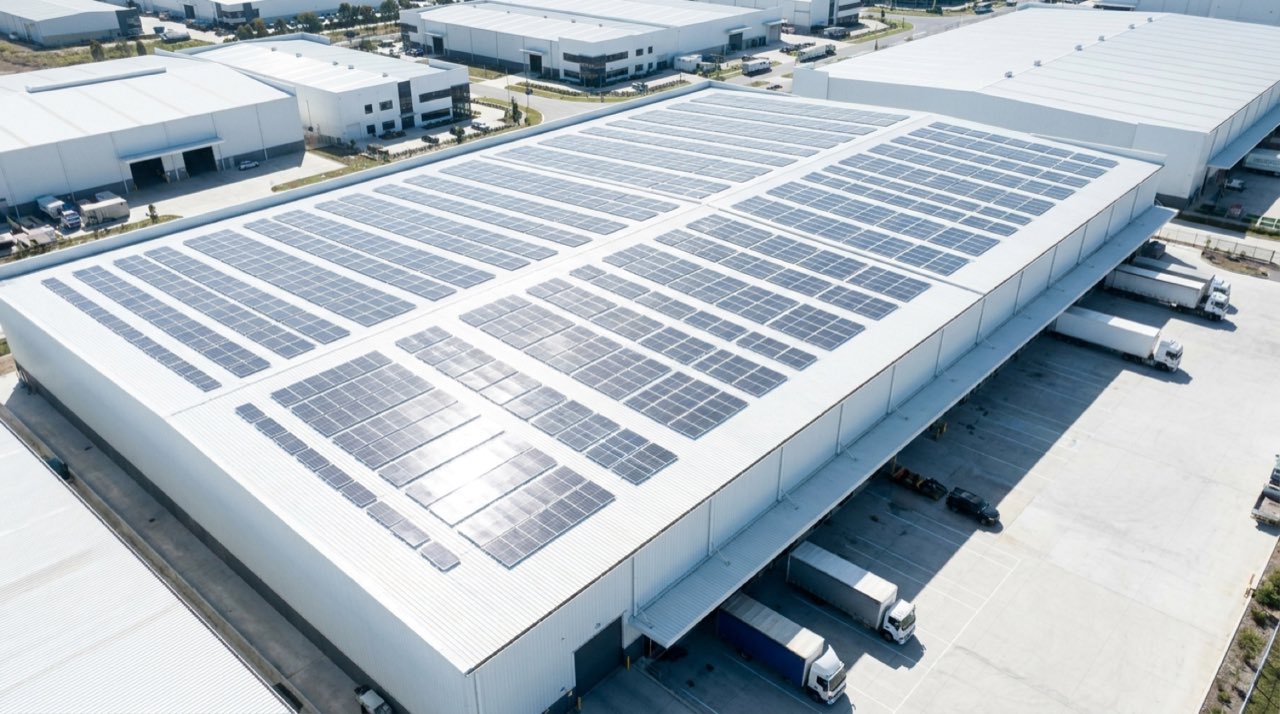
Large flat industrial roofs are among the most productive solar surfaces in the built environment. A single distribution centre can carry a 500 kW to 2 MW array across its roof, generating the equivalent of a substantial portion of its daytime energy draw. Retail precincts, shopping centres and mixed-use facilities benefit from the alignment between peak solar generation and peak air-conditioning load — two curves that track each other closely on hot Australian days. Factories with continuous daytime process loads often achieve the cleanest economics because nearly every kilowatt-hour generated displaces grid energy at commercial rates rather than being exported at a fraction of that value.
What a Zenith C&I system includes
- Detailed load and tariff analysis to size the system for maximum behind-the-meter value
- Three-dimensional roof modelling and shading simulation at 15-minute resolution
- Tier-1 commercial panels with 30-year linear performance warranties
- String and central inverters or distributed microinverters selected for your load profile and footprint
- Power-factor correction and harmonic filtering where network requirements demand it
- Full CEC-accredited design, DNSP connection application and AS/NZS 5033 compliant installation
- Real-time monitoring integrated with your building management system or energy dashboard
Minimal downtime, maximum accountability
Industrial and retail operations cannot stop for a solar install. Zenith project-manages every job with a phased installation plan agreed in advance: sectional roof access, out-of-hours electrical work where required, and a commissioning sequence that keeps your facility operational throughout. Our crews are directly employed and CEC-accredited — not subcontracted chains where accountability dilutes with each handover. Every stage is documented against a commissioning checklist, and you receive a full handover package including as-built drawings, compliance certificates and warranty documentation.
For multi-site portfolios, we offer centralised monitoring across all locations and structured maintenance agreements that keep performance warranties valid and assets performing to their modelled output. Where your network tariff or load profile justifies it, we design battery-ready infrastructure from day one, so adding storage as battery costs continue to fall in 2026 requires no rework to the DC plant or switchboard. The result is a capital asset that earns from commissioning day, adapts to your evolving energy strategy and remains fully supported by one accountable team.
Frequently asked
How do demand charges affect the business case for solar?
Demand charges are levied on your highest 15- or 30-minute average draw in a billing period, and they can represent 30–50% of a commercial bill. Solar reduces demand peaks when your load aligns with generation; where peaks fall outside solar hours, we model battery or load-shifting options to address the remaining demand component.
Can you install without disrupting operations?
Yes. We plan every commercial install around your operational hours, structuring roof access, switchboard work and commissioning in stages so your facility remains live throughout. Out-of-hours electrical tie-ins are standard for food production, cold-chain logistics and other continuously operating sites.
What is the typical payback period for a commercial system?
Most commercial systems return payback in four to seven years before incentives, and faster where demand-charge savings are significant or where a power purchase agreement (PPA) structure is used. Your proposal will include a full financial model based on your actual meter data and current tariff.