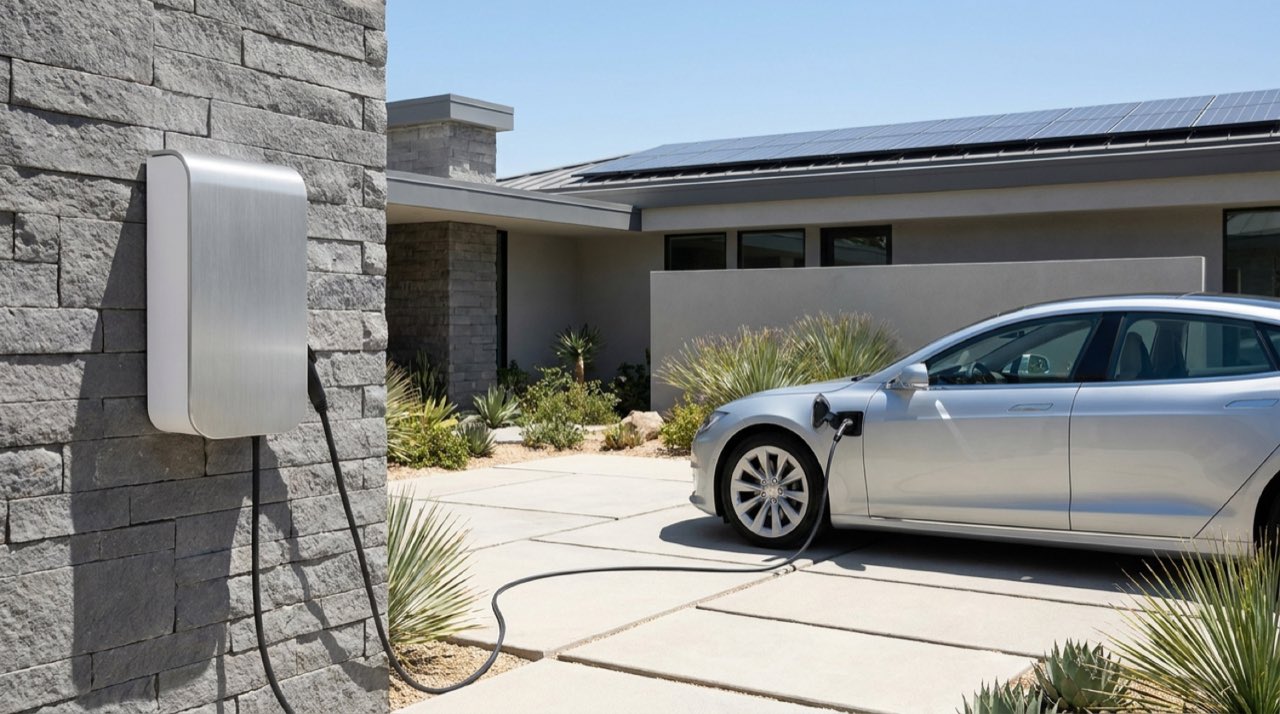
The Australian EV market passed one hundred thousand new registrations in a calendar year for the first time in 2025, and the charging infrastructure market has followed. Home charging remains the primary use case for the majority of EV owners — most drivers cover sixty to eighty kilometres per day and need only six to twelve kilowatt-hours to replenish overnight. But the timing of that replenishment matters enormously. An uncontrolled seven-kilowatt charger switching on when the owner gets home at six in the evening adds directly to the household's peak draw, increases demand charges for those on time-of-use tariffs and contributes to the distribution network stress that drives infrastructure investment and, ultimately, network tariff increases.
Solar-smart EV charging solves this by redirecting generation surplus — power the solar array is producing that the house is not currently consuming and would otherwise export at the feed-in tariff rate — into the vehicle instead. The economic difference is significant. Most Australian feed-in tariffs sit between four and eight cents per kilowatt-hour in 2026. The retail rate for grid electricity is typically twenty-eight to forty cents. A solar-smart controller that captures two thousand kilowatt-hours per year into the EV rather than exporting it is worth between four hundred and seven hundred dollars in annual savings compared to dumb grid charging, on top of whatever the household was already self-consuming.
How solar-smart EV charging works
A solar-smart charger monitors the home's net import or export via a current transformer on the main switchboard and continuously adjusts the charge rate to consume only the surplus being generated. Most systems operate on a minimum threshold — typically one point four kilowatts, the floor for single-phase AC charging — below which the charger pauses rather than importing from the grid. Above that threshold, the charge rate tracks the available surplus in real time, ramping up when solar generation is strong and stepping back when clouds pass or household loads increase. The result is that on a clear day, a vehicle can accumulate fifty to eighty kilometres of range purely from generation that would otherwise have been exported.
For households with a battery storage system, the controller logic becomes more sophisticated: the system needs to decide whether incoming solar surplus should charge the battery or the car, based on the current state of charge of each, the forecast for the day and the owner's departure time. Modern energy management systems handle this automatically via a priority hierarchy that can be configured through an app. The typical default prioritises battery charging in the morning until a target SOC is reached, then switches surplus to the EV, then exports any remaining generation — capturing maximum value from every kilowatt-hour produced.
What a complete EV charging installation includes
- Mode 3 AC home charger, seven to twenty-two kilowatts depending on vehicle onboard charger and supply capacity
- Current transformer energy monitoring on the main switchboard for solar-smart control
- Smart charger controller with excess-solar, schedule and minimum-SOC charge modes accessible via app
- AS/NZS 3000 compliant dedicated circuit with appropriate fusing and earthing for the charger rating
- Load management relay where the existing supply capacity cannot accommodate the charger without upgrade
- OCPP 1.6 or 2.0.1 protocol support for commercial and fleet sites requiring back-office integration
Commercial sites, fleet depots and demand management
Commercial EV charging introduces a layer of complexity that residential installations do not face: simultaneous charging of multiple vehicles can create demand peaks that trigger network tariff demand charges far exceeding the value of the energy delivered. A fleet depot charging ten vehicles at seven kilowatts each draws seventy kilowatts — a significant demand event that, on a typical commercial tariff, can add thousands of dollars per month in demand charges if it occurs at the wrong time. Smart load management solves this by distributing available capacity across vehicles based on departure priority, available solar generation and the site's demand cap.
OCPP (Open Charge Point Protocol) is the standard that enables this coordination. An OCPP-compliant charger can receive dynamic power setpoints from a central management system, allowing the depot operator to set a total site power ceiling and have the system allocate it optimally across all active sessions. Zenith specifies OCPP-compliant hardware for all commercial installations and can integrate with leading charge management platforms including those used by fleet operators, local government and strata buildings. The protocol also supports billing by session or kilowatt-hour for sites where multiple users need to be invoiced separately.
Vehicle-to-grid (V2G) and vehicle-to-home (V2H) technology has moved from demonstration phase to early commercial availability in Australia by 2026, primarily through the Nissan Leaf and several new models with CHAdeMO or dedicated bidirectional AC capability. These technologies allow the vehicle battery to act as a dispatchable storage asset, discharging into the home or grid during peak periods. The economics are compelling in principle — an EV with a sixty-kilowatt-hour battery holds several times more usable capacity than most home battery systems at no incremental hardware cost — and the regulatory pathway through AEMO for V2G export is being established. Zenith installs V2G-ready chargers and inverter configurations on request and will activate bidirectional capability as vehicles and network approvals reach each customer's area.
Frequently asked
Will installing a home EV charger require a supply upgrade or new switchboard?
It depends on your existing supply capacity and the charger rating you choose. A single-phase seven-kilowatt charger typically fits within a standard sixty-three or eighty-amp residential supply without upgrade, provided other major loads are not simultaneously at peak draw. Three-phase twenty-two-kilowatt chargers require a three-phase supply, which not all residential streets have available. We conduct a supply capacity assessment as part of every charger design and specify the charger rating that fits within your existing infrastructure, or clearly scope any upgrade required.
Can I use a solar-smart charger if my EV is parked away from home during peak solar hours?
Solar-smart charging works best when the vehicle is connected during midday solar production hours, which suits owners who work from home, park at a solar-equipped workplace, or return home during the day. If your vehicle is parked off-site during the solar window, the most practical alternative is scheduling charging on an off-peak overnight tariff to minimise cost, and using the solar-smart mode on weekends and days off. Some EV apps also support remote session start, allowing you to trigger a charge remotely when solar generation is strong.
Is workplace EV charging eligible for any government incentives in Australia?
The Australian federal government's Electric Vehicle Charging Infrastructure program has provided grants for destination and fleet charging infrastructure, primarily targeting public access and workplace sites. Several states have supplementary programs. Separately, the FBT exemption for employer-provided EVs makes workplace charging particularly attractive for salary-packaged vehicles, as the electricity used for business-purposes charging can be included in the novated lease arrangement. We can provide a summary of current programs applicable to your state and business type as part of the commercial site design process.