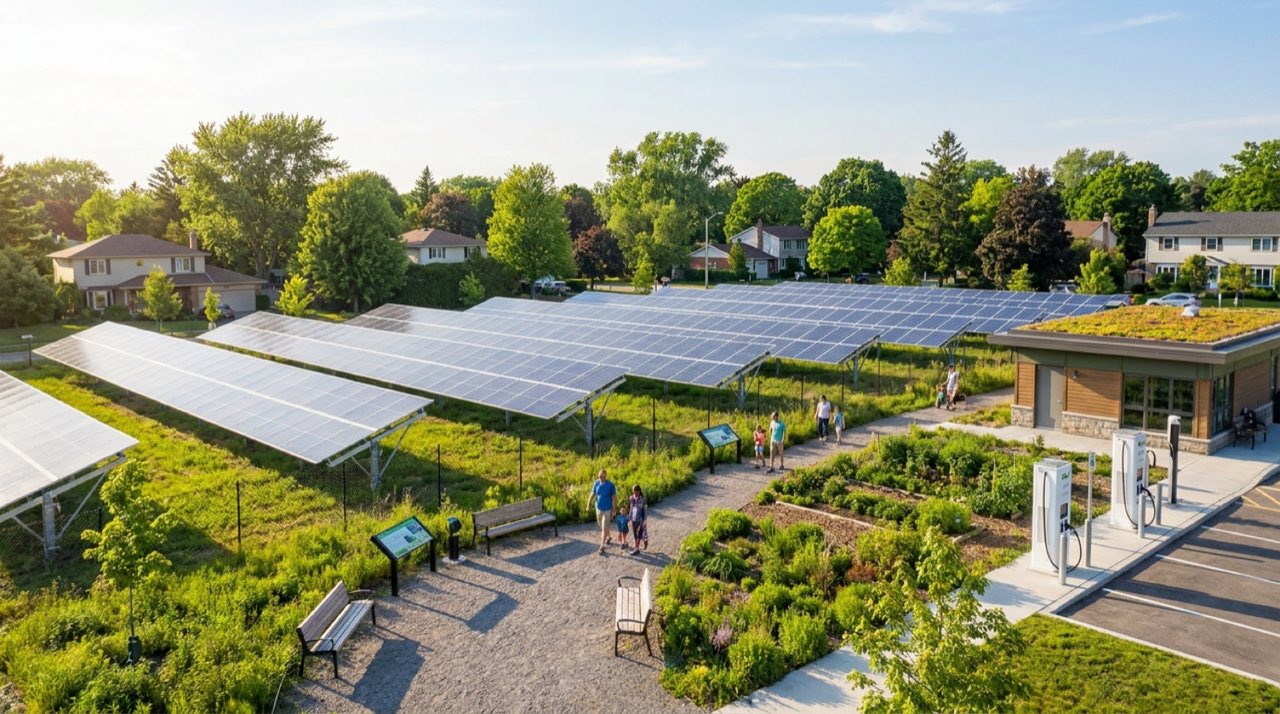
A community solar garden is a grid-connected solar array, typically one to five megawatts, whose output is virtually allocated among a pool of subscribers rather than consumed on-site. Each subscriber owns or leases a defined share of the array's capacity. The generator dispatches into the local distribution network, and your retailer applies a generation credit to your account that offsets the energy you draw from the grid at home. The result is functionally equivalent to rooftop solar without requiring you to touch your roof, negotiate with strata or commit to a twenty-year mortgage on hardware.
Zenith Solar Tech develops community gardens in partnership with distribution network service providers (DNSPs) and local councils to ensure siting is optimised for network headroom, land tenure security and proximity to subscriber load centres. Locating generation close to where subscribers actually consume power reduces transmission losses and, in some network tariff structures, qualifies the project for locational value credits that flow back to members. We target host sites within fifteen kilometres of the subscriber base wherever land availability permits.
How the subscription model works
Subscribers choose a capacity block, typically expressed in kilowatts, sized to match their average consumption. Once the garden is energised and your retailer has activated the virtual net metering arrangement, generation from your allocation is credited at an agreed rate each billing cycle. Most of our gardens operate on month-to-month subscriptions with a ninety-day exit notice, so you are not locked in if you move or eventually install your own rooftop system. Credits are clearly itemised on your bill as a separate line, making it straightforward to verify what you are receiving.
Subscription pricing is fixed for the initial term and indexed modestly thereafter, typically well below the rate at which retail tariffs have risen historically. That predictability is one of the core financial attractions: unlike purchasing panels, there is no large upfront capital outlay, no depreciation to manage and no maintenance liability. You pay a monthly subscription fee and receive generation credits that exceed it when the sun is producing — the margin is your saving.
Who benefits most from community solar
- Renters who cannot obtain landlord consent to install rooftop panels
- Apartment residents subject to strata restrictions or shared roof allocation constraints
- Heritage-listed properties where panel installation is not permitted by council
- Homeowners with heavily shaded or structurally unsuitable roofs
- Small businesses whose tenancy agreement prohibits capital works
- Households awaiting grid connection upgrades that delay rooftop approvals
Accreditation, metering and network connection
Every Zenith community garden is designed and installed by Clean Energy Council (CEC) accredited engineers to AS/NZS 5033 and the relevant DNSP technical requirements. Grid connection is negotiated directly with the network operator, including any required protection relay upgrades and metering infrastructure. Subscriber allocation is tracked through interval data at the garden meter, reconciled monthly by our operations team, and reported to each retailer in a standardised format compatible with Australian Energy Market Operator (AEMO) settlement systems. You do not need to do anything on your end beyond signing up with a participating retailer.
Gardens that reach sufficient scale — generally above two megawatts — are assessed for participation in AEMO's wholesale spot market during periods when subscriber load is low and generation is high. Any wholesale revenue above the contracted floor rate is pooled and applied as an additional credit to subscriber accounts on a pro-rata basis, providing a small but tangible upside in high-price periods. This structure means community solar members share the same wholesale market exposure that large energy users and virtual power plant participants access, without needing a battery or any additional hardware.
As the community solar market matures in Australia, we expect state and federal government programs to supplement subscriber savings further. Several jurisdictions are already consulting on frameworks that would allow community gardens to access the same feed-in incentives and network tariff concessions available to rooftop systems. Zenith actively participates in those consultations and structures our projects to take advantage of new mechanisms as they are gazetted, passing the benefit through to members rather than retaining it at the project level.
Frequently asked
Can I join a community solar garden if my electricity retailer is not listed as a partner?
Virtual net metering requires your retailer to participate in the garden's billing arrangement. We currently work with a growing number of authorised retailers in each state, and the list expands as gardens are commissioned. If your current retailer is not yet supported, we can refer you to a compatible one on comparable base tariffs, and in most cases the credit value from the garden more than offsets any small difference in usage rate.
What happens to my subscription if the garden has a period of low output due to weather or maintenance?
Credits reflect actual metered generation from your allocation, so they will be lower in extended low-irradiance periods — the same variability you would experience with a rooftop system. Scheduled maintenance windows are short, typically one to two days per year, and are communicated in advance. Your grid electricity supply is never interrupted; you simply receive a smaller offset credit in those periods.
Is there a minimum subscription period or lock-in contract?
Our standard subscription is month-to-month with a ninety-day written exit notice, designed to accommodate renters who may need to relocate. Longer fixed-term options are available at a discounted subscription rate for those who want price certainty over two or three years. There are no exit fees on the standard month-to-month plan.