Few capital projects available to a facility manager deliver a more legible return on investment than a well-executed LED lighting retrofit. Unlike structural works or mechanical plant replacements, lighting upgrades yield savings that begin accruing from the first day of operation, are measurable to the kilowatt-hour, and are insulated from the commodity price fluctuations that make other energy strategies difficult to model. In a commercial environment where electricity tariffs have risen materially over the past decade and are not expected to moderate, the economics of converting a legacy fluorescent installation to modern LED are, in most cases, compelling.
The challenge for facility managers is not establishing that LED is superior; that argument was settled years ago. The challenge is building an analysis rigorous enough to survive board-level scrutiny, understanding what rebates and incentive programs are currently available, and ensuring the specification captures the full stack of savings rather than the headline energy reduction alone. A retrofit scoped only on lamp-for-lamp wattage replacement leaves a substantial portion of the available return unrealised.
The Payback Calculation — Done Properly
A credible payback model begins with actual metered consumption from the existing installation, not nameplate wattages. In practice, ageing fluorescent tubes and magnetic ballasts frequently draw more current than their rated wattage suggests, while some circuits will have already been partially upgraded, making blanket assumptions unreliable. A site survey that measures operating hours and actual draw per circuit produces a consumption baseline that can be reconciled against the electricity bill, giving confidence that the savings projection reflects reality.
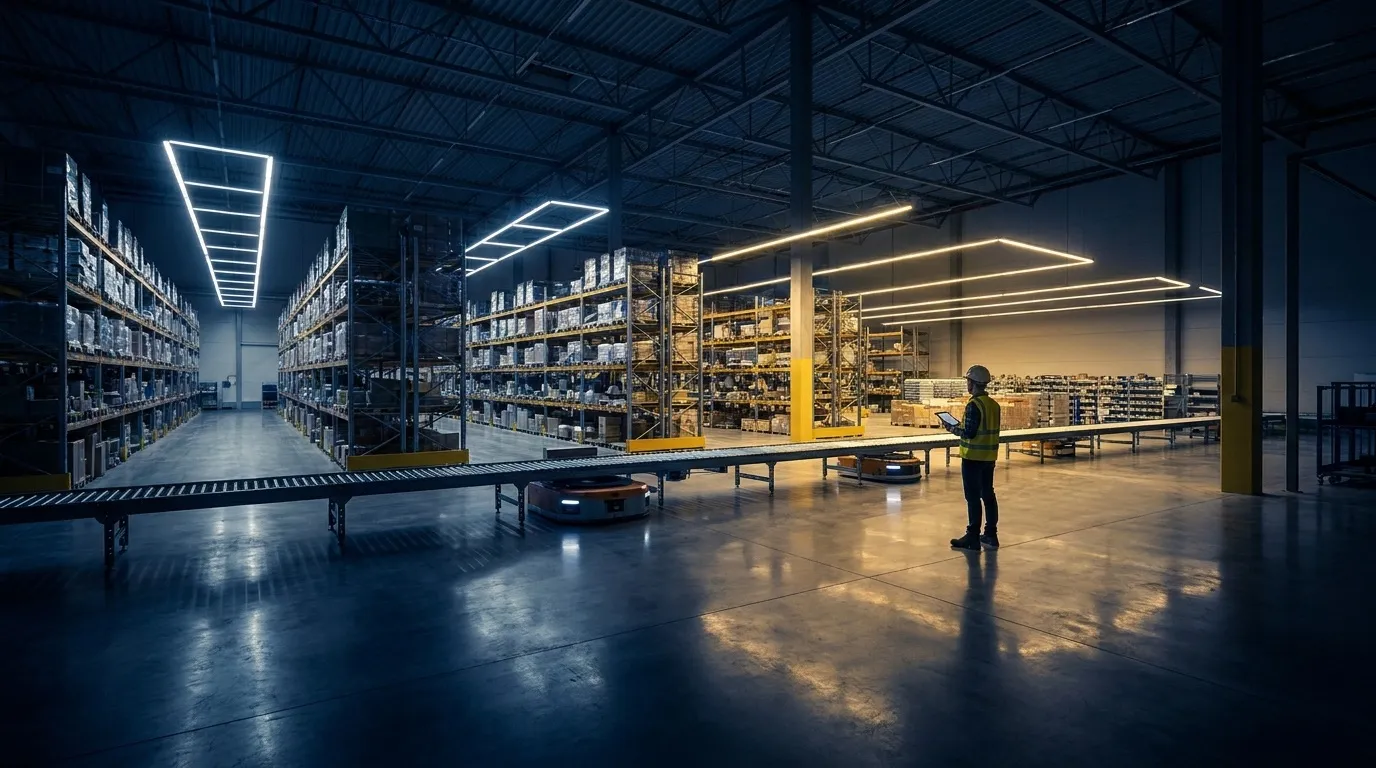
Against that baseline, the LED replacement is specified to deliver equivalent or superior lux levels — the measure of illuminance at the working plane — at a fraction of the wattage. Quality commercial LED luminaires with a luminous efficacy of 120 to 160 lumens per watt will typically deliver the same or better illuminance as a T8 fluorescent at between 40 and 60 percent of the energy. In a large office, warehouse, or retail space operating ten or more hours per day, the resulting dollar saving can be substantial: it is not unusual for sites with all-day operating profiles and legacy technology to see simple paybacks of two to four years on the electrical saving alone, before any other benefit is factored in.
- Energy saving: typically 40 to 60 percent reduction in lighting circuit draw
- Demand charge reduction: lower peak demand from lighting circuits reduces network demand tariff
- Maintenance saving: LED lamp life of 50,000 hours or more versus 10,000 to 15,000 hours for fluorescent eliminates most re-lamping labour and materials
- Cooling load reduction: less waste heat from LED luminaires reduces air-conditioning duty, generating a secondary saving that can add 5 to 15 percent to the total energy benefit
- Productivity and wellbeing: improved colour rendering index and consistent illuminance reduce eye strain and are associated with measurable improvements in occupant productivity
DALI Controls and Intelligent Lighting Management
The full potential of a modern LED installation is unlocked when the luminaires are paired with an intelligent control system. The Digital Addressable Lighting Interface (DALI) protocol is the de facto standard for commercial lighting control, enabling individual addressability of each luminaire, group control, scene setting, occupancy sensor integration, and daylight harvesting — the automatic dimming of artificial light in proportion to available natural light — all on a two-wire bus running alongside the power circuit.
Daylight harvesting alone commonly delivers an additional 20 to 40 percent saving on top of the lamp efficiency gain in perimeter zones with significant glazing. Occupancy control in intermittently occupied spaces — meeting rooms, bathrooms, storage areas, stairwells — eliminates standby losses entirely. A well-commissioned DALI system does not simply replace old lamps with new ones; it transforms the lighting installation from a fixed-cost passive service into a responsive, metered asset that scales its energy consumption to actual building occupancy in real time.
Incentives, Rebates, and Energy Savings Schemes
State-based energy efficiency programs have, at various times, underwritten a meaningful share of the cost of commercial lighting upgrades. The Victorian Energy Upgrades (VEU) program, the NSW Energy Savings Scheme (ESS), and the South Australian Retailer Energy Productivity Scheme (REPS) all create financial instruments — broadly, certificates representing the lifetime energy saving of the upgrade — that an approved installer can generate and surrender to a liable entity, typically a retailer, in exchange for a discount on the installation cost.
The availability and scale of incentives shifts as scheme administrators adjust abatement factors and eligible product lists. Before committing to a retrofit specification, it is worth engaging a licensed installer who participates in the relevant scheme and can provide a current assessment of what incentive is achievable on the proposed scope. In many jurisdictions, the combination of direct energy saving and scheme incentive reduces the net project cost to the point where simple payback falls below two years — a threshold that makes approval straightforward in most capital expenditure frameworks.
Specifying for the Long Term
The lowest upfront cost is rarely the lowest total cost of ownership in commercial lighting. Luminaires specified from commodity-grade supply chains carry uncertainty about driver quality, lumen maintenance, and supplier continuity for warranty claims. A well-specified retrofit project will reference relevant Australian Standards for commercial luminaires, specify driver L70 lumen maintenance life — the hours to reach 70 percent of initial lumens — of at least 50,000 hours, and confirm that the supply chain includes local warranty support.
Apex Current Solutions approaches lighting retrofit projects as a complete scope: site survey and metered baseline, photometric modelling to confirm maintained illuminance to AS/NZS 1680 standards, design of controls infrastructure, supply and installation, commissioning, and connection to any available incentive program. For facility managers who want the investment justified before the project begins and delivered as modelled when it is complete, that end-to-end discipline is the difference between a project that performs and one that merely looked good in the proposal.