A switchboard is the nerve centre of any commercial or residential electrical installation. It receives incoming supply from the network, distributes power to individual circuits, and — critically — houses the protective devices that isolate faults before they become fires or fatalities. When that nerve centre is ageing, undersized, or built to standards that are now decades out of date, every piece of equipment and every person in the building is operating under an elevated and largely invisible risk.
Property owners and strata managers frequently underestimate how rapidly the safety standards governing switchboards have evolved. A board installed in the 1970s or 1980s was compliant at the time of construction. The same board today may carry hazards that are well understood, demonstrably dangerous, and — in certain circumstances — the subject of mandatory replacement orders under state electrical safety legislation. Understanding the warning signs and the compliance triggers is not optional housekeeping; it is a fundamental ownership obligation.
Recognising the Warning Signs
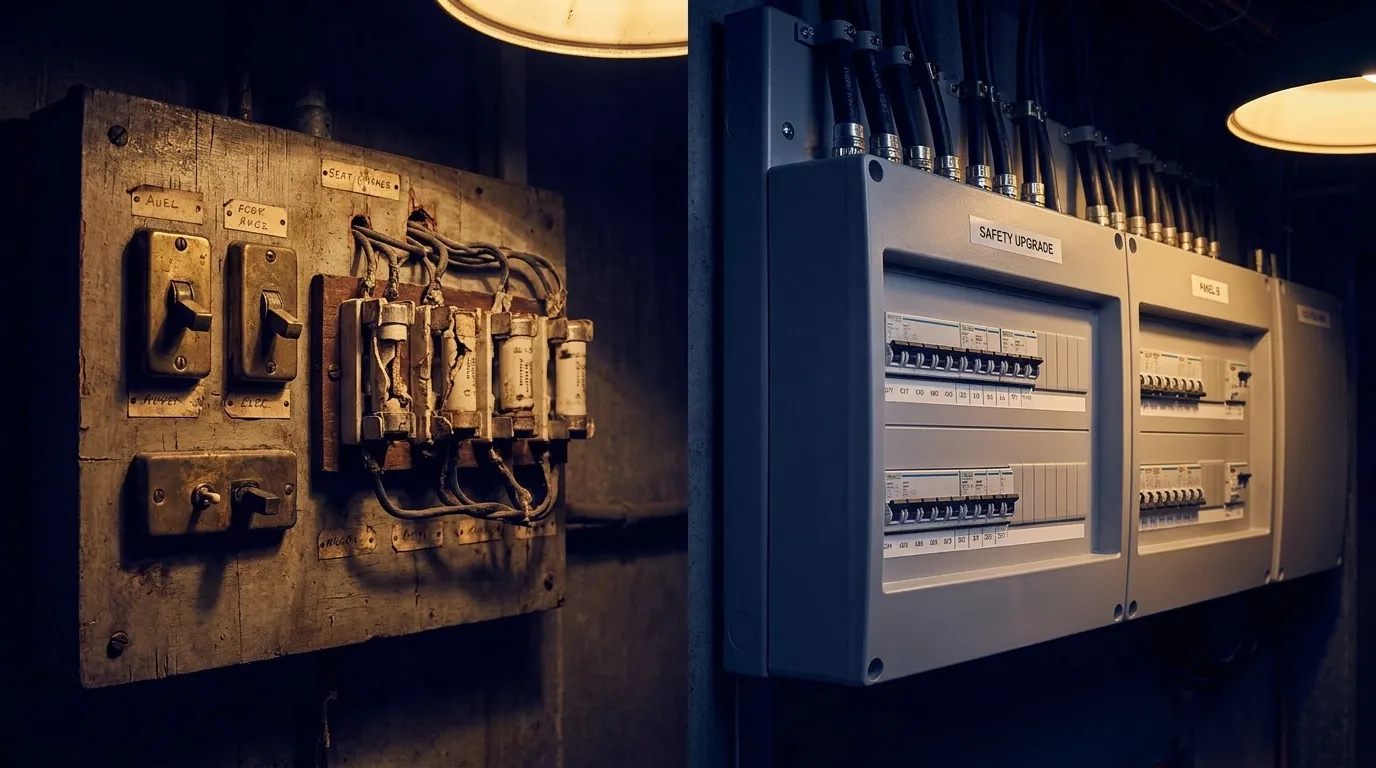
The most immediately dangerous legacy equipment is the ceramic rewirable fuse. Unlike a modern circuit breaker, a ceramic fuse requires a human to physically insert a length of fuse wire to restore power after a fault. The invitation to over-fuse — fitting wire of a higher rating than the circuit demands — is irresistible to a maintenance worker under pressure, and an over-fused circuit offers no meaningful protection against sustained overload or fault current. Scorching around fuse carriers, a persistent smell of hot bakelite, or a consistent need to restore supply more than once a month from the same circuit are all indicators that the protection is failing.
Asbestos-backed switchboards present a separate and serious concern. Until the early 1980s, compressed asbestos sheet was a common backing material in domestic and light commercial boards across Australia. Any work on such a board — including routine maintenance — constitutes disturbance of asbestos-containing material and is governed by state work health and safety legislation, the relevant codes of practice for asbestos removal, and in most jurisdictions requires engagement of a licensed asbestos removalist before electrical work can proceed. A licensed electrician who inspects your board and identifies asbestos backing is not raising an optional point; they are identifying a regulatory obligation that affects how any subsequent work must be managed.
RCDs, RCBOs, and the Modern Protection Standard
The single most consequential shift in Australian switchboard standards over the past two decades has been the mandated proliferation of residual current devices. An RCD — also referred to in earlier literature as a safety switch — monitors the balance of current flowing in and out of a circuit. When it detects a difference of as little as 30 milliamperes, caused by current flowing to earth through a person or a fault path, it interrupts the circuit in under 30 milliseconds: fast enough, in most circumstances, to prevent a ventricular fibrillation fatality.
AS/NZS 3000:2018, the Wiring Rules that govern all fixed electrical installations in Australia, requires RCD protection on all power and lighting circuits in new work. Many older installations were grandfathered under the rules current at the time of construction, but several states have introduced requirements for retrospective RCD installation at the point of sale, major renovation, or the conduct of specified electrical work. A residential circuit breaker board with no RCDs, or a commercial board where RCD protection is absent from socket-outlet circuits, is a known safety gap.
- Standard RCDs protect an entire circuit and trip on any earth leakage above the threshold
- RCBOs (residual current circuit breakers with overcurrent protection) combine RCD and circuit breaker function in a single device, allowing per-circuit discrimination
- Type A RCDs address pulsating and sinusoidal AC fault currents, making them appropriate for circuits supplying inverter-driven equipment and EV chargers
- Type F devices add protection against high-frequency fault currents generated by variable-speed drives and sophisticated appliances
- Arc fault detection interrupters (AFDIs) are increasingly specified for circuits in sleeping areas and where cabling runs through wall cavities
Surge Protection and the Case for SPDs
Surge protective devices have moved from the realm of optional precaution to near-standard practice in quality commercial installations. Transient overvoltages — caused by lightning strikes on the distribution network, switching operations by the network operator, or large inductive loads being switched within the building — can stress or destroy sensitive electronic equipment in milliseconds without ever triggering a conventional circuit breaker. An SPD installed at the main switchboard clamps these transients, diverting the excess energy to earth before it propagates through the circuits.
For facilities housing significant quantities of IT equipment, variable-speed drives, building management system controllers, or medical instrumentation, a coordinated surge protection strategy typically involves a Type 1 or combined Type 1/2 SPD at the main switchboard and Type 2 or Type 3 devices at sub-boards and point-of-use locations. The cost of a coordinated SPD installation is modest relative to the replacement cost of the equipment it protects. More importantly, unmitigated surge damage is rarely covered by commercial insurance without evidence that reasonable surge protection measures were in place.
When Replacement Is Mandatory
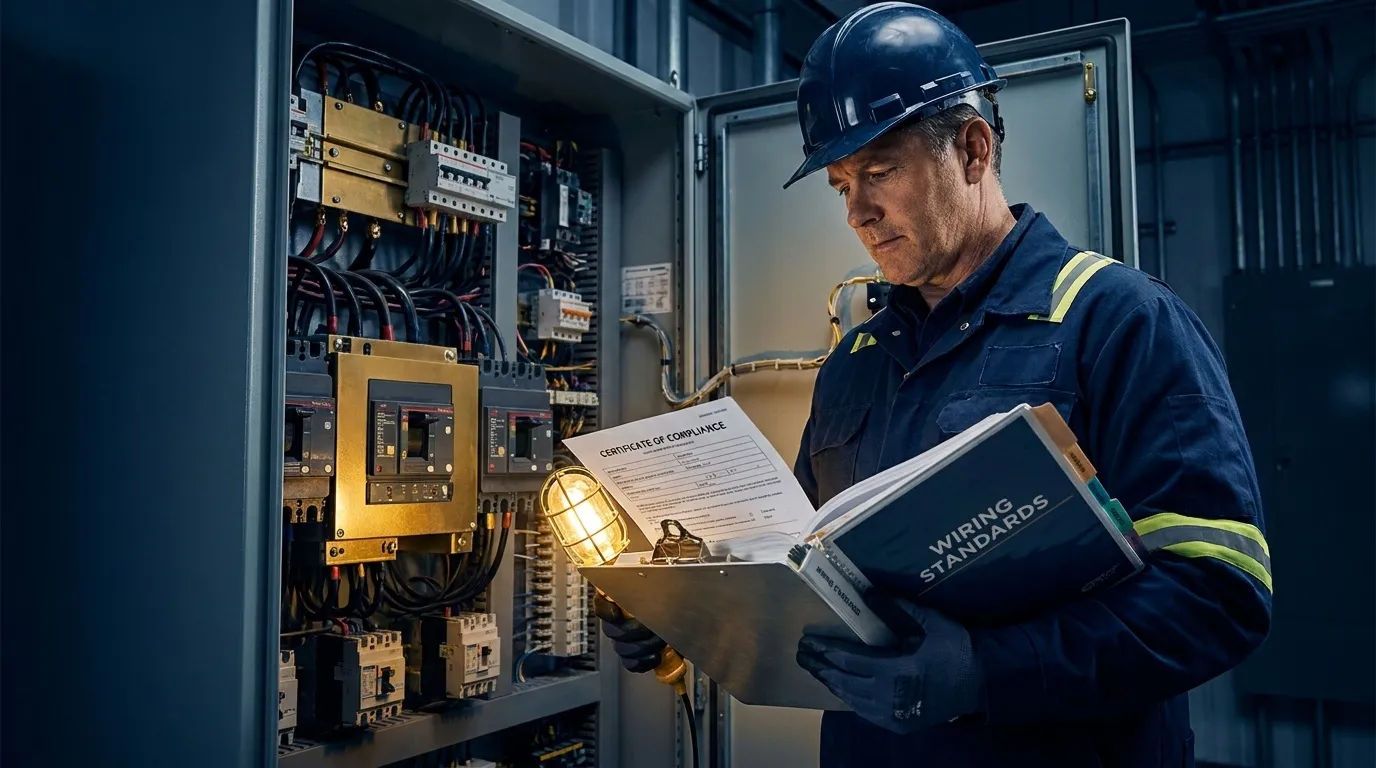
In addition to the safety-driven triggers described above, several circumstances create a regulatory obligation to upgrade rather than simply repair an existing board. Electrical work that requires a certificate of electrical safety — essentially any fixed wiring work — must be performed on equipment that, at the point of work, meets current standards. A licensed electrical contractor cannot in good conscience, and in many cases cannot legally, issue a compliance certificate for new work connected to a switchboard that remains materially non-compliant.
- Sale of a property in states with mandatory RCD requirements at point-of-sale triggers compliance works
- A major renovation that alters or extends circuits will prompt inspection of the board serving those circuits
- Damage, failure, or flooding of an existing board creates an obligation to replace rather than repair where the replacement equipment cannot meet current standards
- Capacity shortfalls — where an existing board cannot accommodate additional circuits demanded by a building use change — require a new or upgraded board
- Identification of asbestos-containing backing material during any inspection or maintenance work triggers asbestos management obligations before further electrical work proceeds
A modern switchboard replacement is not merely a compliance exercise. A well-specified board, properly sized for current load and anticipated growth, with per-circuit RCBOs, coordinated surge protection, and metering provision where appropriate, is a long-term investment in operational resilience. Apex Current Solutions holds a master electrician licence and carries the depth of experience required to assess, specify, and install switchboard upgrades to a standard that satisfies both the letter and the intent of AS/NZS 3000. If your board has not been inspected in the last five years, a professional assessment is the obvious and prudent first step.