There is a persistent belief in Australian homes and small offices that Wi-Fi has made network cabling redundant. It has not. What Wi-Fi has done is shift the bottleneck from the device's wireless radio to the cable that connects the access point to the network switch. A tri-band Wi-Fi 6E access point is theoretically capable of delivering several gigabits of aggregate throughput — but only if it is fed by a cable that can actually carry that bandwidth back to the router or switch. Run a 100-megabit Cat5e cable to your access point in 2024 and you have spent serious money on a wireless radio that is permanently throttled by the infrastructure behind it. SynthWire installs data cabling that matches the capacity of the equipment it serves — and then exceeds it, because future-proofing a cable run that is already open costs almost nothing compared to reopening walls in three years.
Cat6 versus Cat6A: understanding the difference
Cat6 unshielded twisted pair supports 1 Gbps at up to 100 metres and 10 Gbps at up to 55 metres — adequate for most current applications, but the 55-metre 10 Gbps limit is a trap in larger homes and commercial buildings where cable runs regularly exceed that length. Cat6A — Augmented Category 6 — supports 10 Gbps at the full 100-metre channel length, with improved alien crosstalk performance that keeps signal integrity intact when cables are bundled in tight cable trays or wall cavities. For new installations, SynthWire recommends Cat6A as the default specification. The material cost difference over Cat6 is modest; the performance headroom it provides over a fifteen-to-twenty year installation life is significant.
For environments where electromagnetic interference is a genuine concern — industrial facilities, buildings with significant motor loads or fluorescent lighting banks, any installation running parallel to high-voltage power cable for extended distances — shielded cabling (F/UTP or S/FTP) provides additional protection. SynthWire will specify shielded cabling where the installation environment warrants it and ensure that the shielding is correctly bonded at both ends. An improperly bonded shielded cable is worse than no shielding at all — it becomes an antenna rather than a shield.
Fibre: when copper reaches its limits
For runs longer than 100 metres, for connections between buildings, or for backbone links between network switches in a multi-floor commercial installation, multimode or single-mode optical fibre is the correct answer. Fibre is immune to electromagnetic interference, carries no electrical potential between endpoints (which matters when connecting separate buildings with different earth references), and supports distances and bandwidths that copper simply cannot match. SynthWire terminates fibre using fusion splicing or pre-terminated cassette systems depending on the application, tests every link with an optical loss test set, and provides test results as part of the project handover documentation.
Patch panels, racks, and the centralised termination point
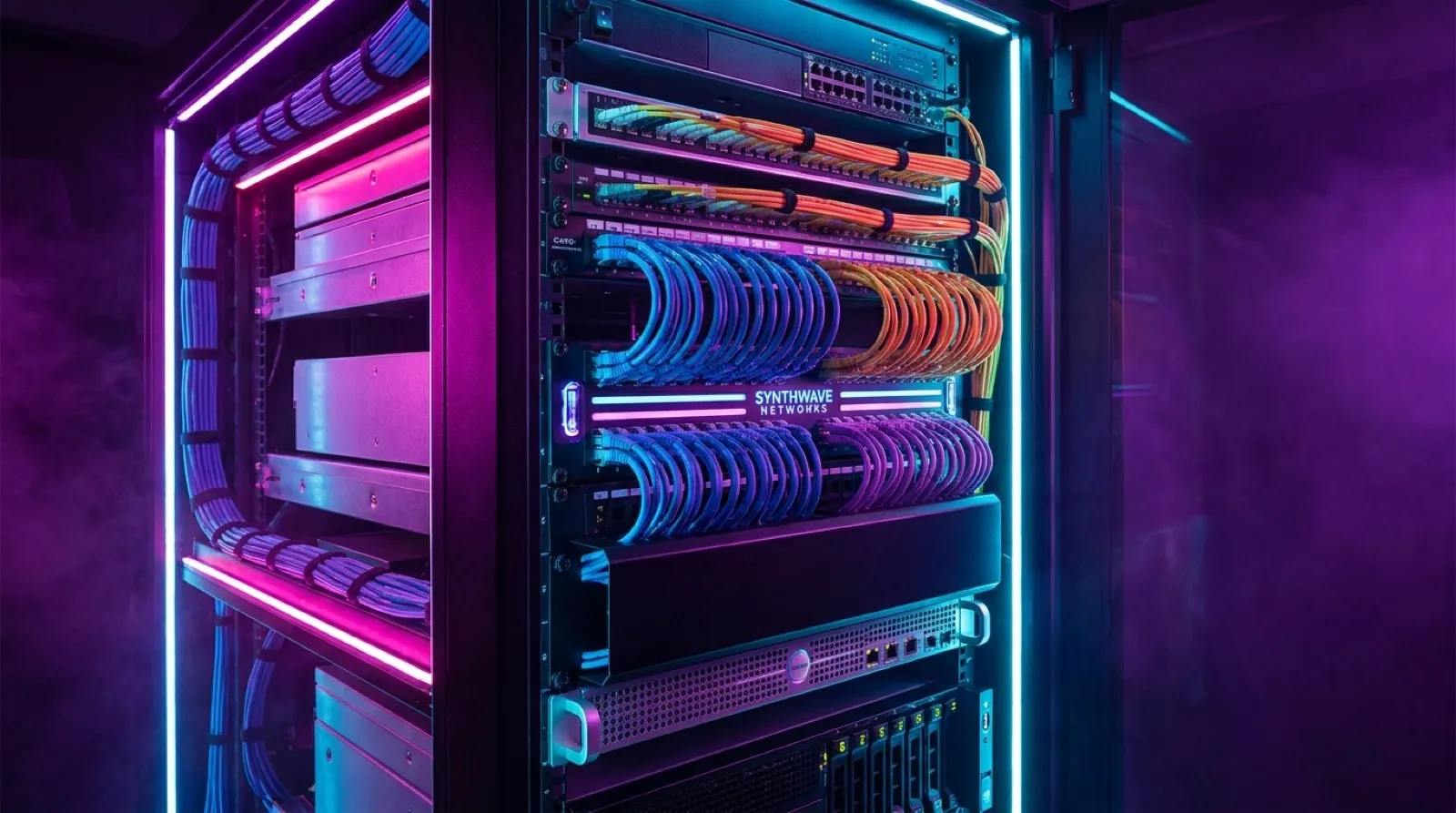
Every structured cabling installation SynthWire delivers terminates at a centralised patch panel. This is not an aesthetic preference — it is what makes a cabling infrastructure manageable over its entire operational life. A patch panel presents every cable run as a labelled, accessible port at a single location. Moves, adds, and changes to the network are made by replugging patch leads at the panel, not by tracing cables through ceiling spaces. For residential installations, a wall-mounted data rack cabinet in a cupboard or utility room serves this purpose perfectly. For commercial installations, a proper 19-inch rack with cable management, a UPS for network hardware, and appropriate cable entry points is standard. SynthWire installs both, to the same standard of workmanship.
Termination quality matters enormously in high-speed data cabling. A Cat6A cable terminated incorrectly — with pairs untwisted too far back from the jack, with the wrong 568-A or 568-B standard mixing between ends, or with a patch cord that does not meet Cat6A performance — will fail certification testing even if every other element of the installation is perfect. SynthWire uses keystone jacks and patch panels rated for Cat6A, terminates to the 568-B standard throughout, and tests every completed link with a Fluke Networks DSX CableAnalyzer — the industry reference tool for structured cabling certification.
Wi-Fi access point cabling: the correct way to build wireless coverage
The correct architecture for whole-home or commercial Wi-Fi coverage is wired access points distributed throughout the building, each connected by a dedicated Cat6A cable run back to a central switch. Mesh Wi-Fi systems using wireless backhaul are a pragmatic solution when running cable is genuinely impractical, but they introduce latency on every wireless hop and reduce available bandwidth with each mesh node. A ceiling-mounted access point on a hardwired backhaul is faster, more reliable, lower latency, and capable of supporting far more concurrent devices than any mesh node in the same location. SynthWire runs dedicated Cat6A to every access point location, terminates at the central patch panel, and ensures cable runs are routed away from electrical cabling to maintain signal integrity. Power over Ethernet (PoE) means no separate power outlet is required at the access point — one cable does everything.
- Cat6 and Cat6A UTP structured cabling for residential, commercial, and industrial installations
- Shielded cabling (F/UTP, S/FTP) where installation environment requires interference rejection
- Multimode and single-mode optical fibre installation with fusion splicing and OLTS testing
- 19-inch rack and wall-mount cabinet supply and installation with cable management
- 24-port and 48-port Cat6A patch panels with 568-B termination throughout
- Fluke DSX CableAnalyzer certification testing with printed pass/fail reports for every link
- Dedicated Cat6A backhaul runs for Wi-Fi access points with PoE switch configuration
Frequently asked
The standard recommendation SynthWire gives for new residential builds is a minimum of two data points per living area and bedroom, four in a home office, and a single data point wherever a Wi-Fi access point will be ceiling-mounted. In practice, we recommend treating data points the same way you treat power points — install more than you think you need during the build, because adding more after the walls are closed costs ten to fifteen times what it costs during rough-in. Living rooms and home offices where people use multiple devices simultaneously, game, or stream in high quality should be treated generously. The marginal cost of an extra data point during construction is the cost of a metre of cable and a keystone jack.
Yes, subject to the separation requirements in AS/NZS 3000 and the cable manufacturers' specifications. Data cable run parallel to 230V mains cable at close proximity can pick up electrical interference that degrades signal quality — particularly relevant for Cat6 and Cat6A at high frequencies. AS/NZS 3000 specifies minimum separation distances between data cable and power cable depending on the mains cable type and shielding. SynthWire routes data cabling to maintain appropriate separation throughout the run, crosses power cable at 90 degrees where parallel separation is not practical, and uses shielded data cable in environments where mains separation cannot be maintained.
A Fluke DSX CableAnalyzer certification test measures the electrical performance characteristics of the completed cable link — including insertion loss, near-end crosstalk (NEXT), far-end crosstalk (FEXT), return loss, and propagation delay — and compares every measurement against the TIA-568 or ISO/IEC 11801 standard limits for the category being certified. A pass result confirms that the installed link will support the rated bandwidth at the rated distance. It detects problems that are invisible to simple continuity testing: marginal terminations, cable damage during installation, excessive untwisting at jacks, and impedance mismatches from mixing cable and component categories. We provide the printed test reports as part of project handover — if a cable fails, it is fixed before those reports are issued.