Electrical faults fall into two broad categories: the ones that make themselves immediately obvious — a circuit breaker that trips the moment you turn on a specific appliance, a safety switch that cuts power and will not reset — and the ones that are intermittent, environment-dependent, or cumulative. The first category is frustrating but tractable. The second category is where electrical fault-finding becomes a discipline rather than a process of elimination, and where the difference between a methodical electrician and one who is guessing becomes expensive. SynthWire approaches every fault-finding job the same way a good diagnostic engineer approaches a failing machine: establish what the system is supposed to do, observe what it is actually doing, form a hypothesis based on evidence, and test that hypothesis with the right equipment before touching anything.
Tripping circuit breakers: overcurrent versus short circuit
A circuit breaker trips for one of two reasons: the circuit is drawing more current than the breaker is rated for (overcurrent), or there is a short circuit producing a very high instantaneous fault current that triggers the magnetic trip mechanism. These two causes require different diagnostic approaches. An overcurrent trip suggests either that the circuit is overloaded — too many high-demand appliances on a circuit that was never sized for that load — or that a specific appliance has developed a fault that causes it to draw excessive current. SynthWire identifies the offending load by systematically measuring current draw with a clamp meter across the circuit while individual loads are connected, isolating the fault to a specific appliance or group of appliances.
A short-circuit trip — characterised by the breaker tripping very quickly, often with a loud snap, frequently when nothing has changed in the load pattern — indicates either a dead short in the cable itself, a faulty appliance, or a deteriorated connection inside a junction box, socket, or light fitting. SynthWire tests the circuit with all loads disconnected: an insulation resistance test from active to earth and from neutral to earth identifies whether the cable insulation itself has failed. A cable insulation failure in an older installation — particularly aluminium wiring from the 1960s and 1970s, or rubber-sheathed wiring that has become brittle — is a safety hazard that warrants immediate cable replacement rather than a fault localisation exercise.
RCD nuisance trips: the most commonly misdiagnosed fault in residential electrical
Residual current devices save lives — they are the reason that touching a live circuit in a modern Australian home is survivable in most circumstances. They are also the most commonly misdiagnosed fault source SynthWire encounters. An RCD that trips intermittently — often in wet weather, often when a specific appliance is first switched on, sometimes for no apparent reason at all — is telling you something specific about the leakage current on its protected circuits. RCDs trip when the difference between the current flowing out on the active and returning on the neutral exceeds 30 milliamps, which indicates that some of that current is finding an alternative return path through earth. That path is often through degraded insulation on cable or appliance components that has become moisture-sensitive.
SynthWire diagnoses RCD nuisance trips by measuring the actual earth leakage current on the protected circuits under normal operating conditions and then systematically removing loads and circuits from the RCD's protection scope to identify which circuit or appliance is contributing the leakage. A clamp-meter measurement around the active and neutral conductors simultaneously at the RCD gives a real-time leakage reading. Insulation resistance testing of individual circuits with all loads disconnected identifies cables with marginal insulation that contributes leakage when warm or wet. The fix is then targeted — a faulty appliance replaced, a section of degraded cable replaced — rather than a blanket swap of the RCD, which only masks the underlying problem.
Intermittent faults: the ones that disappear when you call an electrician
Intermittent faults — lights that flicker only at certain times, power points that occasionally lose power and then come back, circuit breakers that trip once a month for no obvious reason — are the hardest electrical problems to diagnose because they are not present when you are trying to find them. SynthWire's approach to intermittent faults starts with a detailed history: when does it happen, under what conditions, has it changed in frequency, what has changed in the building recently. A fault that started after a power surge points toward component damage. A fault that appears in summer but not winter points toward a thermal expansion issue — a connection that becomes loose as conductors heat up and expand. A fault that correlates with high wind events points toward a mechanical movement in the cable path.
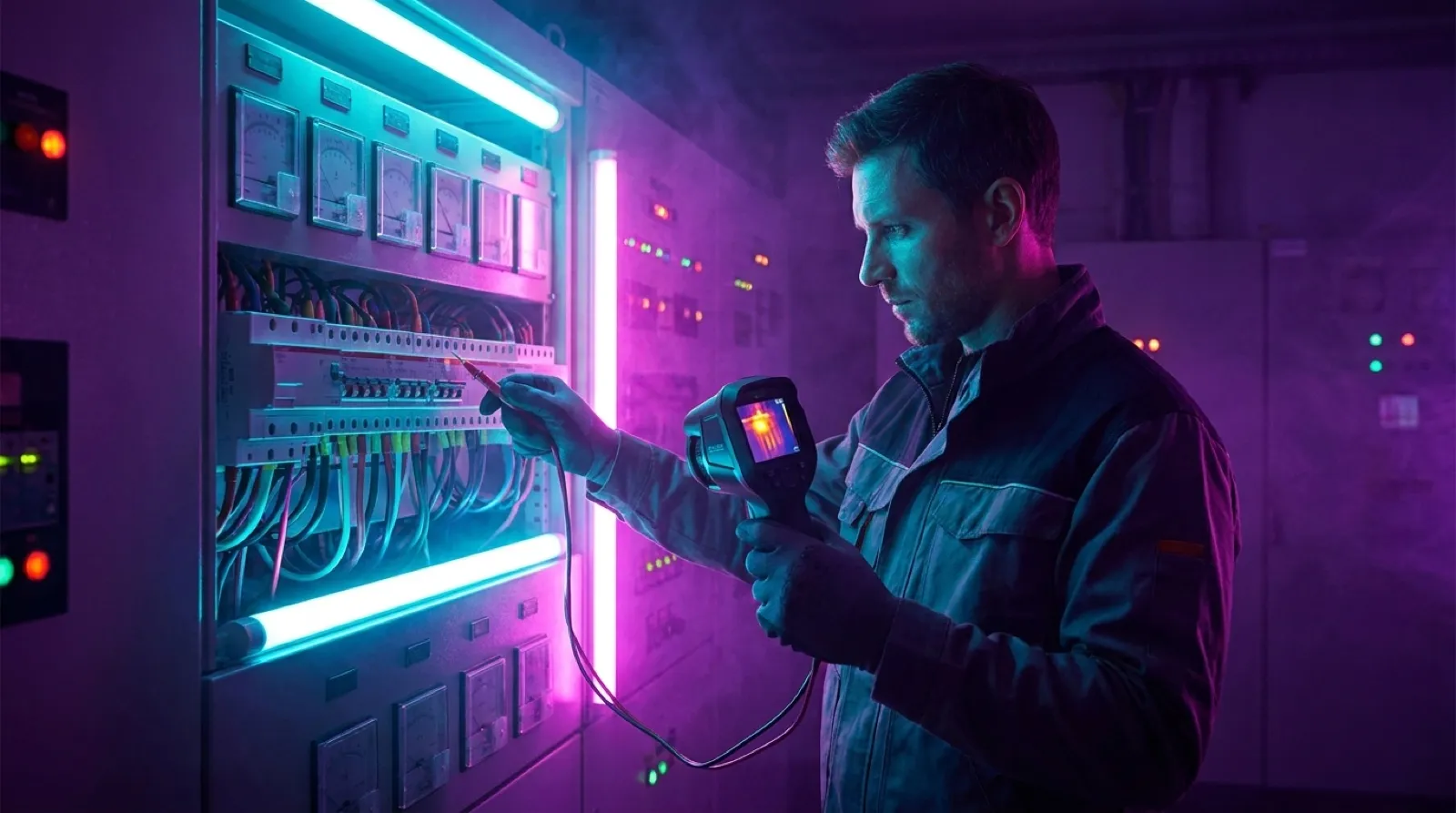
Thermal imaging is particularly valuable for intermittent faults with a thermal component. A connection that is running hot under normal load — because it is loose, corroded, or undersized for the current it is carrying — will show up as a hot spot on a thermal camera even when the fault has not yet become severe enough to cause a symptom. SynthWire uses thermal imaging at switchboards, in junction boxes, and at regularly loaded connection points to identify developing faults before they become emergencies. A loose neutral connection at a switchboard busbar that reads 45 degrees above ambient on a thermal camera is a fire risk that has not happened yet — finding it during a fault-finding investigation and tightening it before it fails is exactly what methodical diagnostics is for.
Insulation resistance testing and what the numbers actually mean
Insulation resistance testing — applying a DC test voltage (typically 500V or 1000V DC) to a cable with all connected equipment isolated and measuring the resistance between conductors and between conductors and earth — is one of the most valuable diagnostic tools in electrical fault finding. A healthy cable with intact insulation will show insulation resistance values in the hundreds of megohms to gigohms range. A cable with degraded insulation may show values in the single-digit megohm range, which means the insulation is present but no longer reliably preventing leakage current. A cable with a partial breakdown may show adequate resistance at room temperature but fail at elevated temperature — a fault type that thermal-cycle testing can trap. SynthWire interprets insulation resistance readings in the context of cable age, cable type, and installation environment, not simply as a pass/fail against a fixed threshold. An insulation resistance of 10 megohms in a 40-year-old cable run through a roof space with significant temperature cycling tells a different story to the same reading in a 12-month-old installation.
- Systematic current measurement with calibrated clamp meters to isolate overcurrent sources
- Insulation resistance testing at 500V and 1000V DC across all conductors in suspect circuits
- Earth leakage current measurement for RCD nuisance-trip diagnosis
- Thermal imaging of switchboards, junction boxes, and connection points for hot-spot detection
- Fault history review and environmental correlation analysis for intermittent faults
- AS/NZS 3000 compliant test and inspection reporting with root-cause documentation
- 24/7 emergency response for loss-of-supply and safety-critical faults
Frequently asked
No, and this is important: an RCD that trips and resets without an identified cause is telling you there is an active earth leakage path on its protected circuits. That leakage path might be a degraded appliance that poses a genuine shock risk, or cable insulation that has deteriorated to the point where it could fail completely under load. An RCD that trips repeatedly is doing its job — protecting you from a fault that exists somewhere in the system. The correct response is to find and fix the fault, not to keep resetting the device and hoping it stops. SynthWire can usually isolate the source of an RCD nuisance trip in a single diagnostic visit.
Treat these as emergencies requiring immediate attention: burning or melting smells coming from any electrical device, outlet, or switchboard; visible scorch marks or discolouration on electrical fittings; a safety switch or RCD that will not reset; flickering or dimming lights that are new and unexplained; any electrical device that sparks, makes unusual sounds, or feels hot to the touch; and loss of power to a significant portion of the building without an obvious cause. SynthWire operates a 24/7 emergency call-out service for Lic. EC-1985 and can dispatch for genuine emergencies. For faults that are inconvenient but not immediately dangerous — an outlet that has stopped working, a circuit that trips occasionally but resets — a booked appointment is appropriate.
In many cases, yes. Insulation resistance testing can confirm whether a cable has failed without knowing where the failure is located. Time-domain reflectometry (TDR) — a technique that sends a signal pulse down the cable and measures the reflection from an impedance discontinuity — can locate the approximate distance to a cable fault from the test point, which narrows down the area that needs to be opened. Thermal imaging can sometimes identify a hot fault location through plasterboard if the fault is generating significant heat. The combination of these techniques allows SynthWire to minimise wall damage by opening at the identified fault location rather than tracing the entire cable run. We will always tell you honestly what we can determine non-invasively and what requires opening the wall to confirm.