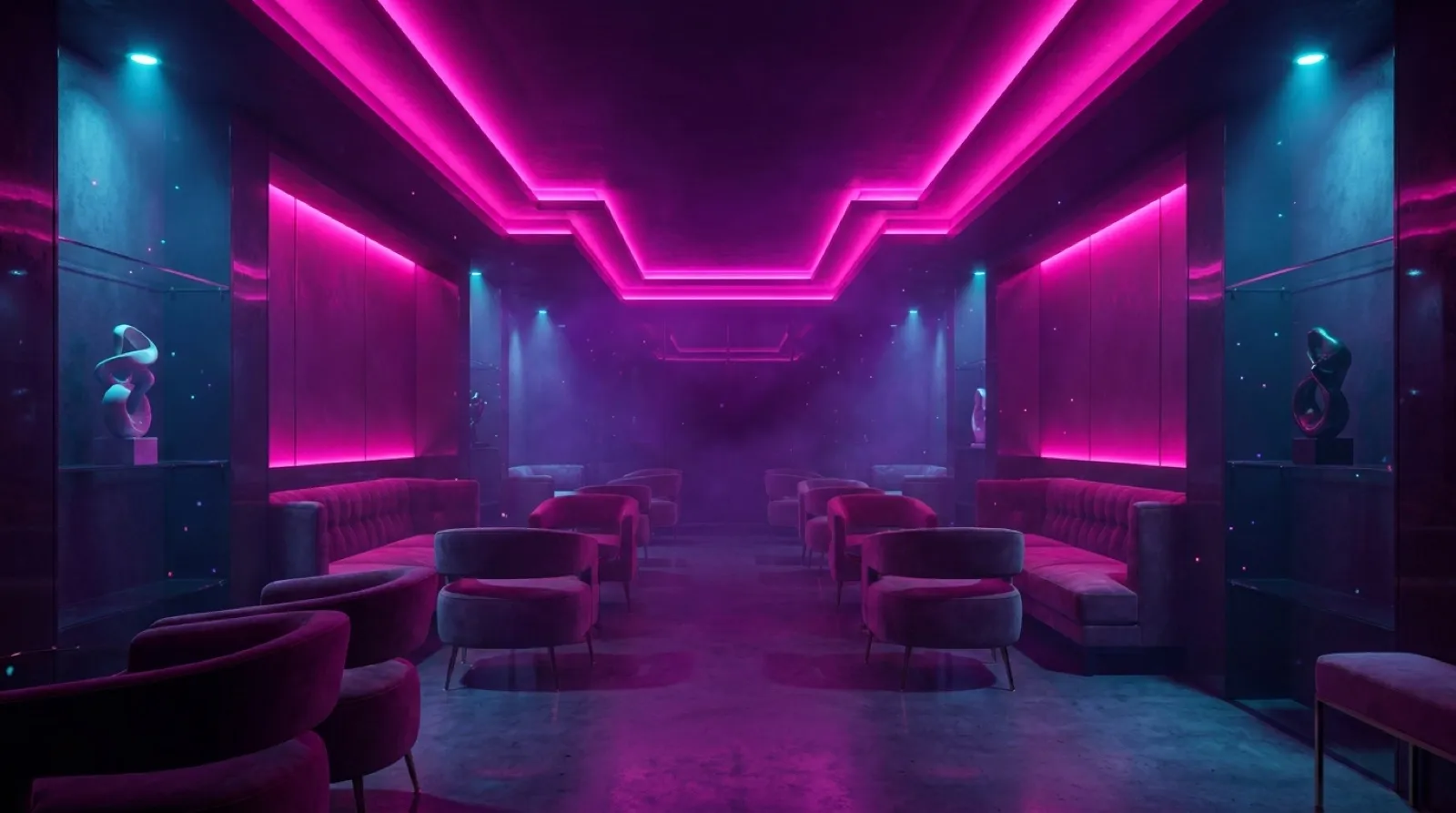
Walk into a beautifully lit room and you feel it immediately — even if you cannot articulate why. The warmth is right, the shadows fall in the correct places, the feature wall glows rather than glares, and the overhead downlights are not the only thing working. That quality of lighting does not happen by accident and it does not come from throwing a dozen downlights into a ceiling grid on 300mm centres. It comes from deliberate layering, careful colour temperature selection, and an installation that executes the design without compromise. SynthWire has been doing exactly that — across residential renovations, new builds, and commercial fit-outs — long enough to know what separates a lighting plan that photographs well from one that you actually want to live in.
The three-layer approach: ambient, task, and accent
Every room benefits from three distinct lighting layers working in concert. Ambient lighting is the general fill light — recessed LED downlights, a central pendant, cove lighting, or a combination — that establishes the base illumination level. Task lighting is targeted and functional: under-cabinet LED strips in the kitchen, a reading lamp wired to a bedside switched circuit, a desk lamp fed from a floor socket. Accent lighting highlights architecture, artwork, and texture — directional spotlights washing a feature wall, LED strips grazing brickwork, adjustable track lighting over a gallery hung with prints. When these three layers are independently switchable and dimmable, you can dial the room to suit any mood or activity. SynthWire designs the circuit layout to put each layer on its own switch leg or smart-scene zone so that control is intuitive and the electricals never dictate the design.
Dimming, colour temperature, and the LED selection process
Not all LED dimmers are compatible with all LED drivers, and not all LED downlights dim smoothly to zero — or at all. This is one of the most common complaints SynthWire hears from people who attempted their own dimmer installations: flickering at low levels, buzzing transformers, lamps that won't go below 30% before dropping out entirely. We spec the complete dimmer-to-lamp pathway before anything is ordered. That means matching the dimmer's minimum load rating and waveform type to the driver technology in the chosen fitting, testing a sample if the combination is unusual, and installing dimmers rated for LED loads — not legacy dimmers re-labelled.
Colour temperature is equally important and far more often overlooked. A 2700K warm white lamp in a living room creates a relaxed, incandescent-style ambience. The same room lit with 4000K cool white downlights looks clinical and flat. Kitchens and bathrooms typically suit 3000K–3500K — bright enough for task work, warm enough to be flattering. Artwork and feature walls generally want a tighter-beam fitting at 2700K to 3000K so colours render accurately. SynthWire will talk through colour temperature room by room so your choices are deliberate, not accidental.
Smart lighting and scene integration
Smart lighting systems — Lutron Caséta, C-Bus, DALI, Philips Hue via a proper wired bridge, or manufacturer-specific smart dimmers — allow scenes to be programmed and recalled with a single tap or a voice command. A 'movie' scene might drop the living room to 15% warm white while bringing the hallway to 50% for safe movement; a 'morning' scene might ramp the kitchen and dining to full over ten minutes. SynthWire installs the wiring infrastructure that smart lighting requires: neutral wires at switch points, clean home-run cabling back to a central processor where relevant, and data conduit for future expansion. We work alongside your AV or smart-home integrator or, where the scope is smaller, we commission simple standalone smart switches that your family can actually use without a manual.
Architectural and feature lighting techniques
Beyond the functional layers, SynthWire has a particular interest in the techniques that make architecture visible at night. Cove lighting — LED strip housed in a reveal or recess that bounces light off the ceiling — adds perceived height and warmth to any room with a flat ceiling. Pelmet lighting under kitchen overhead cabinetry eliminates the shadow cast across the bench by standard downlights. Wall-grazing with a narrow-beam adjustable spotlight set 150–200mm from a textured surface — stone, brick, timber cladding — pulls the texture into sharp relief and creates depth that no interior photograph can do justice. These are not expensive gimmicks; they are techniques that cost relatively little in materials when planned at rough-in stage, and they make a substantial difference to how polished the finished space looks.
- Three-layer lighting plans: ambient, task, and accent on independent circuits
- LED dimmer and driver compatibility selection — no flicker, no buzzing
- Colour temperature specification by room and application
- Smart lighting infrastructure wiring: neutral conductors, home-run cabling, data conduit
- Cove, pelmet, and architectural accent lighting techniques
- Energy modelling and LED upgrade retrofits for existing homes
Frequently asked
Almost always a compatibility issue between the dimmer's waveform and the LED driver inside the fitting. Many dimmers on the market are legacy phase-cut dimmers originally designed for resistive incandescent loads — they work poorly or not at all with certain LED driver topologies. SynthWire selects dimmers and lamps as a matched system before ordering, and we test any unusual combination. If you have existing flickering, we can diagnose the culprit and replace either the dimmer, the lamp, or both with a compatible pairing.
A quality LED downlight typically draws 7–10 watts compared to the 50-watt halogen it replaces — roughly an 80% reduction in energy consumed by that circuit. For a home with 30 to 40 halogen downlights running several hours a day, the annual saving is meaningful and the payback period on quality LED replacements is typically one to three years. SynthWire can model the expected saving for your specific fitting count and usage pattern before we price the upgrade.
In most cases, yes. Modern smart dimmers and smart switches often work with two-wire wiring — though we always check first, because some smart dimmer models do require a neutral conductor. Where neutrals are absent at switch points, there are workarounds: we can pull a new cable to selected switches, use smart dimmers designed to work without neutral, or install a smart relay at the fitting rather than the switch. We'll assess your existing wiring and recommend the most practical path to smart control without unnecessary cost.