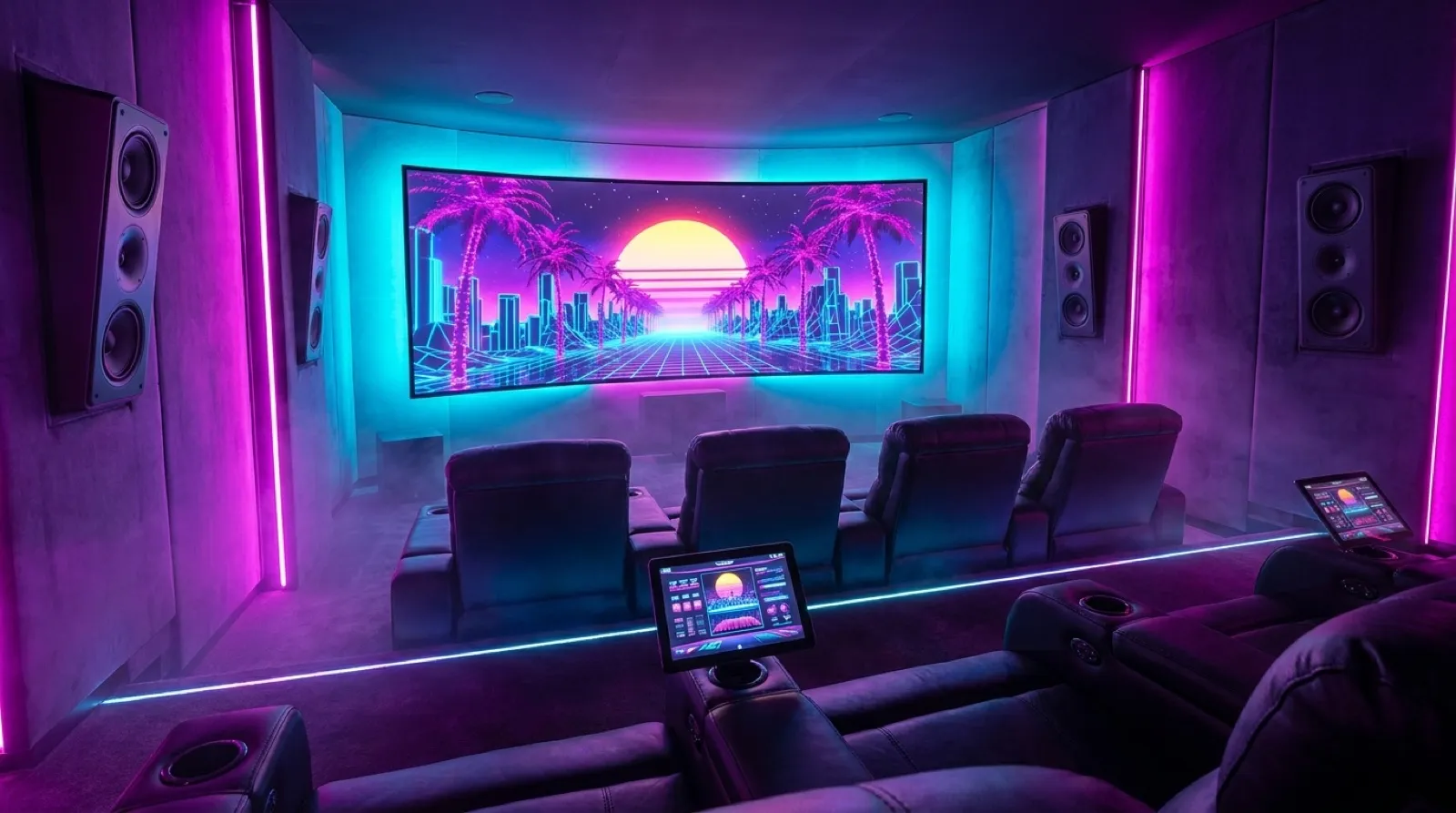
SynthWire has been wiring home theatres since the format was called 'the good TV room' and Dolby Pro Logic was the surround standard. We have watched the technology evolve from Laserdisc and CRT projection through the first generation of plasma panels, through the DLP projector era, through the OLED revolution, and into the current world of 4K laser projectors, 8K displays, Dolby Atmos height channels, and streaming bitrates that would have seemed absurd in 2005. Through all of that change, one thing has remained constant: the quality of the electrical and cabling infrastructure determines how close to the technology's actual ceiling the system performs. A $25,000 projection system on a dirty mains circuit with a shared earth, speaker cables run parallel to power cables, and HDMI runs pulled without attention to signal integrity is a $25,000 system performing like a $12,000 system. SynthWire exists to close that gap.
Dedicated clean power circuits and isolated earthing
The electrical supply to a high-performance AV system matters more than most people — and, frankly, more than many electricians — appreciate. The mains in a typical Australian home carries high-frequency interference from switching power supplies, variable-speed motor drives, LED driver circuits, and the neighbours' loads on the same transformer. That interference couples into the audio signal chain through shared earth paths, power supply regulation limits, and EMI conducted along the mains. The audible result is a background noise floor that manifests as hiss, hum, or an ill-defined quality that audiophiles call 'grunge' in the midrange — the sound of a system that is technically working correctly but not performing at its potential.
SynthWire addresses this at the source. We install a dedicated circuit from the switchboard for AV equipment — not shared with lighting, not shared with air conditioning, not shared with anything that generates switching noise. We run this circuit on a separate breaker with a clean earth conductor back to the board's earth bar. For serious two-channel or multichannel audio installations, we can install an isolation transformer at the AV rack that galvanically separates the system's supply from the mains earth, eliminating the path through which common-mode interference couples into the signal chain. These are not audiophile myths — they are electrical engineering applied to the problem of signal-to-noise ratio, and they produce audibly and measurably better results.
Cinema projection, screens, and display integration
A dedicated home theatre room is a different proposition to a media room with a large flat panel. SynthWire works with projection screens — fixed-frame acoustic screens (perforated to allow centre-channel and left/right speakers to sit behind the screen for phantom imaging), motorised tab-tensioned screens, and ultra-short-throw projection setups where the projector mounts on a low cabinet below the screen. We install projector ceiling mounts with the structural backing and conduit infrastructure to hide power, HDMI 2.1, and control cables completely — no surface-run cable loom hanging from the ceiling. Projection screen motor circuits are fed on dedicated switched supplies, and we ensure the control protocol (usually a simple 12V trigger or RS-232 command from the AV processor) is wired and tested before we hand over.
For flat-panel installations, SynthWire pulls power and all signal cables inside the wall cavity before the screen is mounted — leaving no visible cables on a finished wall. We fit a recessed cable management plate at screen height and a corresponding recessed outlet at floor level for the source equipment, giving a completely clean finish regardless of panel size. If the TV position is not on an internal wall with accessible cavity, we discuss the options honestly: surface conduit finished in matching wall colour, a feature wall built forward to create cavity, or a trunking solution that at least manages the cables neatly.
Surround sound, Atmos height channels, and acoustic basics
A properly configured Dolby Atmos or DTS:X system requires between five and thirteen discrete speaker positions depending on the object-based channel layout chosen — front left/centre/right, surround left/right, surround back left/right, and height channels that can be in-ceiling, on-ceiling, or Atmos-enabled upfiring modules on the main speakers. SynthWire installs in-wall and in-ceiling speakers with the correct backing boxes, pulls individually labelled speaker cable to every position (14 AWG or 12 AWG oxygen-free copper for main channels), and terminates every run at both the speaker position and the AV receiver or processor rack. No joins, no inline connectors, no speaker cable rolled up in the ceiling cavity. The cable run from amplifier output to speaker terminal is a direct, uninterrupted conductor — because every connector in that path is a potential failure point and a potential source of resistance and signal loss.
Acoustics are a separate discipline from electrical installation, but SynthWire understands enough of the fundamentals to make your room work better without a full acoustic consultant. The single most impactful change in most home theatre rooms is bass trapping in the corners — absorptive material that reduces the room modes that cause boomy, one-note bass response. We can advise on placement of acoustic panels relative to first reflection points for the main listening position, and we can recommend local acoustic treatment suppliers whose products are suited to residential installation. If the room is being purpose-built, we will discuss ceiling height, parallel wall treatments, and the benefits of a floating floor structure for mechanical isolation from the rest of the house.
Concealed cabling, AV rack infrastructure, and single-remote control
The mark of a professional home theatre installation is the absence of visible infrastructure — no cable loom, no power boards, no stacked equipment with tangled interconnects, no remote controls that need to be pointed at different equipment in different locations. SynthWire runs all speaker cable, HDMI, USB, network, IR, and control wiring inside wall cavities, ceiling spaces, and purpose-pulled conduit before finishes go on. AV equipment is rack-mounted in a dedicated rack cabinet — either in the theatre room itself or in an adjacent equipment cupboard for a truly clean aesthetic — with ventilated shelving, correctly rated power distribution, and cable dressing that a system integrator would recognise as professional work.
Single-remote control integration — Logitech Harmony, Control4, Crestron, Savant, or a simpler HDMI-CEC configured system depending on budget and complexity — means every function of the theatre is accessible from one device without pointing it at the rack. SynthWire installs the IR repeater infrastructure, the RS-232 and IP control wiring, and the discrete power sequencing circuits that ensure the system powers up and down in the correct order without user intervention. Projector first, then AV processor, then amplifiers — in sequence — so that the amplifiers never see an input signal appear before their reference voltage is established. This is the kind of operational detail that separates a professionally commissioned system from one that was just connected and switched on.
Calibration, commissioning, and handover
SynthWire does not consider a home theatre complete until we have run through system calibration with you in the room. For multichannel audio, that means running the AV receiver's automated room correction (Dirac Live, Audyssey MultEQ XT32, YPAO, or similar) and then reviewing the results manually — because automated room correction occasionally makes decisions that optimise for measurement rather than listening experience and benefit from a trained ear checking the output. For projection, it means setting throw distance and lens shift, calibrating the projector's grayscale and colour to a D65 target where the unit allows it, and setting the screen gain and room lighting conditions for maximum dynamic range. We walk through every function with you before we close out, and we leave documentation — a clear, labelled diagram of the system architecture, the IP addresses of any networked components, and the app login details for any remote-controllable devices — so that future servicing is straightforward regardless of who does it.
- Dedicated clean power circuits from switchboard with isolated earth for AV equipment
- Isolation transformer installation for serious two-channel and multichannel audio
- Projector ceiling mounts with fully concealed power, HDMI 2.1, and control cabling
- In-wall TV installation with recessed cable management — zero visible cables
- In-wall and in-ceiling speaker installation with direct, unjoined 12–14 AWG oxygen-free copper runs
- Dolby Atmos and DTS:X height channel wiring for 5.1.2 through 7.1.4 configurations
- AV rack build and cable dressing — structured, ventilated, and professionally terminated
- IR repeater, RS-232, and IP control wiring for single-remote system integration
- System calibration, power sequencing commissioning, and documented handover
Frequently asked
It does — and this is one of the more technically interesting aspects of high-performance AV installation. Mains-borne interference from switching power supplies, motor drives, and LED drivers couples into audio equipment through shared earth paths and power supply regulation limits. The audible result is a raised noise floor and a loss of fine detail retrieval in the midrange. A dedicated circuit with a clean earth conductor eliminates the shared-earth interference path; an isolation transformer goes further by galvanically separating the system's supply. These are measurable improvements in noise floor, not subjective audiophile belief — and on a high-resolution system, they are audible.
Infrastructure planning before the walls are finished is the honest answer. If we are involved at the rough-in stage of a build or renovation, we pull dedicated conduit for every cable type — HDMI, speaker, network, power, IR, control — from the equipment rack position to every device location, before plasterboard goes on. On existing construction, we work through ceiling cavities, wall cavities, and purpose-drilled conduit routes to achieve the same result, though it takes more time and planning. For flat-panel TVs we fit recessed cable management plates at screen height and floor level. For projection systems, the ceiling conduit from the projector mount to the rack position hides everything. The result in every case is a system with no visible cable runs — the way it should be.
At the simpler end: correctly configured HDMI-CEC between devices so that one remote powers and controls multiple components, plus IR repeater wiring if the equipment is in a closed cabinet. At the more sophisticated end: a dedicated control system (Logitech Harmony hub, Control4, Crestron, Savant) that communicates with every component via IR, RS-232, or IP, executes programmed macros ('watch a movie' powers the projector, switches the processor to the correct input, drops the screen, dims the lights, and sets the amplifiers to a preset volume in sequence), and puts all of that on a single app or touchscreen. SynthWire installs the wiring infrastructure for whatever control tier you choose and can commission systems from Harmony hub complexity through to full Control4 integration — or work alongside your preferred AV integrator if they are handling the control programming.