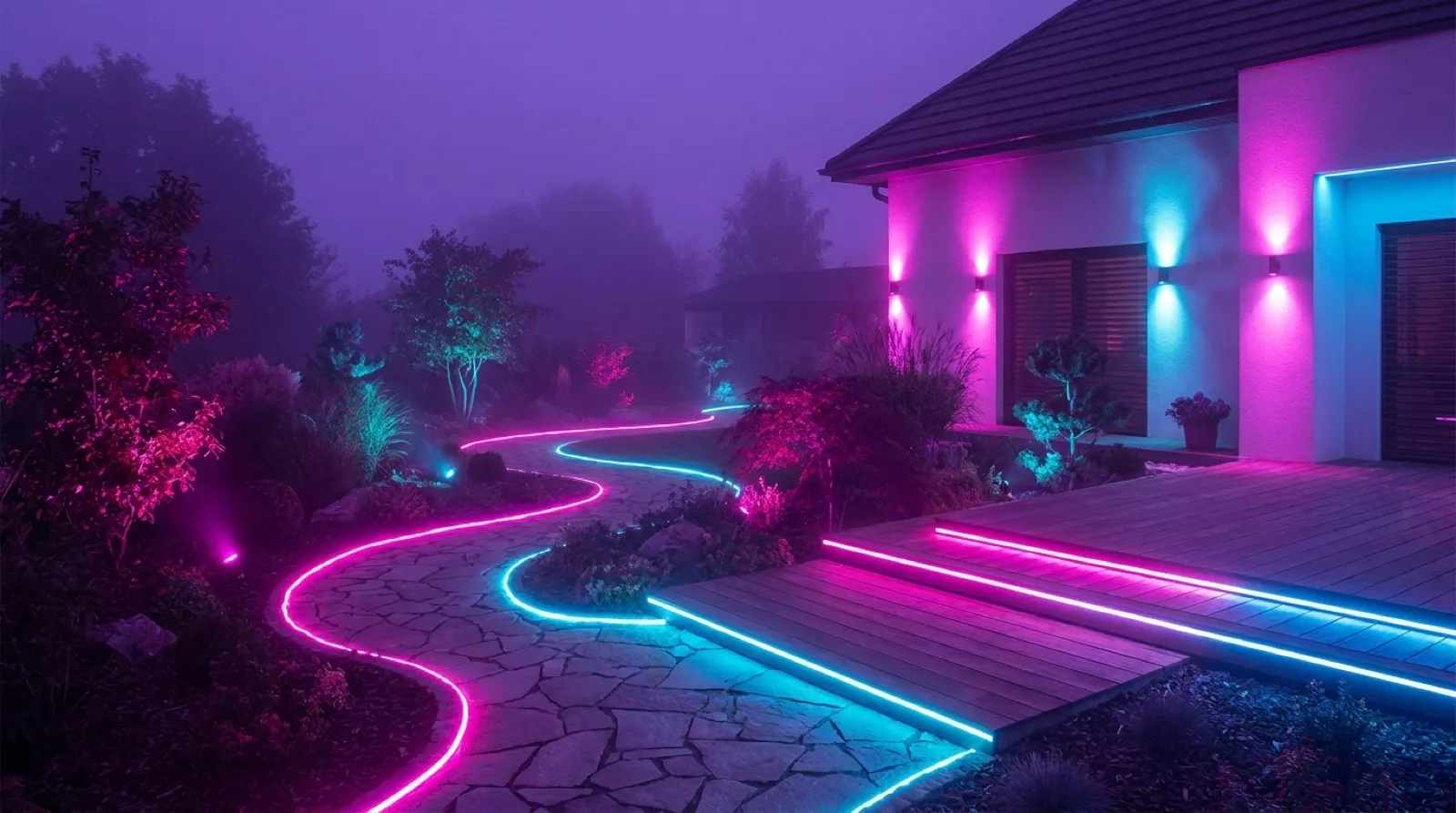
The Australian outdoors is not kind to electrical fittings. UV radiation, heat cycles, driving rain, coastal salt spray, insects seeking warm transformer enclosures, and the occasional pressure-wash from an enthusiastic home owner — outdoor lighting endures a punishment regime that indoor fittings would not survive a season of. SynthWire specifies only fittings and transformers rated for outdoor installation: IP65 as a minimum for exposed positions, IP66 or IP67 where direct water contact is likely (below-deck in-ground uplighters, for instance, or poolside wall fittings). Every outdoor circuit is protected by a residual current device, every cable is UV-stabilised or conduit-run, and every penetration through a wall or paving surface is correctly sealed. This is the baseline. What makes the difference between a serviceable outdoor lighting job and an exceptional one is the design that sits on top of that baseline.
Garden and path lighting — guiding movement and revealing planting
Path lighting serves two purposes that are easy to separate in theory but frequently confused in practice. The first is functional: illuminating the walking surface sufficiently that nobody trips on the front steps at 10pm. The second is aesthetic: revealing the planting, the texture of paving materials, and the geometry of the garden in a way that looks intentional and considered. The two purposes call for different fittings and different aiming angles. Low bollard fittings with a downward-directed beam handle the functional requirement without creating glare for approaching visitors. Separate directional spotlights or in-ground uplighters handle the aesthetic requirement — aimed at specimen plantings, statement rocks, or architectural elements that are worth highlighting. SynthWire plans both layers and wires them to separate control zones so you can run path guidance lighting all night on a timer while the decorative landscape lighting switches off at midnight.
Facade lighting and architectural kerb appeal
Facade lighting is one of the highest-impact, most cost-effective things you can do to a home exterior. Grazing a rendered or textured masonry wall with a narrow-beam uplighter reveals the texture and creates shadow depth that makes a plain front wall look genuinely architectural. Illuminating the eaves or soffit line gives the home a sense of mass and presence at street level. Up-lighting a feature tree in the front garden — particularly a sculptural species like a Japanese maple, a bird of paradise, or a well-shaped native — turns a dark corner of the front yard into a focal point visible from the street. SynthWire can run all of this from a single weatherproof outdoor sub-board, with circuits separated by zone and controlled via a photocell or a smart outdoor timer — on at dusk, off at a pre-set hour.
Deck, alfresco, and entertaining area lighting
Outdoor entertaining areas live or die by their lighting. A deck with a single bulkhead light is functional but uninspiring. The same deck with dimmable LED strip under the handrail cap, recessed step lights in the risers, a pendant or two over the outdoor dining setting, and a pair of directional spotlights washing the fence-line planting becomes somewhere you genuinely want to spend an evening. SynthWire wires alfresco and deck lighting systems with the same layered philosophy applied indoors — ambient, task, and accent — and ensures every circuit is on an RCD, every fitting is IP-rated for the exposure category, and dimmers are specified for LED loads. Festoon lighting systems are a popular addition to pergolas and alfresco frames; we install the weatherproof outdoor GPOs or dedicated circuits that feed them cleanly, without extension leads running across decking.
Low-voltage systems, transformers, and automation
Many garden and path lighting systems operate at extra-low voltage — typically 12V DC or 12V AC — stepped down from mains by a weatherproof transformer. This is inherently safer for environments where children and pets are moving around garden bed cables, and it opens up a wide range of low-voltage garden fittings unavailable in mains-voltage form. SynthWire sizes low-voltage transformers correctly for the connected load — an undersized transformer runs hot, shortens its own service life, and causes early LED driver failure in the fittings. We also set up photocell or timer automation so your outdoor lighting switches itself on at dusk and off at a pre-set hour without manual intervention. If you want to include outdoor lighting in a broader smart-home automation system, we can wire accordingly and coordinate with your home automation installer.
- IP65 to IP67 rated fittings specified for Australian outdoor exposure conditions
- Garden and path lighting: separate functional and aesthetic zones on independent circuits
- Facade and architectural uplighting for kerb appeal and feature reveal
- Deck and alfresco layered lighting: handrail strip, step lights, pendant feeds, spotlights
- Low-voltage transformer sizing and installation for garden systems
- Photocell and timer automation, smart outdoor controller integration
Frequently asked
It depends on the exposure level. A fitting under a deep verandah with minimal direct rain exposure can get away with IP44 in some cases, but SynthWire specifies IP65 as the practical minimum for any external fitting with any weather exposure — it's the threshold for dust-tight and protected against water jets from any direction. For in-ground uplighters, below-deck fittings, or poolside installations, we specify IP66 or IP67. Underrated fittings in exposed positions is the single most common cause of early outdoor lighting failure in the Australian climate.
Considerably safer than mains-voltage systems in garden bed environments. Extra-low voltage (12V) garden systems operate below the threshold of danger for incidental contact, which matters when children or pets might encounter a cable at ground level. The transformer itself operates at mains voltage and must be correctly installed and weatherproofed by a licensed electrician — SynthWire handles that component properly. The low-voltage cable running through the garden is a safe-to-touch system once the transformer is in place.
Absolutely. The simplest and most reliable option for most homes is a photocell dusk-to-dawn sensor with a programmable timer relay — no app required, no Wi-Fi dependency, reliable for years. For integration into a broader smart-home platform, we wire outdoor circuits to smart outdoor switches or relays compatible with your chosen system (Google Home, Apple HomeKit, Control4, and similar). We can also discuss mid-tier options like Clipsal Iconic smart switches for outdoor GPOs that give you app and schedule control without a full automation system.