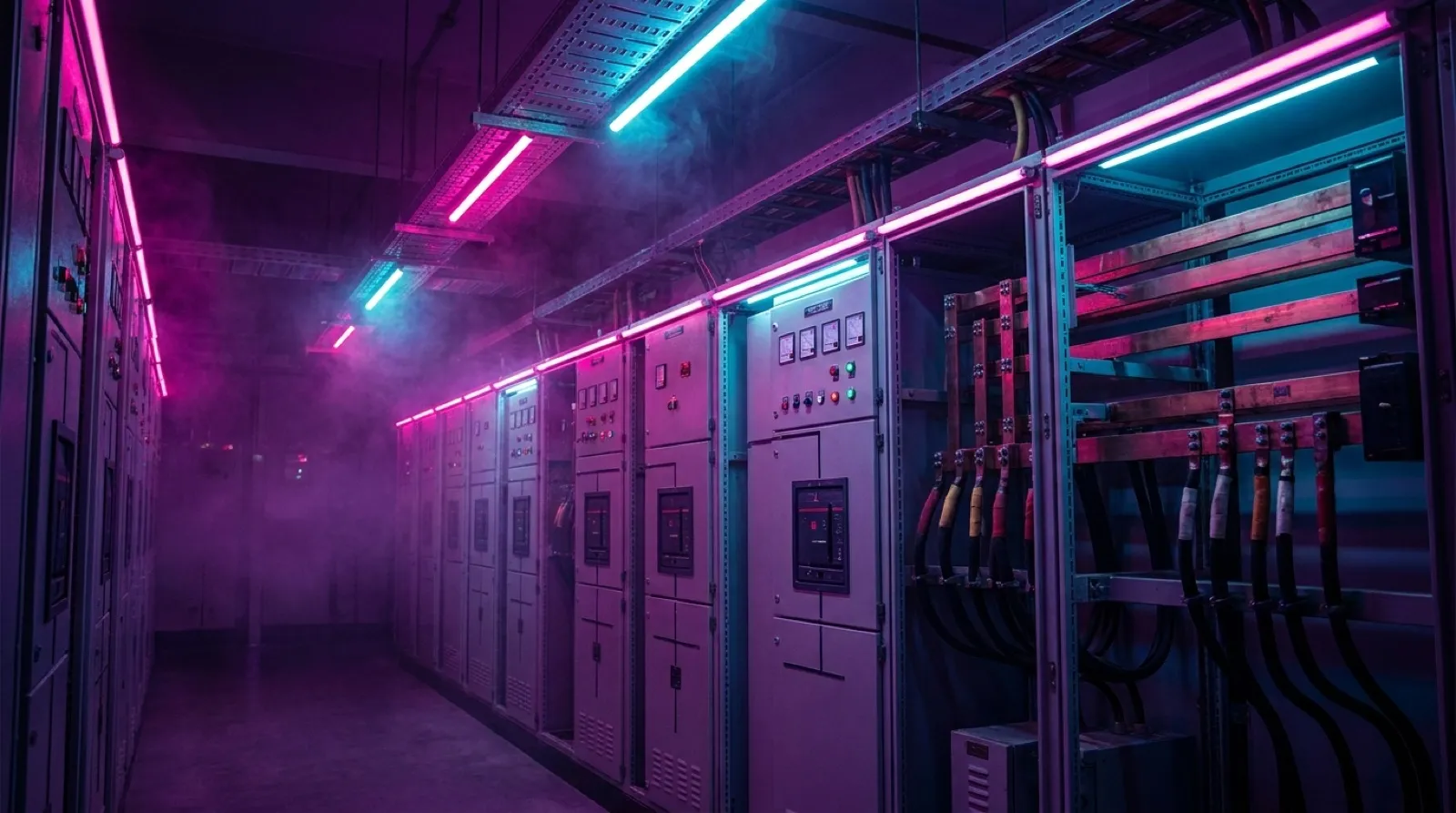
Industrial electrical is not scaled-up domestic work. It is a distinct discipline with its own standards, hazards, and engineering demands. SynthWire Electrical (Lic. EC-1985) works in manufacturing facilities, food processing plants, water and waste utilities, mining support facilities, and heavy fabrication workshops. We do not sub-contract the difficult parts — our licensed electricians are on the tools from switchroom design through to machine commissioning, and we hold full insurance cover for industrial environments. Every installation is documented, labelled, and handed over with the drawings and test records the site will need for ongoing maintenance.
Switchroom design and installation
A well-designed switchroom is the backbone of a safe industrial facility. Main high-voltage switchgear, transformers, sub-distribution boards, and bus-duct interconnections need to be laid out for safe access, logical circuit segregation, and thermal performance under sustained load. SynthWire works from electrical schematic drawings — our own or those supplied by your electrical engineer — to build out switchrooms that meet AS/NZS 3000 and the specific requirements of your equipment manufacturers and insurer. Busbar sizing, cable routing in cable tray and conduit, earth fault protection co-ordination, and arc-flash risk assessment are all part of how we approach a switchroom build. We do not cut corners on protection co-ordination — a fault that cascades through an improperly graded protection system is a production disaster.
Motor control centres and variable speed drives
Motor Control Centres (MCCs) are among the most common industrial electrical installations and among the most often poorly executed. Undersized control cable, incorrect overload relay settings, and missing interlocks create reliability problems that production teams live with for years without knowing they can be fixed. SynthWire builds and commissions MCC panels from free-standing enclosures, specifies and installs Variable Speed Drives (VSDs) for pump and fan applications, and carries out the commissioning documentation — motor direction checks, no-load and full-load current measurements, overload relay setting records — that turns an installation into a maintainable asset. We also retrofit soft-starters and VSDs to existing motor circuits where reduced starting current or speed control will improve process efficiency or power quality.
Machine power, control wiring, and PLC interfacing
New machinery arriving on your floor needs a dedicated power circuit designed for its actual demand, not a generic outlet. We work from the machine manufacturer's electrical data sheet to specify the correct cable size, protection rating, and isolator type, then install the supply to the correct point on the machine's incoming terminals. For production lines and automated plant, we carry out control wiring between PLCs, I/O modules, field sensors, and actuators. Our electricians are experienced reading and marking up control drawings, and we test every I/O point before handover. We do not program PLCs — that is a specialist automation discipline — but we install and terminate the electrical infrastructure correctly so the automation contractor or your own production engineers can work from a solid foundation.
Uptime, safety, and electrical isolation procedures
Industrial plant runs on uptime. Every hour of unplanned downtime has a real cost, and the risk of electrical fault in a high-load environment compounds that with safety consequences. SynthWire works within site-specific electrical isolation procedures (lockout/tagout) as a matter of course — we do not energise equipment without written isolation authority, and we do not leave a site with temporary arrangements in place. All fault-finding on live equipment is carried out only where necessary and only by qualified personnel using appropriately-rated PPE and test equipment. We also carry out thermal imaging surveys of switchboards and MCCs, which identify failing connections and overloaded components before they become fires or process shutdowns.
Hazardous area and classified zone electrical work
Facilities that handle flammable gases, vapours, dusts, or fibres are required under Australian Wiring Rules and AS/NZS 60079 to install electrical equipment that is appropriately rated for the classified zone. SynthWire installs and inspects electrical equipment in Zone 0, Zone 1, Zone 2, Zone 20, Zone 21, and Zone 22 classified areas, including explosion-protected luminaires, Ex-rated motors and junction boxes, and intrinsically safe instrumentation circuits. Zone classification must be carried out by a suitably qualified person — we work with your safety engineer or EPC contractor on the classification documentation before any installation begins.
- Switchroom and sub-distribution board design and installation
- Motor Control Centre (MCC) build, installation, and commissioning
- Variable Speed Drive (VSD) and soft-starter installation
- Machine power supply circuits and electrical terminations
- Control wiring and PLC I/O field terminations
- Thermal imaging surveys of switchboards and cable terminations
- Hazardous area electrical installation and inspection (AS/NZS 60079)
- 24/7 industrial fault response and emergency call-out
Frequently asked
Planned shutdown work — often weekend or overnight — is a routine part of our industrial project schedule. We staff appropriately for shutdown work, carry out pre-shutdown planning meetings to co-ordinate with your maintenance and production teams, and work to defined isolation and reinstatement procedures. All work is tested before the plant returns to service and documented before our crew leaves.
Industrial installations are handed over with insulation resistance test results, earth continuity measurements, protection relay setting records, motor commissioning data sheets (no-load and full-load current, direction confirmation, overload relay settings), and marked-up as-built drawings. Where thermal imaging surveys are carried out, we provide a written report with thermographic images, defect severity ratings, and a prioritised remediation list.
Our industrial electrical licence covers low-voltage work to the AS/NZS 3000 boundary — typically the secondary side of the site transformer. High-voltage (above 1 kV) switching and maintenance work requires a separate HV electrical licence and is a specialist discipline. Where HV switching is required to isolate equipment for our low-voltage work, we co-ordinate with your site's licensed HV electrical worker or the DNSP's switching crew.