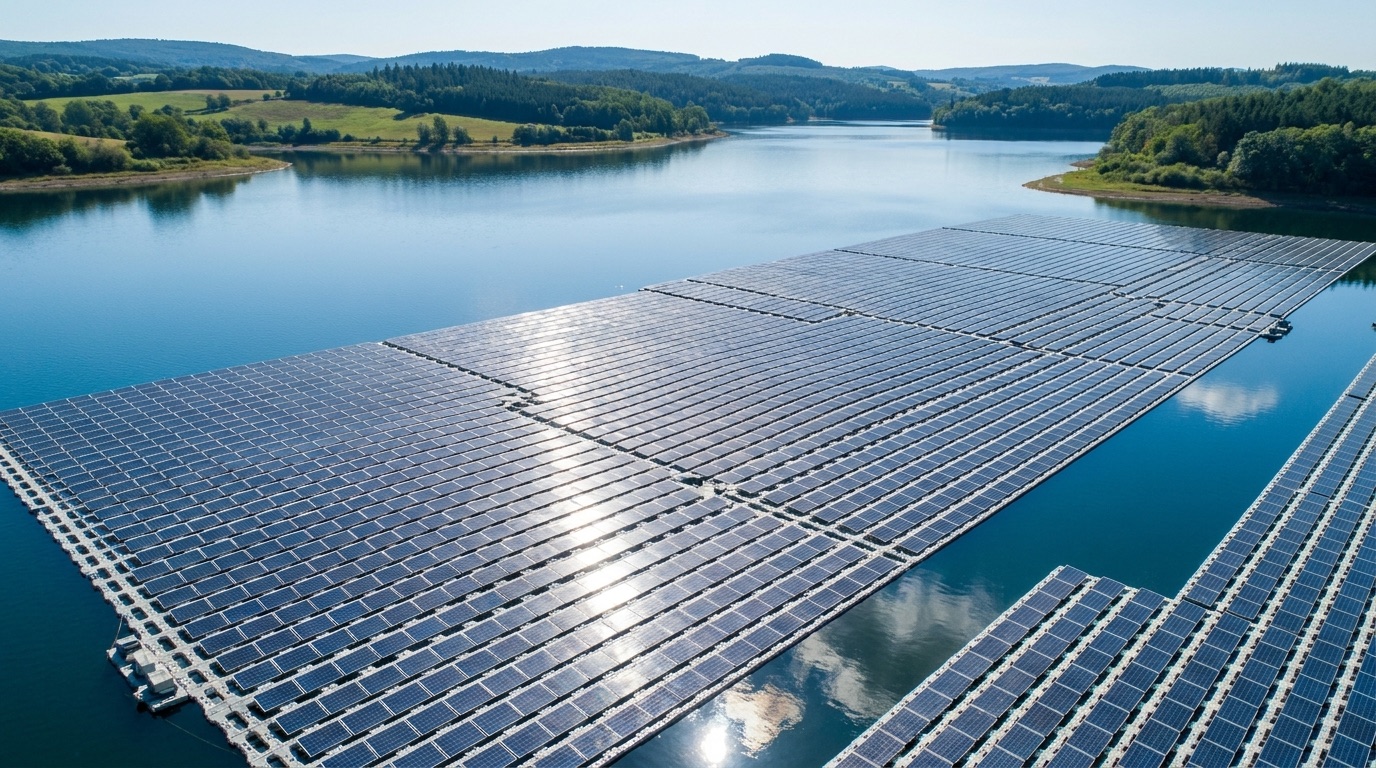
Floating solar — commercially known as floatovoltaics or FPV — has moved from niche pilot project to proven utility-scale technology. Global installed capacity exceeded 5 GW before 2023 and is accelerating as land constraints, environmental approvals, and agricultural competition make conventional ground-mount development increasingly difficult. For industrial operators with tailings ponds, process water reservoirs, irrigation storages, or wastewater treatment lagoons, floating solar transforms a passive water asset into a generation asset — without disturbing the land, the water body's function, or the surrounding environment.
Engineering for Water Environments
Floating solar is not ground-mount solar bolted to a pontoon. The structural, electrical, and materials engineering required for a reliable 25-year asset on water is substantially more demanding than its land-based equivalent. Float modules must resist UV degradation, salt spray, algal fouling, and cyclic loading from wave action and water level variation. Anchoring systems must accommodate drawdown cycles of metres without imposing fatigue loads on cables or float connections. Electrical systems must be rated for the wet and humid environment inherent to a water surface installation.
- HDPE float module systems rated to UV exposure Class A and minimum 25-year design life with zero structural metal in the water column
- Anchoring systems designed for site-specific soil conditions, water depth, and drawdown range — concrete block, helical pile, or driven anchor depending on bathymetry
- Marine-grade cable management with double-insulated, UV-stabilised submersible-rated DC cabling throughout
- Inverter and AC electrical equipment located onshore or on elevated floating platforms above maximum flood level
- Bifacial module selection to capture reflected irradiance from the water surface — typically 8–12% additional yield
- Integrated water quality monitoring to demonstrate compliance with evaporation, temperature, and dissolved oxygen obligations
- Modular design enabling phased installation and future capacity expansion without full system disconnection
Yield Advantages of Floating Arrays
Panels on water run cooler than panels on land. The evaporative cooling effect of the water surface below the array suppresses module temperature by 5–15°C under high-irradiance conditions. Since photovoltaic output declines approximately 0.35% per degree Celsius above the standard test condition temperature, this consistently translates to 5–15% higher energy yield compared to an identical array on a ground-mount structure. Over a 25-year asset life, that yield differential is material to project IRR.
Simultaneously, the shading effect of floating panels reduces evaporative water loss from reservoirs and storages — a significant operational benefit for agricultural water authorities, mine site water management, and municipal utilities in water-stressed regions. Studies across multiple climates have demonstrated 20–33% reduction in surface evaporation under covered-array conditions. In some jurisdictions, this water saving can be monetised through water entitlement mechanisms.
Permitting, Environmental Approvals, and Grid Connection
Floating solar projects intersect with water resource legislation, environmental assessment frameworks, and grid connection processes simultaneously. Apex Grid's development team has navigated EPBC Act referrals, state water authority licence amendments, and DNSP grid connection works approval processes for FPV projects ranging from 500 kW on agricultural irrigation dams to 50 MW on industrial process water storages. We manage the full development pathway, including pre-application community engagement, environmental impact assessment, grid connection pre-study, and AEMO registration — so your team receives a commissioned, energised asset, not a partially approved development application.