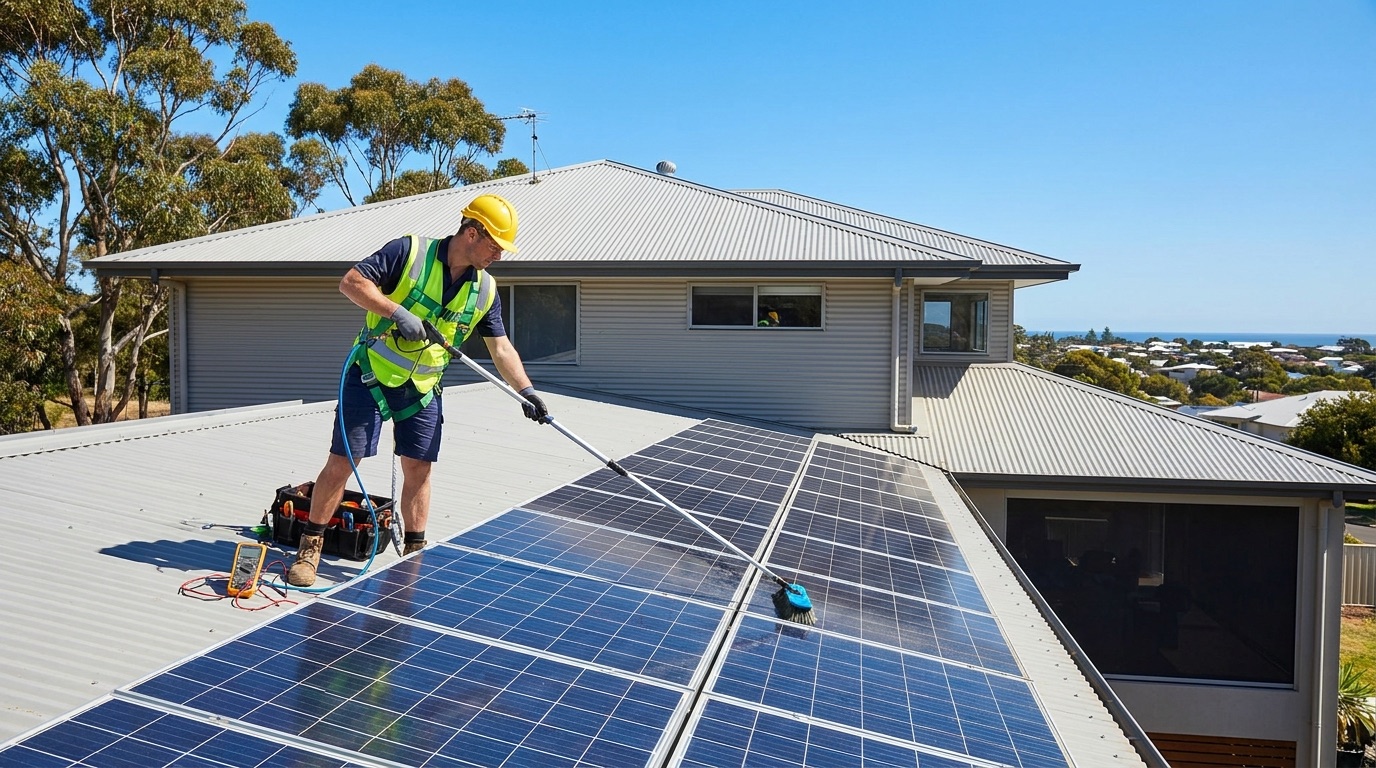
Solar PV installations do not maintain themselves. Inverter firmware drifts, DC string fuses blow silently, soiling accumulates at non-uniform rates across a large array, and module degradation proceeds faster than the manufacturer's warranty curve when cells are operating under elevated temperature stress. Each of these factors reduces your system's energy yield — quietly, without triggering an alarm, and without appearing on your monitoring dashboard until the loss is already material. An Apex Grid O&M contract is an active engineering service, not a scheduled inspection tick-box. We operate against a documented performance baseline and are accountable to it.
Performance Monitoring and Loss Analysis
Apex Grid's monitoring platform ingests inverter telemetry, string-level current data, on-site irradiance and temperature measurements, and grid export records at 5-minute intervals. Our performance analysis engine compares actual generation against a modelled energy yield baseline derived from PVsyst simulation, real-time irradiance data, and equipment performance specifications. Deviations above a defined threshold trigger automated alerts for engineering review. We distinguish between weather-driven under-performance, soiling losses, shading events, inverter faults, and module degradation — because each requires a different response and has a different priority in the maintenance schedule. Treating all losses as equivalent leads to wasted corrective maintenance spend and unresolved systemic issues.
The performance baseline matters as much as the monitoring. Apex Grid establishes a site-specific PVsyst energy yield model calibrated against your array's actual orientation, tilt, module specifications, and local shading geometry at the commencement of every O&M contract. This model is the reference against which all performance deviation is measured. Where the monitoring identifies a persistent loss that cannot be resolved through maintenance — such as incremental module degradation above the warranted rate — we initiate the warranty claim process on your behalf, managing the manufacturer's technical review and replacement logistics.
- Continuous inverter and string-level monitoring via cloud-connected SCADA at 5-minute data resolution
- Monthly performance ratio (PR) reporting benchmarked against IEC 61724 reference yield methodology
- Thermal imaging surveys using calibrated drone-mounted infrared cameras — identifies hot cells, delamination, and bypass diode failures invisible to electrical monitoring
- I-V curve tracing and string resistance testing to isolate degraded modules and connection losses
- Inverter preventive maintenance including capacitor condition assessment, cooling system inspection, and firmware management
- Soiling loss quantification and cleaning programme optimisation based on rainfall data and irradiance monitoring
- Vegetation management and shading encroachment assessment for ground-mount installations
Inverter and Equipment Management
Inverters are the most failure-prone component in a solar PV system and the most consequential: a single central inverter fault on a 500 kW system can halt generation entirely until a field response is dispatched. Apex Grid maintains field stock of critical inverter spare parts — including capacitor banks, IGBT modules, and control boards — for the major inverter brands we service, minimising repair cycle time from fault detection to restoration. For sites operating central inverters with end-of-life power electronics, we provide proactive component replacement scheduling that avoids mid-summer failure events when generation revenue is at its peak and replacement parts lead times are longest.
String inverter and optimiser-based systems require a different maintenance approach: the fault is not a total generation outage but a partial loss event that can persist undetected for months without granular monitoring. Our string-level current monitoring identifies non-producing or underperforming strings within a single monitoring interval, and our field technicians carry portable I-V curve tracers and insulation resistance testers to diagnose and resolve string faults on the same site visit wherever possible. We track mean time to resolution (MTTR) for all corrective maintenance events as a KPI within our O&M reporting.
Performance Guarantees and Contract Structures
Apex Grid offers performance-based O&M contracts structured around a contracted Performance Ratio and system availability threshold. Where the system under-performs against contracted targets due to factors within our scope of maintenance, we provide financial compensation quantified against your applicable energy tariff or PPA rate. This aligns our engineering team's incentives directly with your financial outcome — we are not paid to visit your site, we are paid to keep it generating. Contracts are available from 12 months, with multi-year terms offering reduced annual pricing in exchange for long-term programme certainty.
All O&M contracts include scheduled preventive maintenance visits, unlimited corrective maintenance callouts within SLA response windows, and annual thermal imaging surveys as standard inclusions. We do not use tiered response structures that leave your lowest-priority callout waiting weeks for a site visit. Every fault on an operating solar installation is degrading your financial return — it gets a response under contract, not a place in a queue. Our quarterly performance reports give your finance and sustainability teams the granular data needed for PPA compliance reporting, LGC registry reconciliation, and ESG disclosure obligations.