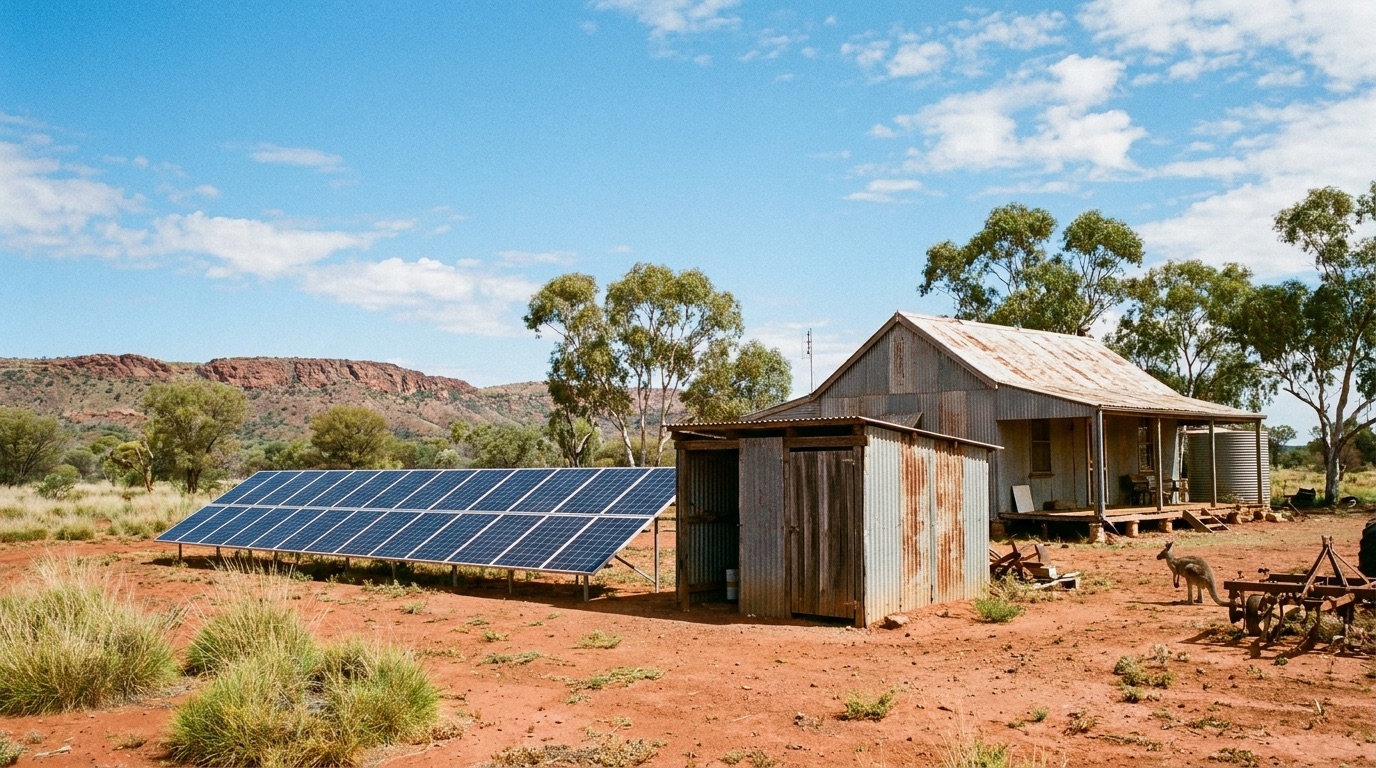
Diesel generation is expensive, logistically complex, and environmentally unsustainable — but for remote sites, it has historically been the only option capable of providing reliable, dispatchable power independent of grid infrastructure. The convergence of utility-grade solar, lithium battery storage, and advanced microgrid controllers has changed that calculus entirely. A correctly engineered solar-plus-storage microgrid can now provide grid-equivalent power quality and supply availability at sites where grid connection is either technically infeasible or economically unjustifiable. Apex Grid engineers these systems to the same standards we apply to grid-connected infrastructure — because at a remote site, reliability is non-negotiable and the cost of a supply failure extends well beyond the value of ungenerated power.
Microgrid Architecture and Component Integration
An Apex Grid off-grid microgrid begins with a load characterisation study that maps your site's consumption by circuit, time of day, season, and criticality. From this load profile we size the solar generation array, battery storage system, and backup generation capacity to meet a defined supply availability target — typically 99.5–99.9% uptime — under P90 solar irradiance conditions. System architecture options include pure solar-battery islanded systems for sites with stable load profiles and sufficient irradiance; solar-battery-diesel hybrid systems where critical load continuity requires dispatchable backup; and multi-bus microgrid configurations for large industrial campuses with distinct critical and deferrable load categories. The choice of architecture determines both your capital cost and your ongoing operational cost profile for the next 20 years.
Grid-forming inverter selection is one of the most consequential engineering decisions in an off-grid microgrid design. Unlike grid-following inverters, grid-forming inverters must synthesise the voltage and frequency reference for the entire microgrid — a function normally performed by the transmission network. Apex Grid specifies and commissions grid-forming inverters from proven utility-grade manufacturers, configures droop control parameters to maintain frequency stability under step-load events, and validates black-start capability as part of the commissioning protocol. This is not a software setting — it is a protection engineering process.
- Load characterisation study with critical load segregation and demand priority scheduling
- P50/P90 solar resource assessment using satellite irradiance data and on-site measurement campaigns
- Battery energy storage system sizing to defined autonomy periods under design load scenarios
- Microgrid controller specification and commissioning — including grid-forming inverter configuration and black-start capability
- Seamless islanding and grid-reconnection logic compliant with IEEE 1547 and AS 4777 standards
- Backup generator integration with automatic transfer switching and priority dispatch hierarchy
- Remote SCADA and NOC monitoring with autonomous fault response and operator alarm escalation protocols
Diesel Displacement and Fuel Cost Reduction
For sites currently operating diesel generation sets, the financial case for solar-hybrid microgrid conversion is driven by fuel cost displacement. Remote sites commonly pay $0.80–$2.50 per litre for diesel delivered to site, producing electricity at an effective cost of $0.40–$0.90 per kWh before accounting for maintenance, generator capital replacement, and logistics management overhead. A solar-battery hybrid system engineered to achieve 70–90% diesel displacement can reduce site energy costs by 50–75% on a total lifecycle basis, with project IRRs in the range of 15–25% depending on fuel price exposure and site load factor. Apex Grid's financial modelling is built on your actual fuel invoices and consumption records — not industry averages applied to a generic load profile.
For greenfield sites where grid connection quotes have been received, we routinely demonstrate that a solar-hybrid microgrid delivers lower levelised cost of energy (LCOE) than grid connection augmentation where the grid connection cost exceeds approximately $800,000 — a threshold reached at distances of roughly 3–5 km from existing infrastructure, depending on network voltage level. We provide the comparative LCOE analysis as part of every scoping study, giving your capital approvals committee a defensible, engineer-signed basis for the energy supply decision.
Autonomous Operation and Remote Monitoring
Off-grid sites cannot depend on on-call electricians or manual generator starts. Apex Grid's microgrid control systems are engineered for fully autonomous operation under all foreseeable operating conditions — including extended cloud cover, unexpected load spikes, battery cell anomalies, and inverter faults. The control system executes a pre-defined dispatch hierarchy that prioritises solar, draws from storage, starts backup generation as required, and sheds non-critical loads before allowing critical loads to be at risk of supply interruption. All system state changes are logged and transmitted via satellite or cellular link to our NOC, where anomaly detection algorithms flag developing faults before they escalate to outage events.
Remote monitoring is not a dashboard — it is an engineering service. Apex Grid's NOC team includes power systems engineers who review anomaly alerts and distinguish between a genuine fault condition requiring field dispatch and a transient event that resolved autonomously. This triage layer prevents both missed faults and unnecessary field mobilisation. Every site on our monitoring network has a documented emergency response procedure and escalation matrix, updated annually, so that any event outside the autonomous control envelope has a defined human response pathway regardless of time zone or day of week.