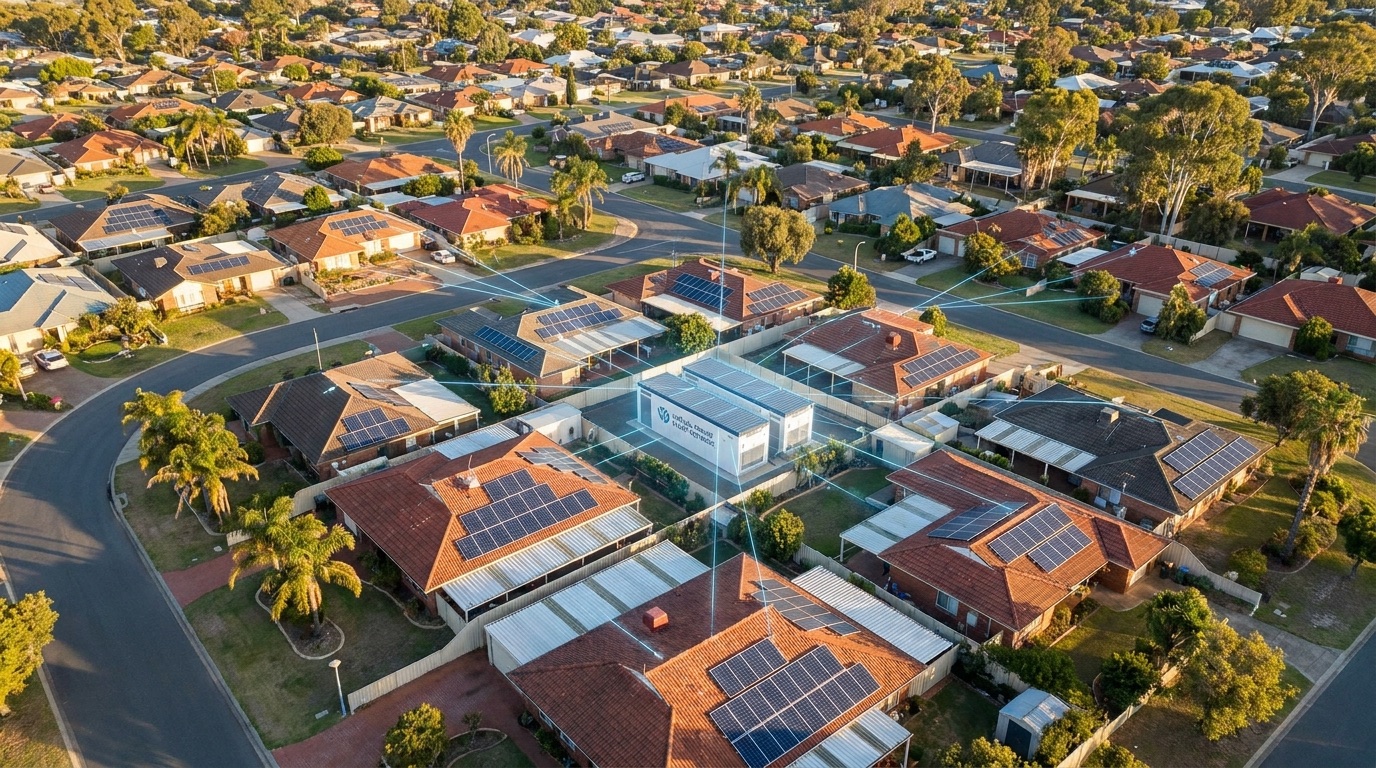
Individual rooftop solar and battery assets are each too small to participate directly in Australia's National Electricity Market. A single 10kWh residential battery cannot register as a generating unit with AEMO, cannot bid into the FCAS market, and cannot contract with a network operator for voltage support. A Virtual Power Plant solves this constraint by aggregating hundreds or thousands of distributed energy resources (DERs) behind a single control and registration layer that bids into the wholesale energy market and FCAS markets as a single coordinated unit. The aggregate looks, from the grid's perspective, like a dispatchable power station with fast response characteristics that synchronous generation cannot match. From the participant's perspective, it is a passive revenue stream from hardware they already own.
How the Apex Grid VPP Platform Works
Apex Grid operates a cloud-based VPP orchestration platform that communicates with enrolled inverters and battery management systems via direct API integration or AS 4777.2 Demand Response Mode (DRM). The platform polls asset state — state of charge, available export capacity, current household consumption, and grid connection status — at sub-minute intervals across the enrolled fleet. Dispatch instructions are issued to the aggregated fleet in response to AEMO dispatch signals, FCAS contingency events triggered by generation or load separation events on the NEM, or network support requests from the local distribution network service provider. Each enrolled site operates under a participant-defined constraint envelope: the platform applies individual site load reservation thresholds to ensure no household drops below its minimum power floor before dispatching grid support from that asset.
- Direct API integration with SolarEdge, Fronius, SMA, Sungrow, GoodWe, Enphase, and Tesla Powerwall platforms
- AS 4777.2 Demand Response Mode (DRM) compatibility for CEC-approved inverter models without API integration
- AEMO registration as an Aggregated Demand Response provider and Market Ancillary Service Provider
- Sub-minute state-of-charge telemetry and availability polling across the full enrolled fleet
- Participant load reservation logic — household consumption floor is enforced before any VPP dispatch event
- Revenue allocation engine distributing metered market earnings to participants on a per-kWh-dispatched basis
- Participant portal with real-time dispatch event visibility, monthly earnings statements, and cumulative revenue dashboard
Revenue Streams and Participant Economics
VPP participation generates revenue from two primary NEM market mechanisms: wholesale energy market dispatch during high-price intervals — including the increasingly frequent spike events driven by renewable intermittency — and FCAS market participation, particularly in fast frequency raise contingency services where battery response speed creates a structural competitive advantage over slower thermal plant. Apex Grid's dispatch algorithm co-optimises bids across both revenue streams in every 5-minute dispatch interval, balancing state of charge preservation against immediate market opportunity. Revenue is allocated to participants on a metered per-kWh-dispatched basis and paid monthly, net of the platform management fee. Enrolled participants on a typical 10kWh residential battery have received between $200 and $800 per year in VPP revenue, with variance driven by battery cycling frequency, available FCAS market capacity, and wholesale price events in their network region.
Grid Services and DNSP Partnerships
Beyond wholesale market participation, the Apex Grid VPP platform is registered to deliver network support services under formal agreements with distribution network service providers. These contracted services include voltage management through inverter reactive power dispatch across the enrolled fleet, emergency demand response to defer or avoid costly network augmentation capital expenditure, and peak demand management to reduce congestion on heavily loaded distribution feeder circuits during afternoon and early evening peak periods. DNSP network support agreements carry contracted payment structures that are independent of wholesale spot market volatility, providing a stable baseload revenue layer for the VPP fleet that reduces participant earnings variance across the year.
Enrolment in the Apex Grid VPP does not require hardware replacement if your inverter and battery system are already API-accessible or DRM-compatible with our platform integrations. Our technical team performs a compatibility assessment within 48 hours of enrolment application, covering firmware version requirements, communication gateway options, and any network configuration changes needed at the inverter level. Enrolment is completed digitally with a plain-language participant service agreement that discloses the revenue share schedule, dispatch constraint parameters, load reservation thresholds, and exit terms clearly. There are no lock-in penalties beyond the initial 12-month enrolment term, and participants may adjust their load reservation settings at any time through the participant portal.