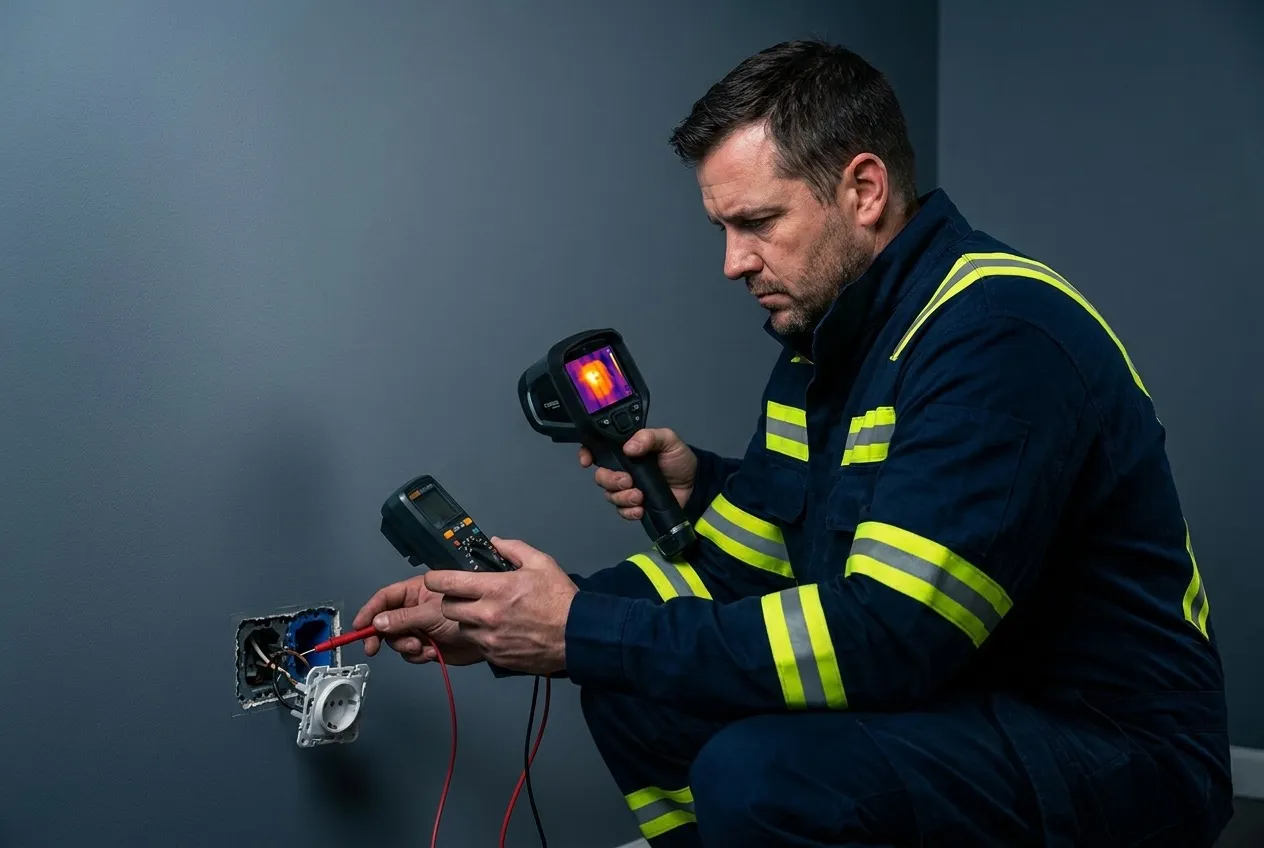
Electrical faults range from a nuisance — a circuit that trips when you run the kettle and the microwave together — to a genuine safety risk, like a wiring fault that causes a circuit to heat up inside a wall cavity. The difference between those two situations is not always obvious to the person living with it, which is why a proper diagnostic process matters more than a quick guess and a reset.
MetroPulse Electric approaches fault finding the way a good mechanic approaches a car that will not start: systematically, with the right instruments, without replacing parts in the hope that something will fix it. Our diagnostics produce a clear picture of what has failed, why, and what it takes to fix it properly.
Why intermittent faults are the hardest to find — and how we find them
A fault that is present all the time is actually easier to diagnose. The really difficult cases are the intermittent ones: a circuit that trips when the weather is damp, a light that flickers only when the air conditioner is running, or a safety switch that trips overnight when nobody is in the building. These faults often do not show up under standard load testing because the conditions that trigger them are specific.
Intermittent faults frequently have thermal signatures that are detectable even when the fault is not actively present. A loose or corroding termination develops resistance over time, and that resistance generates heat under load — heat that a thermal imaging camera can identify on a distribution board, in a ceiling space, or at a connection point. MetroPulse carries thermal imaging equipment as standard on fault-finding callouts, not as an add-on.
Diagnostics for strata and commercial buildings
In a multi-tenancy building, an electrical fault in common property affects every occupant. A tripped circuit to car park lighting leaves residents without safe access. A fault on the common-property switchboard can cut power to shared services including lifts, pumps, and security systems. When that happens, every minute without a diagnosis matters.
MetroPulse Electric's commercial and strata fault-finding service prioritises getting the building back to normal operation as quickly as possible, then carries out a thorough investigation of the root cause so the fault does not reoccur. We communicate directly with building managers and strata committees, provide written fault reports, and make recommendations for any remediation work.
- Thermal imaging to identify overloaded terminations, failing connections, and hidden wiring faults
- Insulation resistance testing to locate cable insulation breakdown
- Earth loop impedance and RCD trip-time testing
- Methodical circuit isolation to trace intermittent and nuisance trip faults
- Written fault report with findings, cause, and recommended rectification
Why DIY fault-finding costs more than calling us first
The most common pattern we see on complex faults is this: a handyman or building maintenance worker has already replaced several components, moved wiring, or reset the same fault multiple times before calling us. By the time we arrive, the fault is harder to find because the original conditions have been disturbed, and there are new questions about whether the maintenance work itself introduced problems. That costs the building owner more in diagnostic time and more in the rectification.
Electrical fault finding is licensed work in every Australian state. Isolating circuits, testing insulation, and making or adjusting any electrical connections must be done by a licensed electrician. Beyond the legal requirement, the practical argument is simple: guessing at electrical faults in an occupied building, or in a building where safety switch tripping has a real consequence for residents and businesses, is not a risk worth taking.
After the fault: restoring your installation and preventing the next one
Once a fault is confirmed and the repair is carried out, MetroPulse provides a written fault report documenting what was found, what was done, and any observations about the broader condition of the installation. For strata buildings and commercial properties, that report feeds into the ongoing maintenance record. For residential clients, it is plain-English documentation they can keep alongside their Certificate of Compliance.
In a number of cases, fault finding reveals a wider issue — wiring that has degraded beyond a single circuit, a switchboard that was never adequate for the building's load, or a pattern of previous work that did not meet AS/NZS 3000. We will tell you what we found, give you options, and let you make an informed decision rather than pressure you into immediate additional work.
Frequently asked
We start by isolating circuits one at a time to identify which circuit is causing the RCD to operate, then we test the insulation resistance of that circuit's cabling and any connected appliances. If the fault is intermittent, we may use thermal imaging on the switchboard and at accessible connections to identify heat signatures that indicate a developing fault. Most causes are found within the first hour on site.
Yes. MetroPulse Electric provides after-hours response for genuine electrical faults — situations where power is out to part or all of a property, where a safety switch is tripping repeatedly, or where there is reason to believe a fault poses a safety risk. After-hours call-outs are charged at a higher rate than standard work, and we will confirm the rate with you when you call before dispatching.
In most cases, yes. Modern distribution boards in strata buildings are designed to allow individual circuit isolation without affecting unrelated tenancies or common areas. Where the fault is on a common-property circuit that serves multiple areas, we will plan the isolation sequence with the building manager to minimise impact and carry out the work during a window that causes the least disruption to residents and businesses.