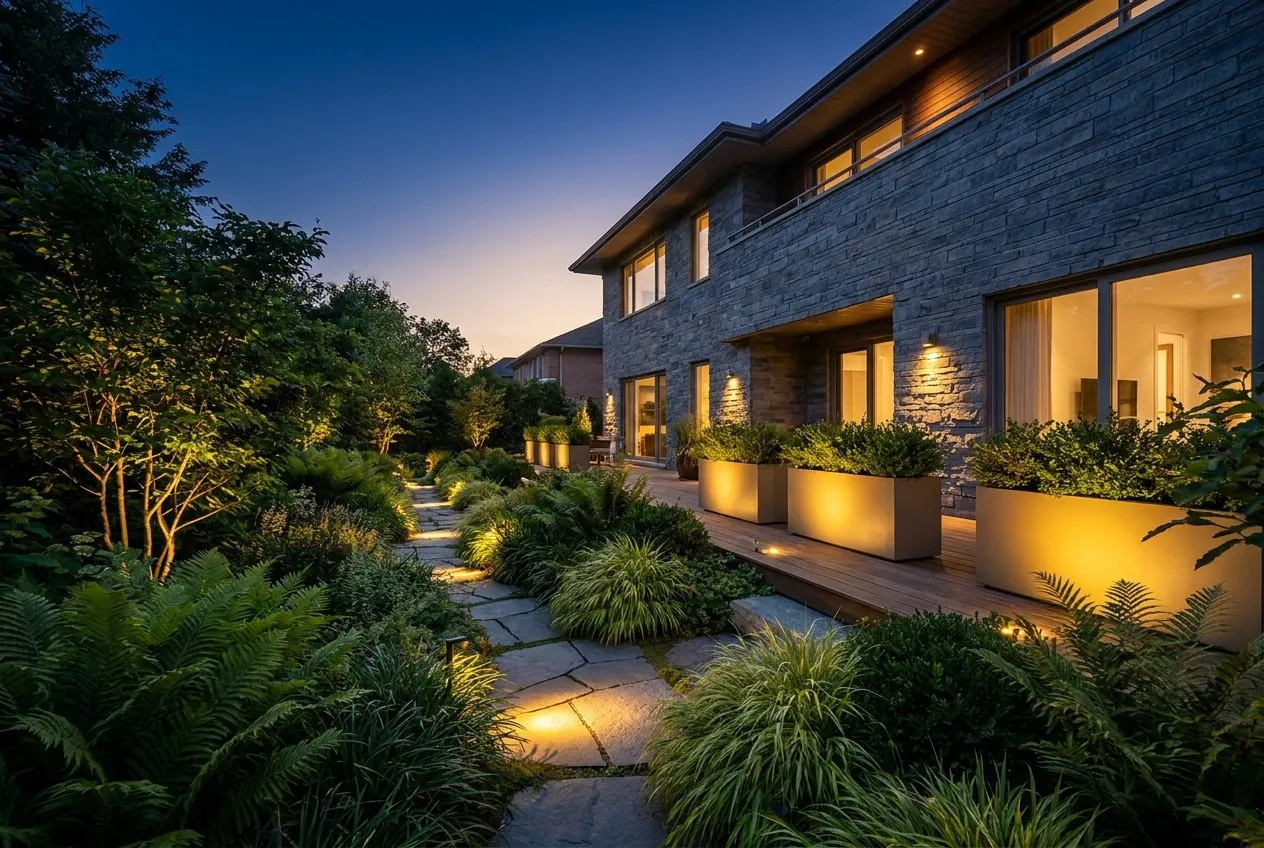
Outdoor lighting does at least three things at once: it provides safe passage after dark, it discourages opportunistic intruders, and it extends the usable hours of your outdoor spaces. Done well, it also makes a property look considered and well maintained — an important factor for commercial premises, strata buildings, and homes on the market.
The challenge is doing it durably. Outdoor electrical work is exposed to UV degradation, moisture ingress, rodent damage, and physical impact in ways that indoor wiring is not. MetroPulse Electric specifies fittings, cable types, and wiring methods appropriate for the specific outdoor environment — from a sheltered residential verandah to a fully exposed coastal strata car park — so that the installation does not become a fault-finding exercise twelve months after completion.
Gardens, paths, and feature lighting for homes
A residential outdoor lighting scheme typically combines path lighting for safe pedestrian movement, uplighting for trees and feature plantings, facade and soffit lighting for architectural interest, and entertainment-area lighting over decks and alfresco dining. We design these as separate circuits or zones so you can operate them independently — security perimeter lighting running all night does not need to take the garden feature lighting with it.
For garden installations we use UV-stabilised direct-burial cabling run in conduit where it crosses paved or trafficked areas, and we select fittings rated to at least IP65 for ground level and IP44 where above-ground fittings are sheltered. Spike-mounted path lights and uplights use weatherproof connectors and appropriate transformer sizing so the system remains serviceable and expandable.
Strata common areas and body corporate grounds
- Common driveway, car park, and basement entry lighting on occupancy control
- Pathway and garden lighting for strata complexes with body corporate metering
- Security lighting with PIR sensors and timer overrides for strata grounds
- Pool and water feature lighting compliant with AS/NZS 3000 zone requirements
- Facade uplighting and entry feature lighting for apartment building street presence
- Maintenance-friendly wiring with accessible junction points for strata facilities managers
Strata managers face a specific challenge with outdoor lighting: fittings and cabling must be maintainable by a contractor who may not have been involved in the original installation, and body corporate owners are entitled to expect the lights will actually work. We design strata outdoor lighting with this in mind — clear circuit labelling, weatherproof junction boxes at accessible heights, and fitting selections with available replacement lamps and drivers.
Commercial facade and security lighting
Commercial properties rely on exterior lighting for after-hours security, brand presentation, and meeting the minimum lux requirements on pedestrian access routes. MetroPulse designs and installs floodlighting, wall-mounted lanterns, bollards, and ground-recessed uplights for commercial facades, car parks, and loading areas. We also integrate outdoor lighting with security camera systems, alarm panels, and building management platforms where required.
All outdoor lighting work includes correct earthing and surge protection for fittings connected to long cable runs — something frequently missed on installations that later develop nuisance trips or fitting failures after a lightning event. We also handle DNSP applications where new metering or supply connections are needed for separate outdoor lighting circuits on commercial sites.
Frequently asked
IP ratings have two digits: the first is protection against solids (dust), the second against moisture. For ground-level garden fittings exposed to rain and irrigation, IP65 is the practical minimum. Fittings mounted under a sheltered overhang can use IP44. Fittings in or near pools must meet specific zone requirements under AS/NZS 3000, which in Zone 1 (within 2 metres of water edge) typically requires IP67 or higher. We select fittings appropriate to each location rather than applying a single rating across the whole job.
Possibly, but only if the transformer is sized for the combined wattage of all connected fittings, the cable section is correct for the run length, and the transformer itself is safety-listed and installed to AS/NZS 3000. Many retail transformers are undersized and poorly weatherproofed. Adding fittings to an existing low-voltage system without checking the transformer rating is a common cause of dimming, flickering, and premature fitting failure.
Generally yes. Lighting in common areas — driveways, paths, gardens, car parks, lobbies — is a common property expense and should be metered and billed to the body corporate account, not to an individual lot. When we install or upgrade strata outdoor lighting, we confirm the circuit origin and metering arrangement with the strata manager before we start to avoid billing disputes after completion.