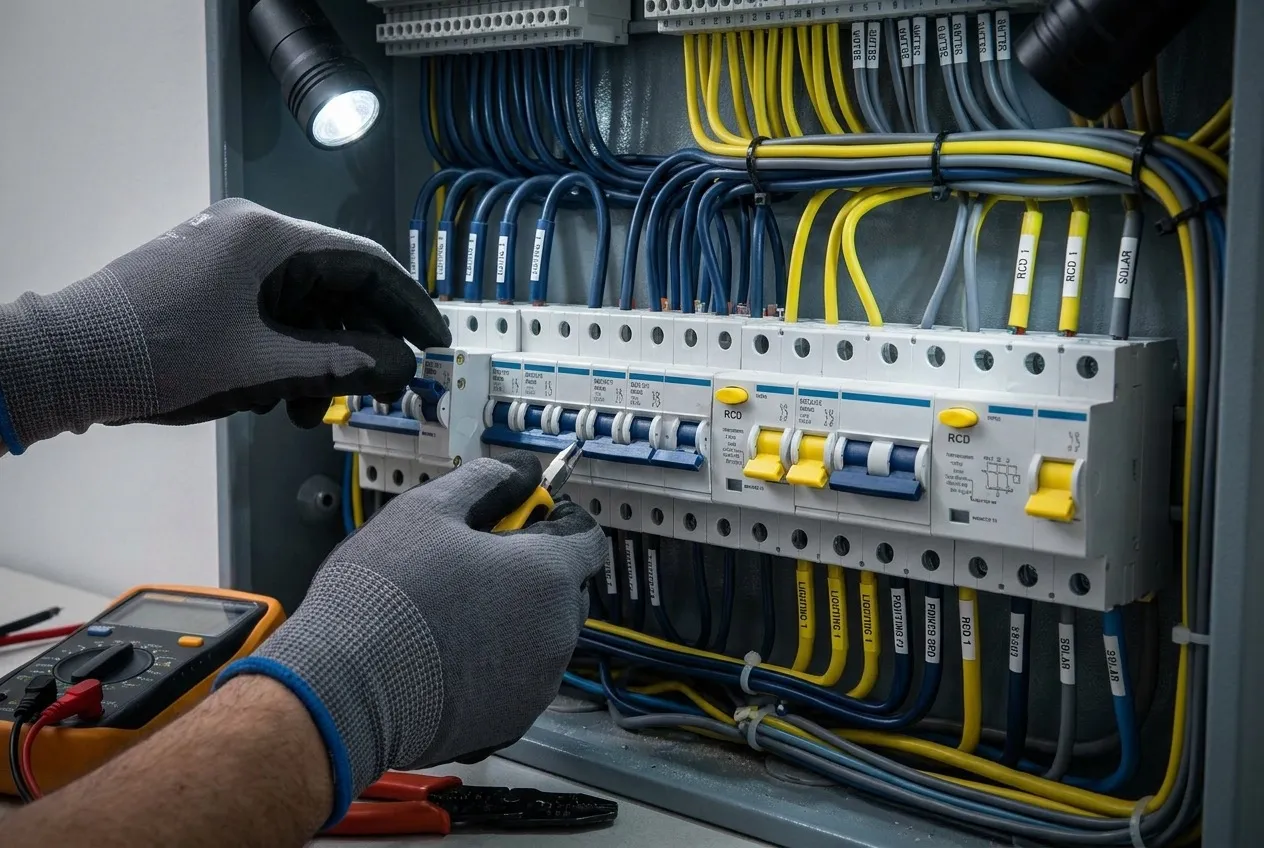
The switchboard is the nerve centre of any electrical installation. It controls every circuit in the building, protects those circuits from overload, and — if it has been upgraded properly — protects the people using them from electric shock and electrical fire. An old ceramic fuse board does none of those things reliably.
MetroPulse Electric upgrades switchboards in homes, commercial tenancies, and strata common-property areas throughout the city. Whether you are replacing a single household board or upgrading the common-property distribution system across a multi-storey residential block, the process is the same: remove what is outdated, install what is correct, test everything thoroughly, and issue the compliance documentation.
Why ceramic fuse boards need to go
A ceramic fuse board was the right technology when it was installed, but it has two serious shortcomings by today's standards. First, it has no residual current protection — it cannot detect the tiny leakage currents that cause fatal electric shock. Second, when a fuse wire blows, the instinct is often to replace it with heavier wire to stop the nuisance, which removes the only overload protection the circuit had. A modern switchboard with correctly rated RCBOs solves both problems.
Many Australian homes and older commercial buildings are also running on switchboards that were never designed for the loads now connected to them. Adding an air conditioning system, EV charger, induction cooktop, or solar inverter to a board that was already at capacity is a recipe for constant tripping and, in the worst case, an overloaded mains cable.
RCDs, RCBOs, and what the difference means for your board
An RCD (residual current device) monitors the balance of current flowing through a circuit. When current starts returning via an unintended path — through a person, for example — the RCD trips within 30 milliseconds. An RCBO combines the functions of an RCD and a circuit breaker in a single unit, protecting each circuit individually against both overloads and earth faults. Individual RCBOs mean that a trip on one circuit does not take down the entire board, which matters enormously in commercial premises and strata buildings.
- Full replacement of ceramic fuse boards and older circuit breaker panels
- Individual RCBO protection for each circuit, meeting current AS/NZS 3000 requirements
- Board capacity assessment and sizing for EV chargers, solar inverters, and air conditioning
- Strata and body corporate common-property switchboard upgrades
- Certificate of Compliance issued on completion of all switchboard work
Strata and body corporate common-property boards
Residential and mixed-use strata buildings present a specific challenge: the common-property electrical system serves lifts, car park lighting, pool pumps, stairwell lighting, and shared mechanical services, and it is the responsibility of the owners corporation — not any individual lot owner. When that common-property switchboard is outdated, the risk sits with the entire building.
MetroPulse Electric works directly with strata managers and building managers to assess common-property boards, prepare specifications that can be put to a general meeting for approval, and carry out the upgrade work with minimum disruption to residents. We schedule supply interruptions carefully, communicate in advance to residents, and restore common-area power as quickly as possible. We also provide the ongoing maintenance documentation that forms part of a strata building's compliance record.
Sizing the board for what you are actually going to use
A switchboard upgrade is the right moment to reconsider the capacity of your installation, not just to replicate what was there before. If you are planning to add a 7 kW EV charger, a 6.6 kW solar system with battery storage, and a new ducted air conditioning system in the next few years, that is a very different load profile from a standard household. We carry out load calculations before specifying the new board so you are not back in front of us in three years asking for another upgrade.
We also advise on controlled load tariffs and time-of-use metering during the upgrade, because the switchboard and metering arrangement affects your ability to take advantage of off-peak rates for EV charging and hot water. Getting those details right at upgrade time costs nothing extra.
Frequently asked
A standard residential board upgrade — replacing a ceramic fuse board with a modern panel fitted with RCBOs — takes one day for a typical house. We schedule a planned outage with you, carry out the work, test every circuit, and restore power before we leave. Complex upgrades involving mains cable replacement or metering changes may take longer, and we will give you a realistic timeframe before we start.
If the switchboard serves only your lot and is contained within your lot boundaries, approval from the owners corporation is generally not required, though you should notify the strata manager before work commences. If the work touches common property, or if you are the strata manager arranging an upgrade to the building's common-property distribution system, a committee or general meeting resolution will typically be required. MetroPulse can advise on the distinction and prepare documentation for the strata process if needed.
Nuisance tripping can be caused by either, and the two are not mutually exclusive. Common causes include a faulty RCD unit that is too sensitive, an earth leakage issue in an appliance or circuit, moisture in an external power point or fitting, or an older wiring installation where the accumulated leakage across multiple circuits exceeds the RCD's threshold. We diagnose the cause before recommending a solution — sometimes it is a single circuit or appliance, sometimes a board reconfiguration, and occasionally it is a wiring issue that needs rectification.