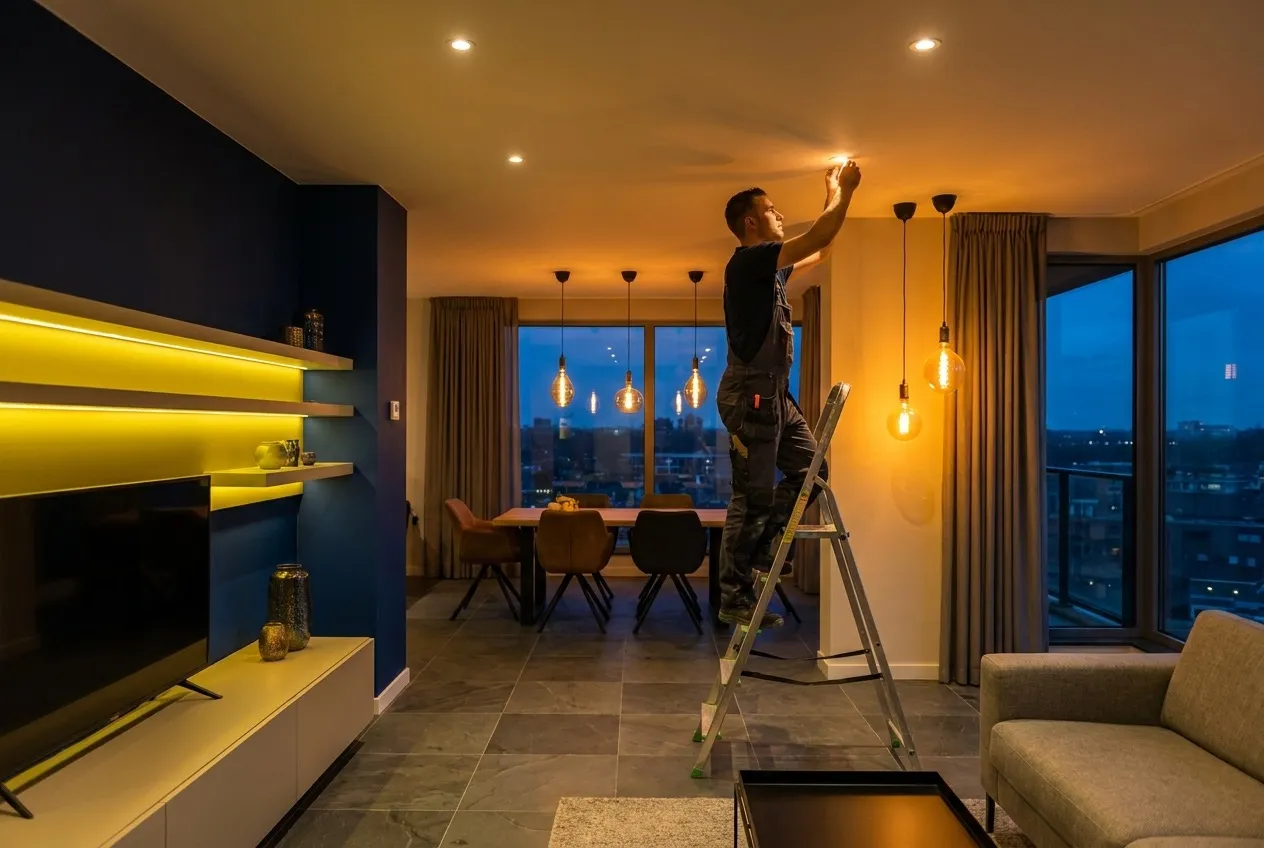
Bad lighting costs money twice: once on the energy bill and again in the form of complaints, errors, and productivity lost to eyestrain and glare. Whether you are outfitting a new commercial tenancy, refreshing a retail floor, or replacing a 20-year-old halogen scheme in a residential renovation, a properly designed LED layout delivers measurable improvements in comfort, safety, and operating cost.
MetroPulse Electric approaches lighting design from the electrical side: we translate an architect's or interior designer's concept into a real installation plan, calculate lumen levels to Australian Standards for the task areas involved, and select luminaires that perform reliably rather than just looking good in a catalogue photo.
Layered lighting for homes and hospitality
Residential and hospitality lighting that relies on a single downlight circuit washed across a flat ceiling is flat — visually and functionally. Layered lighting combines ambient (general), task (work surfaces and reading zones), accent (artwork, joinery, architectural features), and decorative (pendants and feature fittings) sources on separate circuits or dimmer channels. The result is a space that can shift from practical daytime use to a comfortable evening atmosphere without looking like a hospital corridor at either extreme.
We work with your builder or designer during the rough-in stage to position conduit, recess housing, and cabling before plasterboard goes up. This is the time to make decisions about dimming wiring, pelmet LED strip runs, and bathroom exhaust-fan-light combinations — changes after plaster are expensive and disruptive.
Commercial and retail lighting that supports the business
- Maintained illuminance levels calculated to AS/NZS 1680 for offices, warehouses, and workshops
- Retail accent lighting with high CRI (Ra 90+) to render merchandise colours accurately
- Emergency lighting and exit sign compliance under AS 2293
- Occupancy sensor and daylight harvesting control to reduce standby energy consumption
- Tunable white systems for circadian-supportive lighting in aged care and healthcare facilities
- Three-phase distribution for large commercial and industrial lighting panels
Office and hospitality fit-outs also need to consider glare index (UGR) for screen-based workplaces, and colour temperature for the tasks being performed. Warm white (2700-3000 K) suits relaxed environments; neutral to cool white (4000-5000 K) is better for focus work and food preparation. Getting this wrong on a fit-out is a common complaint from staff once they move in — and retrofitting it after practical completion is an avoidable cost.
Dimming, controls, and integration
Modern LED dimming goes well beyond a rotary dial. MetroPulse installs DALI-2 and 0-10 V dimming systems, scene controllers, and integration with building management systems (BMS) for commercial applications. In residential settings we integrate lighting control with smart-home platforms including C-Bus, KNX, and mainstream consumer systems, so lights respond to schedules, occupancy, and other home automation triggers.
For strata common areas — corridors, car parks, lobbies, lift vestibules — we design and install occupancy-controlled LED schemes that dramatically cut the body corporate's electricity bill without leaving residents or visitors in the dark. A well-configured common-area lighting upgrade typically pays for itself within two to four years through energy savings alone, and the improved light quality reduces slip-and-fall risk in the process.
Frequently asked
A typical halogen downlight draws 50 W. Its direct LED replacement draws 7-9 W for the same or better lumen output. In a home with 20 downlights running four hours a day, that is a reduction of roughly 1,700 kWh per year. At current Sydney residential tariff rates that represents a saving of around $500-$600 per year on the lighting circuit alone. Payback on quality LED lamps and drivers is typically 18-30 months.
If you are replacing the entire fitting or driver — which is the case with most halogen-to-LED upgrades — then yes, this is electrical work that must be carried out by a licensed electrician and covered by a Certificate of Compliance. Simply swapping a lamp into the same holder may be a DIY task, but only if the holder is specifically rated for LED. Mixing lamp types in a non-rated holder is a fire risk and an insurance issue.
CRI measures how accurately a light source renders colours compared to natural daylight, on a scale of 0 to 100. A CRI of 80 is adequate for general areas; Ra 90 or above is recommended for retail, medical, and food preparation environments where true colour appearance matters. Cheap LED fittings often have CRI of 70 or below, which makes food look unappetising, renders paint colours inaccurately on display, and causes visual fatigue over long working periods.