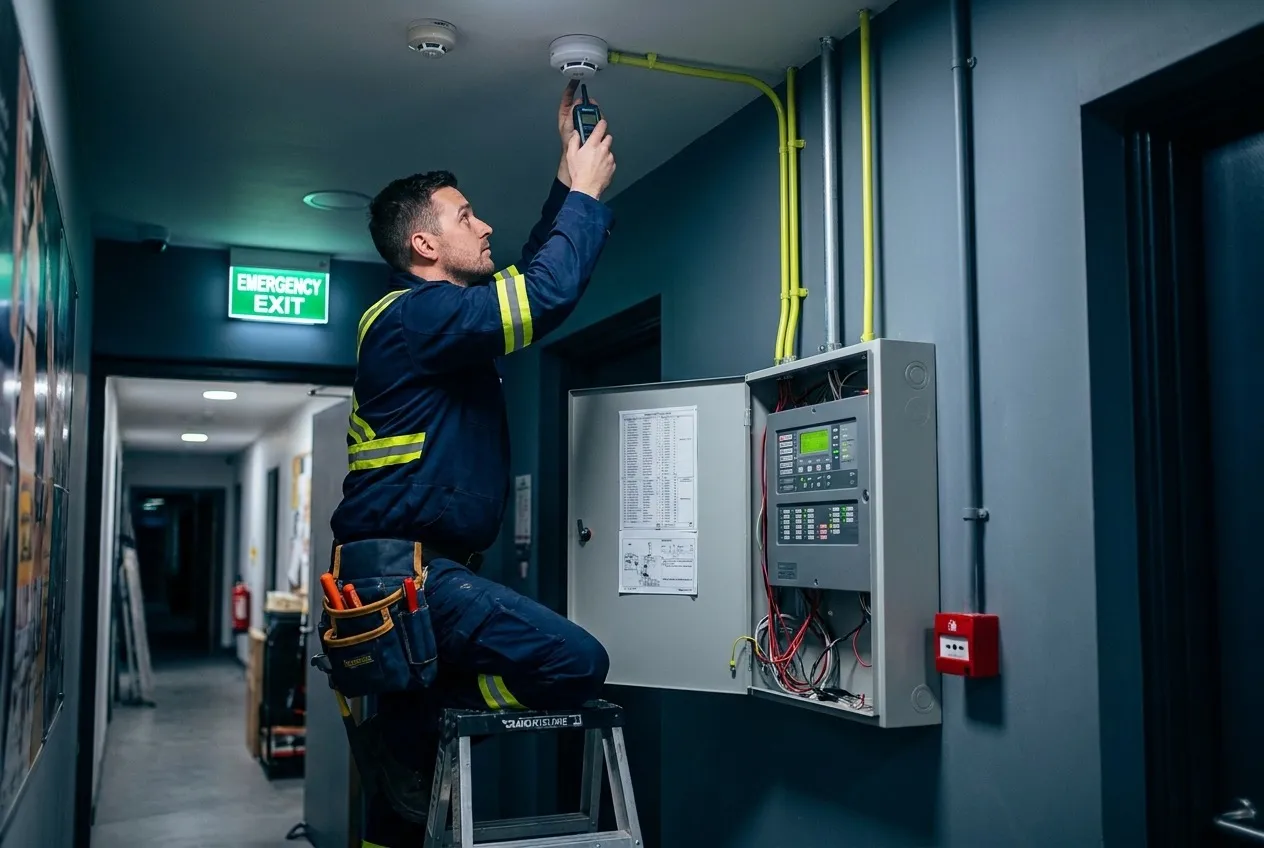
Fire detection and emergency lighting are not optional features of a commercial or strata building — they are life safety systems, and the regulatory framework around them reflects that. The Australian Standard AS 1851 governs the routine service and maintenance of fire protection systems. AS 2293 covers emergency lighting and exit signs. The National Construction Code sets the installation requirements for new systems. A building that is not meeting these obligations is not just at risk from a fire — it is exposed to enforcement action, voided insurance, and liability that cannot be transferred to anyone else.
MetroPulse Electric installs and maintains fire detection, alarm panel, occupant warning, and emergency lighting systems for commercial premises, industrial facilities, and strata buildings. We work with accredited fire protection engineers where the system design requires one, and we carry out all electrical installation and testing in-house rather than subcontracting the work.
Smoke and heat detection, and addressable alarm panels
Modern fire detection uses addressable systems: each detector and call point has a unique address on the system loop, so the panel can identify the exact device that has activated rather than just the zone. This matters during an emergency response — knowing it is the detector at the north stairwell entry on level three, not just that something has triggered on the ground floor, makes the response faster and more accurate.
We install photoelectric smoke detectors, heat detectors, and multi-criteria detectors selected for the environment. Kitchens and dusty areas need detectors chosen for those conditions — a standard smoke detector in a commercial kitchen will give you false alarms within a week. Strata buildings require careful zoning so that an activation in one lot does not trigger full building evacuation until the panel logic confirms the alarm has been validated by a second device or zone.
Emergency and exit lighting to AS 2293
AS 2293 requires emergency lighting and exit signs to be installed wherever the National Construction Code requires them, tested on commissioning, and maintained on an ongoing basis. The standard specifies minimum illuminance levels, battery duration requirements — at least 90 minutes of operation following a mains failure — and test intervals. Self-testing units carry out automatic duration tests and log results internally, which simplifies compliance reporting for building managers.
- Addressable fire detection panels with zone and device-level identification
- Photoelectric smoke detectors, heat detectors, and manual call points
- Occupant warning system speakers, sounders, and strobe units
- Emergency and exit lighting to AS 2293, including battery and duration compliance
- AS 1851 routine maintenance and testing with written service reports
Occupant warning systems and evacuation signalling
An occupant warning system (OWS) is the means by which a building alerts its occupants to evacuate. In smaller buildings this may be a series of alarm sounders. In larger commercial or strata buildings, the system includes voice evacuation capability — pre-recorded messages and the ability for a warden to broadcast live instructions over the building speaker network. The OWS must interface with the fire alarm panel and be tested to confirm that activation of the panel triggers the correct warning signal in the correct zones.
For strata buildings, the occupant warning system is one of the more complex elements because it must function correctly across common areas, car parks, and individual lot corridors without generating nuisance activations or failing to reach all occupants. We design and install OWS cabling and equipment to meet the detection system's requirements and coordinate panel programming with the fire alarm installer or fire engineer where that scope is held separately.
AS 1851 routine maintenance and building compliance records
AS 1851 routine service is not a once-off inspection — it is a structured maintenance regime with specified inspection tasks at quarterly, six-monthly, and annual intervals depending on the system type and the equipment installed. The maintenance provider must issue a written service record after each visit. That record is the building owner's evidence of compliance and the document that authorities and insurers will ask for following any fire or insurance event.
MetroPulse Electric can take over the AS 1851 maintenance schedule for existing fire detection and alarm systems, carry out any remediation work identified during the service inspection, and manage the documentation so the building manager always has an up-to-date compliance record. For buildings that have fallen behind on their service schedule, we carry out a catch-up inspection and provide a written gap assessment before resuming the regular maintenance cycle.
Frequently asked
AS 1851 sets a tiered maintenance schedule. Addressable fire detection systems typically require inspection at quarterly intervals for alarm devices, six-monthly inspection of the panel and monitoring connections, and a full annual inspection and test. The specific tasks at each interval are defined in the standard and depend on the equipment type. Buildings that go more than 12 months without a compliant service are in breach of the standard, which creates liability exposure for the building owner or body corporate.
Start with a condition inspection. We attend the building, inspect the alarm panel for fault logs and service records, test a representative sample of detectors and call points, check emergency lighting battery condition, and confirm the monitoring connection is active. From that inspection we produce a written report documenting the current system status and any deficiencies, which gives the owners corporation an accurate picture of what needs to be done to achieve and maintain compliance.
A conventional system divides the building into zones, and when a device activates, the panel indicates the zone — which might cover an entire floor or wing. An addressable system gives every detector and call point a unique electronic address, so the panel pinpoints the exact device. For any building of meaningful size, addressable is the correct choice: faster emergency response, simpler fault isolation, and far better capability when the system needs to be expanded or modified. Most new commercial installations are addressable as a matter of course.