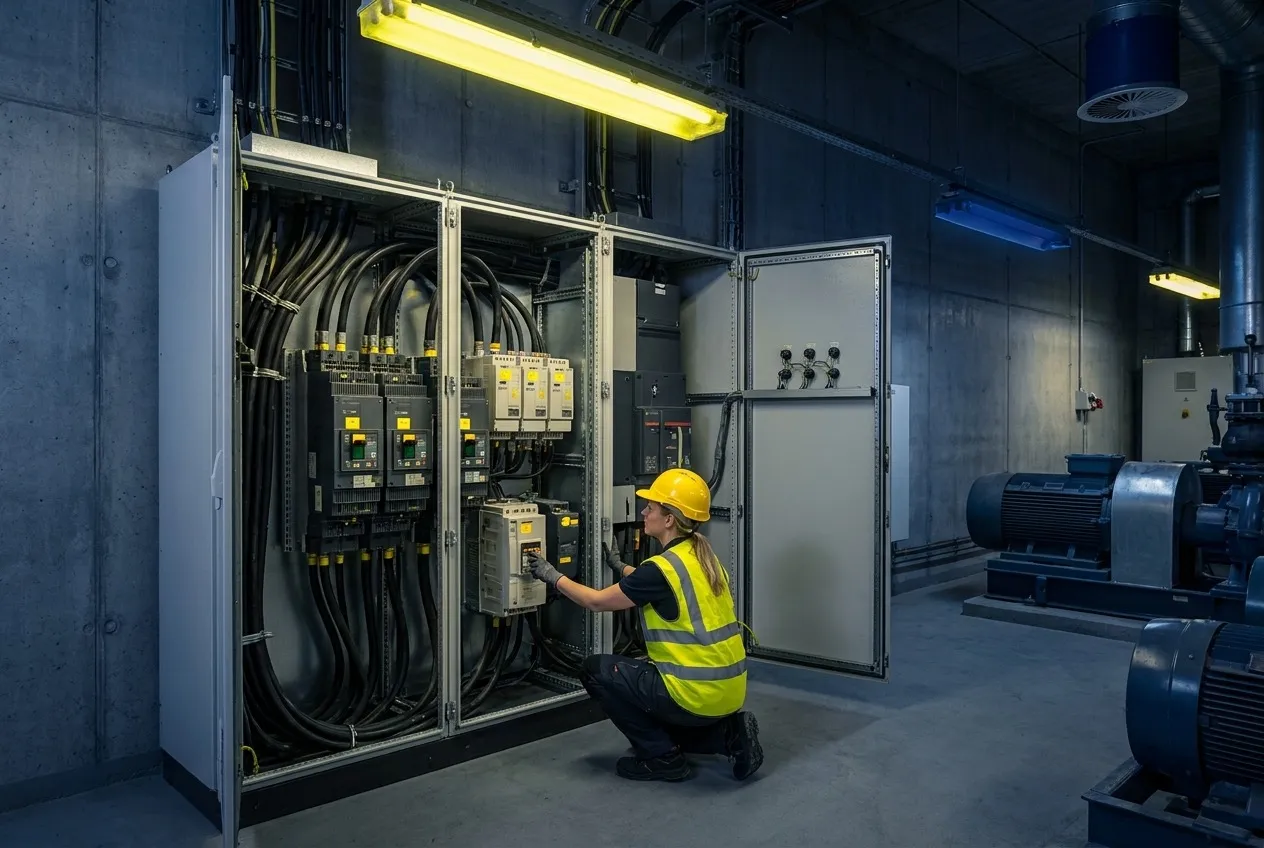
Industrial electrical systems carry more current, operate at higher voltage levels, and face demands that have no equivalent in residential or commercial work. The consequences of a failure are also amplified: lost production, damaged plant, and in the worst cases, a workplace safety incident. Sound industrial electrical work is methodical, documented, and built with redundancy in mind from the start.
MetroPulse Electric operates across warehousing, manufacturing, food processing, cold storage, water and waste treatment, and transport depots. Our industrial electricians are experienced with three-phase motor circuits, variable speed drives, distribution board design, and switchroom upgrades — and they work within your production schedule, not against it.
Three-phase motor circuits and machine power
Getting motor circuits right is the foundation of reliable plant operation. Undersized conductors, incorrect overload relay settings, and poor earthing are the three most common causes of motor failures we encounter on sites coming to us after a breakdown. We design and install motor circuits to the correct cable size, with properly rated overcurrent protection and earthing continuity to Australian standards.
For new machine installations, we provide three-phase power from the nearest suitable distribution board, confirm the supply voltage is within tolerance at the machine terminals, and test the motor circuit under load before signing off. For variable speed drive installations, we pay particular attention to earthing and harmonic filtering, both of which affect drive reliability and motor longevity.
Distribution boards and switchroom upgrades
Aging distribution boards are one of the clearest risk factors on any industrial site. As plants grow, distribution boards accumulate additional circuits that were never planned for in the original design — overloaded busbars, mixed protection devices, and circuits without adequate documentation. A switchboard audit tells you exactly where you stand before something fails.
- Distribution board design, installation, and load testing
- Motor control centre installation and motor circuit protection
- Variable speed drive installation and commissioning
- Cable management, containment, and reticulation through plant areas
- Switchroom upgrades, including live switchroom work by qualified persons
Planned maintenance and shutdown coordination
The most cost-effective maintenance strategy for industrial electrical systems is planned, not reactive. MetroPulse Electric can develop a maintenance schedule tailored to your plant — thermographic scanning of switchboards and terminations, infrared testing of motor terminals, insulation resistance testing of cable and motor windings, and earth continuity verification. Thermal imaging in particular catches failing terminations and overloaded conductors before they become a failure.
We coordinate shutdown access with your operations team, stage the work to match the production calendar, and document every test result so you have a baseline for future comparison. That documentation also satisfies due diligence requirements for insurers and WorkSafe compliance audits.
Getting the plant back on after an unplanned failure
When a distribution board trips and will not reset, when a motor circuit has developed a fault, or when the plant is dark and production has stopped, methodical fault finding gets you back faster than guessing. MetroPulse Electric's industrial response team carries the test equipment — megohmmeters, thermal cameras, power quality analysers — needed to identify the fault at the first visit rather than the third.
We maintain call-out capability for industrial sites and understand that every hour of unplanned downtime has a dollar figure attached. Our goal is a confirmed diagnosis and a clear repair scope within the first hour on site, not an open-ended investigation that drags through a shift.
Frequently asked
AS 3000 does not prescribe a specific thermographic scanning interval, but most industrial insurers and plant managers operate on an annual cycle for critical switchboards, with a six-month cycle for high-utilisation distribution boards. We recommend your first scan establishes a baseline, and subsequent scans are compared against it so developing hot spots are caught early.
Yes, where the scope requires it and safe work procedures are in place. Live LV switchroom work requires a qualified person under the relevant state electrical safety legislation, a safe work method statement, and appropriate personal protective equipment. We do not carry out live HV work — that requires specialist accreditation and is coordinated separately with the relevant authority.
Start with a load study. We assess your existing supply capacity, the available headroom on your current switchboard, and what the new equipment will actually draw under load — not just the nameplate figure. From that, we produce a distribution design that integrates the new line without compromising existing production, and we manage the DNSP application if the supply needs upgrading.