Fault Finding with Diagnostic Precision
Intermittent trips, unexplained RCD nuisance tripping, dead circuits, and flickering power are symptoms that demand proper investigation — not guesswork. Starwatt Systems uses thermal imaging, insulation resistance testing, and power quality analysis to find faults that visual inspection alone will never locate.
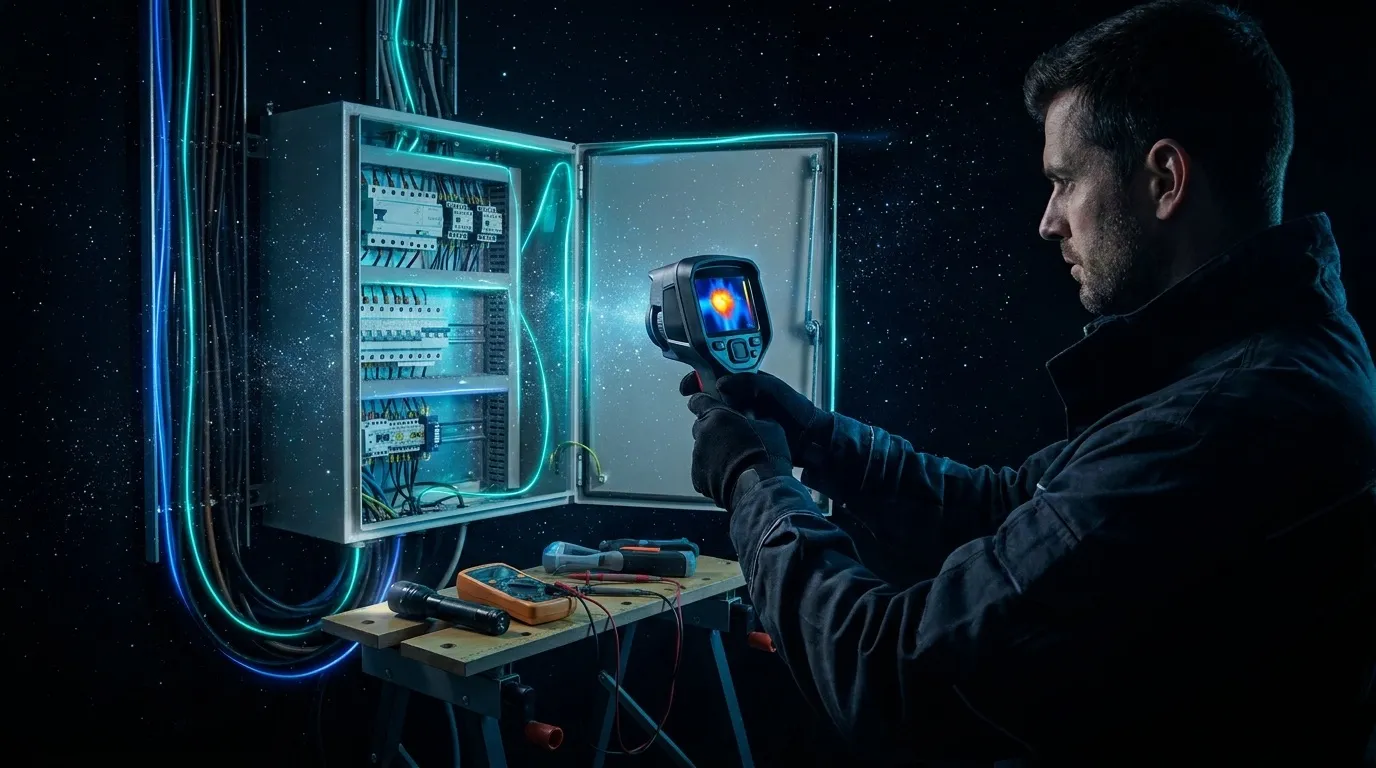
Electrical faults do not always announce themselves with a tripped breaker or a blown fuse. Many of the most dangerous faults — degraded insulation, loose neutral connections, corroding terminations, and failing appliances — develop slowly and present as intermittent symptoms that are difficult to reproduce during a site visit. Finding them requires a systematic, instrument-based approach rather than the trial-and-error substitution method that costs time, misses the actual cause, and risks leaving a hazard in place.
Starwatt's fault-finding team approaches every investigation with a structured diagnostic protocol. We gather a detailed history of the fault's behaviour, identify the circuits and zones involved, and select the appropriate test methodology before any physical work begins. This approach consistently reduces investigation time and eliminates the unnecessary circuit modifications that amateur fault-finding often leaves behind.
Thermal Imaging Inspection
A thermal imaging camera reveals what the eye cannot see. Loose terminations, overloaded conductors, failing circuit breakers, and corroding connections all generate elevated heat that shows up clearly in a thermal scan long before the fault becomes a visible failure or a fire. Starwatt carries calibrated FLIR thermal imaging cameras and conducts thermal sweeps of switchboards, distribution boards, and in-ceiling junction boxes as a standard part of the fault-finding process on any complex or intermittent fault.
- Thermal scan of switchboard and all distribution boards under load
- Identification of hot spots in terminations, bus bars, and circuit breakers
- Thermal imaging of accessible in-ceiling and in-wall junction boxes
- Calibrated temperature reports with photographic documentation of findings
- Follow-up thermal verification after corrective work to confirm resolution
Insulation Resistance Testing
Insulation resistance testing — commonly called a megger test after the instrument used — applies a controlled DC voltage to a circuit conductor and measures the resistance of the insulation to earth. Healthy insulation shows resistance in the hundreds of megaohms. Degraded, moisture-contaminated, or physically damaged insulation falls dramatically in resistance and can be identified even when the fault is intermittent under normal operating voltage. Starwatt conducts insulation resistance tests to AS/NZS 3000 and interprets the results in the context of the circuit's age, cable type, and installation environment.
Nuisance RCD Tripping
An RCD that trips repeatedly without an apparent cause is one of the most frustrating electrical problems a property owner or facilities manager can face. The causes range from genuinely dangerous earth leakage in a deteriorating appliance or cable, through harmless but excessive capacitive leakage from a large population of electronic equipment, to a failing RCD device that has degraded below its rated trip threshold. Starwatt uses a calibrated RCD tester to measure actual trip current and trip time, isolates circuits systematically to identify leakage sources, and distinguishes between genuine faults and false tripping before any cable or device is changed.
- Calibrated RCD trip current and trip time testing to AS/NZS 61008
- Systematic circuit isolation to identify the source of earth leakage
- Appliance insulation testing to identify leaking equipment
- Earth-loop impedance testing to verify protective conductor integrity
- RCD replacement where test results confirm device failure
Intermittent and Concealed Faults
Intermittent faults — those that only appear under specific load conditions, temperatures, or moisture levels — are the most difficult electrical problems to resolve. Starwatt uses a combination of long-term power quality logging, circuit resistance measurement under varying thermal conditions, and time-domain reflectometry (TDR) cable testing to locate faults that only manifest occasionally. TDR instruments send a signal pulse along a cable and measure the reflection from any impedance discontinuity — a damaged conductor, a water-ingress point, or a corroded joint — to within a metre of the fault location, even on long buried cable runs.
Electrical Fault Finding questions
We start by testing the RCD itself — a surprising number of nuisance trips are caused by the protective device failing, not by a genuine fault. We then measure earth leakage on each circuit individually with all loads disconnected, progressively reconnect equipment to identify leaking appliances, and finally test the cable insulation if the leakage persists with all loads removed. This systematic approach identifies the cause on the first visit in the great majority of cases.
Often, yes. Time-domain reflectometry (TDR) can locate conductor damage or water-ingress faults in underground cables to within one to two metres of the actual fault location. Once the fault is pinpointed electronically, we can minimise the excavation to a small targeted area rather than digging up the full cable run. For very deep or long runs, we can also coordinate with cable-locating specialists who use ground-penetrating radar.
We charge a diagnostic call-out fee that covers the first hour of investigation and instrument-based testing. Time beyond the first hour is charged at our standard labour rate. Once the fault is identified, we provide a fixed-price quote for the rectification work before proceeding. In most cases, straightforward faults are found and repaired within a two-to-three hour visit.
Ready to deploy electrical fault finding?
Tell us about your site and we will model the yield, returns and the fastest path to energised.