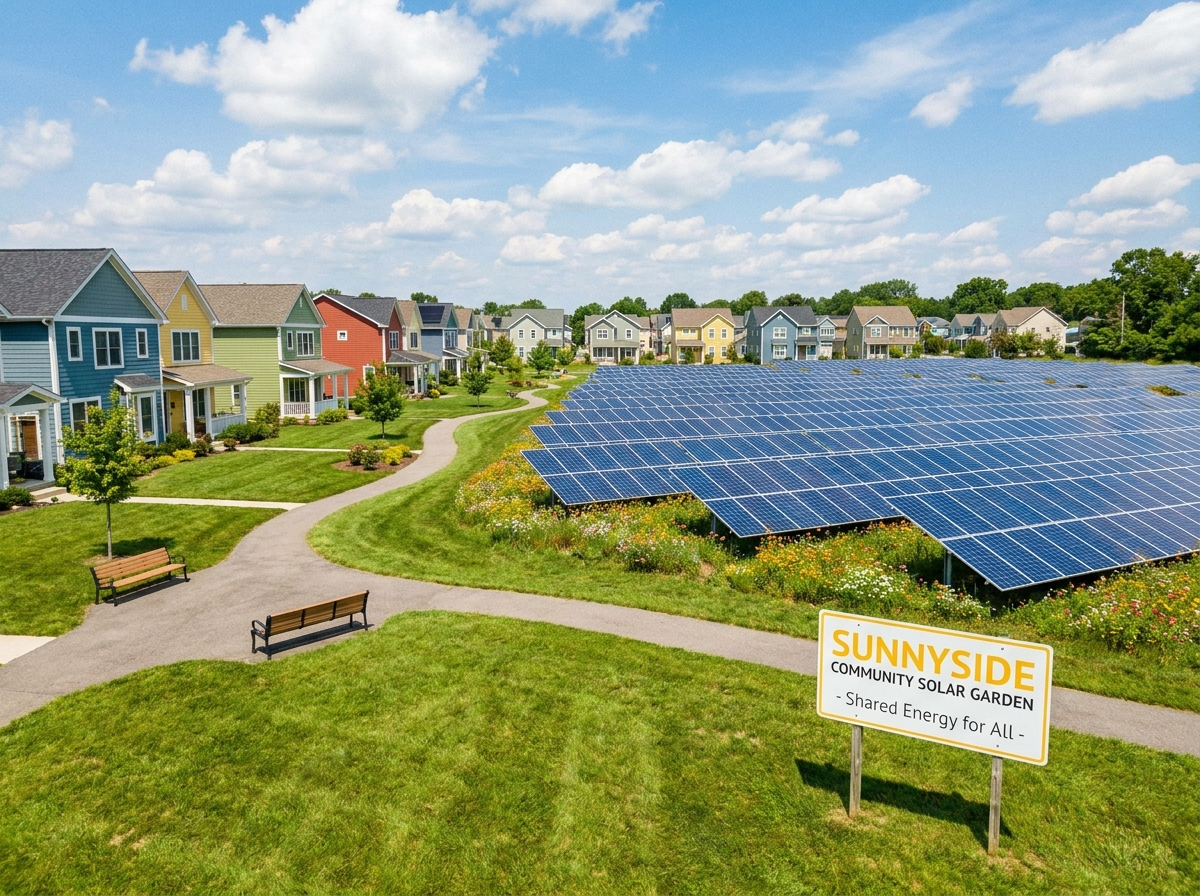
Rooftop solar has been a success story for Australian homeowners, but it has a blind spot. Renters, apartment dwellers, people on shaded or poorly oriented roofs, and households without the upfront capital are largely locked out. That is close to a third of the population who pay full grid prices while their neighbours generate their own. Community solar is built to close that gap.
Meridian develops shared arrays, often called solar gardens, that one community subscribes to together. A single well-sited installation does the work, and the value is distributed to many participants through their electricity bills rather than their roofs.
How a solar garden works
A solar garden is a mid-scale array built on land or a building chosen for good sun and a strong grid connection, rather than on each subscriber's home. Members buy or subscribe to a share of the array, and the energy it produces is allocated to them. It separates where solar is best generated from where the people who benefit happen to live, which is exactly what unlocks access for everyone left off the rooftop.
Because the array is sited and engineered properly once, rather than compromised across dozens of individual roofs, it usually performs better and costs less per kilowatt than the scattered alternative. It is also a productive use for land or rooftop space that would otherwise sit idle.
Virtual net metering
The mechanism that makes this practical is virtual net metering (VNM). Instead of physically wiring the array to each home, the generation is metered centrally and the credit for each member's share is applied directly to their individual electricity bill. A renter in an apartment three suburbs away can hold a stake in the array and see the benefit as a line item on their bill, without a single panel on their building.
- Renters and apartment residents who cannot install their own panels
- Households with shaded, north-blocked or structurally unsuitable roofs
- Owners who lack the upfront capital for a rooftop system
- Community groups and councils wanting a shared local asset
The subscriber model
Participation can be structured as ownership, where members buy a share of the array outright, or as a subscription, where they pay a periodic fee for an allocation of its output and the credits that come with it. The subscription model carries no large upfront cost and is the easiest entry point for renters and lower-income households, which is the whole point. We design the commercial structure, billing and governance so the project is fair, transparent and durable across changing membership.
Throughout, the project sits within National Electricity Market rules and the relevant distribution network's arrangements, so the credits flow correctly and the array is a compliant, connected participant rather than a workaround.
Land, value and community
Community solar is fundamentally a land-use story. A single parcel of land or one large roof generates power for a whole community, sparing dozens of smaller compromised installations and putting an otherwise idle site to work. For landowners and councils, hosting a solar garden creates a productive, income-generating use that also delivers a visible local benefit, strengthening both the value of the property and its standing in the community it serves.
Frequently asked
Yes. That is exactly who community solar is for. You subscribe to or buy a share of a shared array, and through virtual net metering the value of your share is credited to your own electricity bill, with no panels needed on your home.
It is the billing arrangement that lets one central array benefit many people. The array's generation is metered in one place, and each member's share is applied as a credit to their individual electricity account, even if they live nowhere near it.
Not under a subscription model. You pay a regular fee for your allocation rather than buying hardware, which removes the upfront barrier that keeps many renters and lower-income households out of rooftop solar.