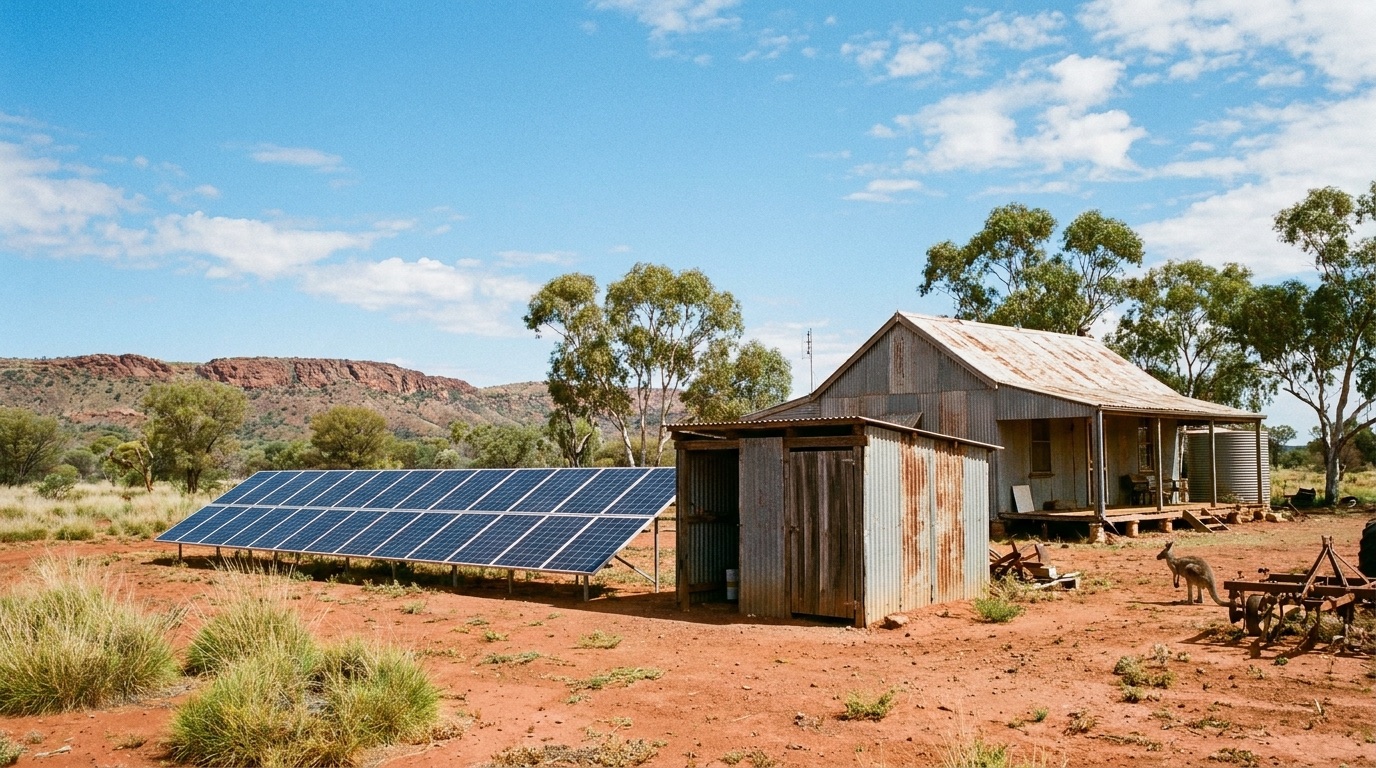
Out past the grid edge, and increasingly within it, power has to look after itself. Remote communities, mine sites, agricultural operations and critical facilities cannot rely on a distant network alone. A microgrid lets a site generate, store and manage its own electricity, connected to the grid or fully independent of it.
Meridian designs these systems around the loads that matter and the land available to host them. Solar arrays, battery storage and intelligent controls combine to deliver power that is cleaner, cheaper to run and far more resilient than a diesel generator working alone.
Islanding and grid support
A grid-connected microgrid can island - disconnect cleanly from the wider network during an outage and keep running on its own generation and storage. Done well, the transfer happens in milliseconds, so sensitive loads never see the interruption.
When the network returns, the microgrid resynchronises and reconnects safely. For sites at the end of long, fault-prone feeders, this islanding ability turns frequent outages into non-events for the people and processes that depend on power.
Black-start and resilience
True resilience means a site can recover power from a complete shutdown without any external supply. Black-start capability lets batteries and inverters re-energise the microgrid from zero, bringing critical loads back online and then restarting larger plant in a controlled sequence.
- Seamless islanding for sensitive and critical loads
- Black-start recovery with no external grid required
- Diesel offset and generator stop-start optimisation
- Tiered load shedding to protect priority circuits
- Remote monitoring and control of distributed assets
Offsetting diesel
Many remote sites still burn diesel around the clock. Adding solar and storage with smart dispatch can offset the large majority of that fuel, running generators only when needed and at efficient load points rather than idling through the night.
The result is lower fuel costs, fewer fuel deliveries to hard-to-reach locations, reduced maintenance on hard-run engines and a substantial cut in emissions. Generators become a backstop rather than the baseline.
Remote and critical loads
We design from the load list outward, classifying circuits by how critical they are and how they behave through the day. Priority loads such as communications, refrigeration, water pumping and safety systems are guaranteed continuity, while flexible loads are scheduled around generation and storage.
Siting matters as much as sizing. Array layout, battery enclosures and switchroom placement are planned against the terrain, access and future expansion of the site, so the microgrid uses land efficiently and can grow without a rebuild.
Frequently asked
Yes. With sufficient solar and storage, a microgrid can operate completely independent of the network, using a generator only as backup. We size the system to your loads, location and reliability target.
Islanding is the microgrid disconnecting cleanly from the grid during an outage and continuing to run on its own generation and storage, then reconnecting safely when the network returns. The switch happens fast enough that critical loads stay powered.
On most sites a well-designed system offsets the large majority of diesel use, often 80 to 95 percent, with the generator reduced to a backstop. The exact figure depends on your load profile, solar resource and storage sizing.