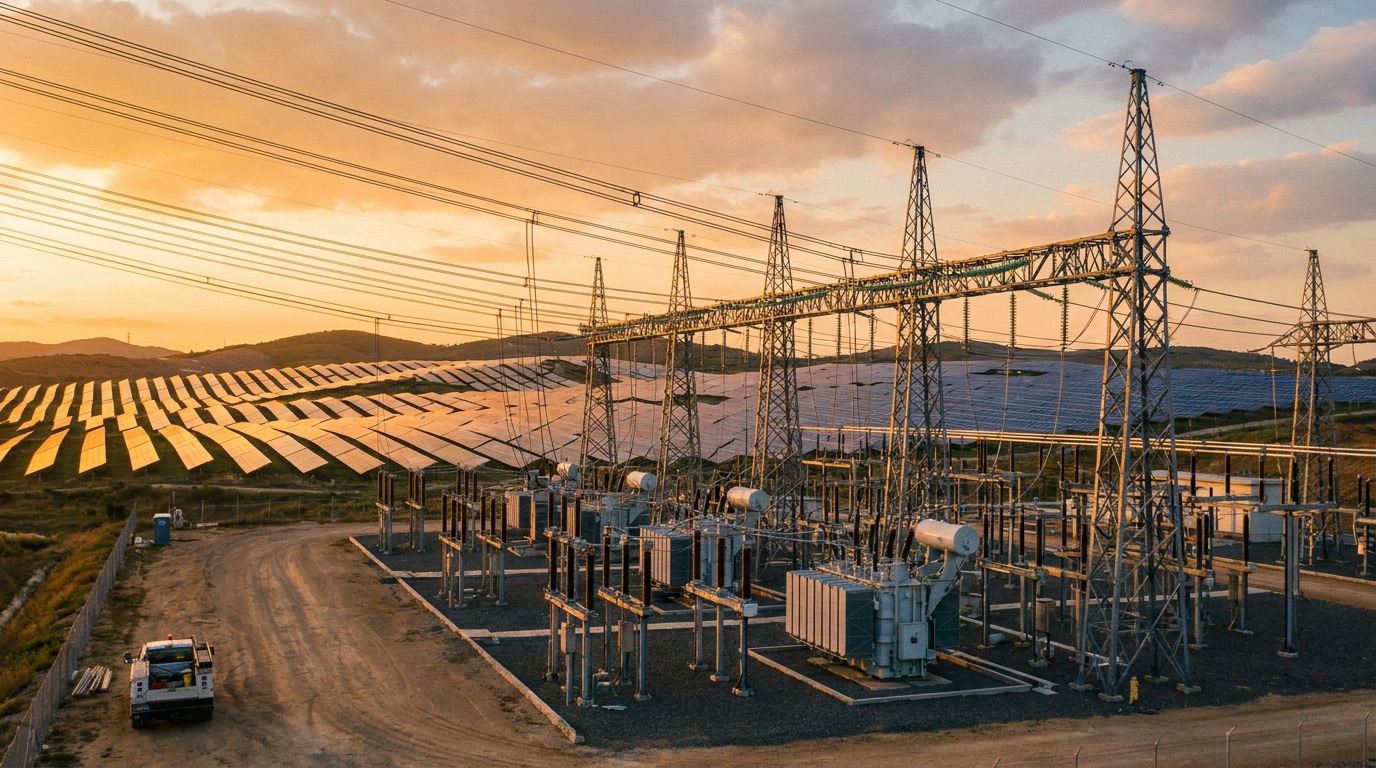
Grid interconnection is the gate every generation project must pass through, and it is rarely the part developers underestimate at their peril more than any other. Whether you are connecting behind the meter with export, or as an embedded or registered generator, the network's process is sequential, technical and unforgiving of gaps.
Meridian runs that process as a discipline. We act as the single interface to the network so you are not personally negotiating connection agreements, chasing study results or interpreting the National Electricity Rules between other priorities.
Enquiry, application and offer
The path begins with a connection enquiry to the relevant Distribution Network Service Provider or, for larger projects, the Transmission Network Service Provider. The enquiry establishes feasibility and indicative constraints before you commit to a formal connection application.
From there we prepare the application, negotiate the connection offer and connection agreement, and lock the commercial and technical terms - including the export limit the network will permit at your point of connection.
Generator performance standards
Larger connections must agree Generator Performance Standards with the network and AEMO. These define how the plant behaves under fault, voltage and frequency events, and negotiating them well is the difference between a workable asset and one hamstrung by overly conservative settings.
We prepare and negotiate the GPS, working through the access standards in the Rules to land a position that protects the network while preserving your plant's commercial capability.
Protection and power systems studies
Connection approval depends on a body of technical studies that demonstrate the plant will not destabilise the network. We commission and manage the full suite required for your connection size.
- Protection coordination and grading studies
- Power quality, harmonics and flicker assessment
- Compliance with AS/NZS 4777 and Schedule 5.2 standards
- Export limitation and dynamic connection arrangements
Where the network imposes a low static export limit, we evaluate dynamic and flexible export arrangements that let the asset push more energy when the local network can absorb it, recovering yield that a fixed cap would strand.
Commissioning and energisation
The final stage is commissioning, hold-point testing and the network's sign-off to energise. We coordinate the witness testing, submit the compliance evidence and manage the registration steps so the asset moves from approved to live without the late surprises that so often delay connection.
Frequently asked
A Distribution Network Service Provider operates the local lower-voltage network most projects connect to, while a Transmission Network Service Provider runs the high-voltage backbone. Larger projects may interact with both.
An export limit is the maximum power the network allows you to push back to the grid. Static limits are fixed, but dynamic or flexible arrangements can lift that ceiling when local network conditions allow.
It varies with size and network capacity, from a few months for small behind-the-meter connections to well over a year for large registered generators. An early enquiry gives the most reliable timeline.