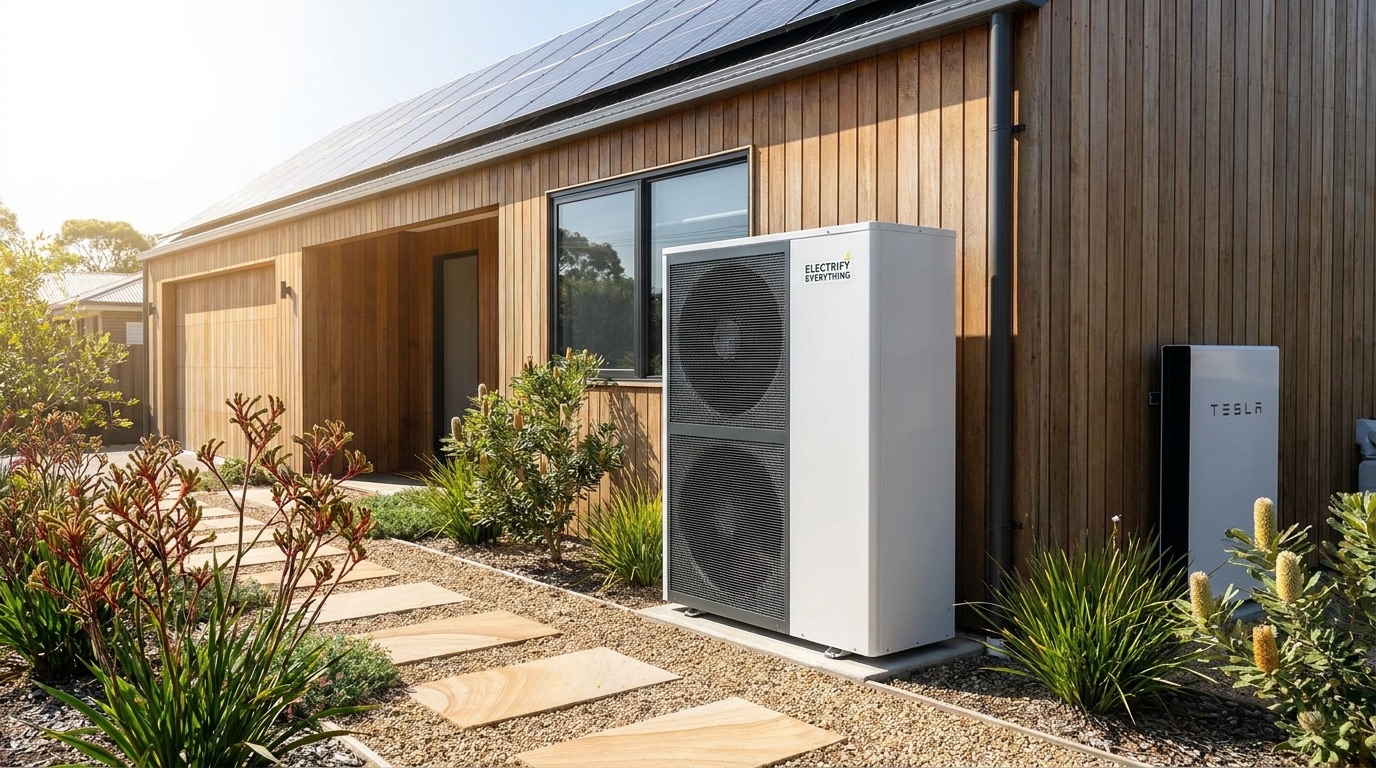
Electrification is the practical end of decarbonisation. Instead of burning gas for hot water, space heating and process heat, a heat pump moves existing heat from the air or ground, delivering several units of useful energy for every unit of electricity it draws.
That efficiency is measured as Coefficient of Performance, and a well-specified heat pump routinely returns a CoP of 4 or more. When the electricity comes from your own rooftop solar, the effective cost of heat falls dramatically and the case against gas becomes hard to argue with.
Hot water and space conditioning
Hot water heat pumps are usually the first and easiest win. They replace gas or electric-resistance storage with a unit that runs on a fraction of the energy, and they can be timed to run during the solar day so the load is met almost entirely by self-generated power.
Reverse-cycle air conditioning handles space heating and cooling with the same logic, replacing gas heaters with equipment that is both more efficient and more controllable across a building's zones.
A staged electrification roadmap
Disconnecting gas is a journey, not a single switch. We audit every gas appliance and load, then sequence the changeover so the most cost-effective replacements happen first and the building is never left without heat or hot water during the transition.
- Heat pump hot water sized to your demand profile
- Reverse-cycle systems for space heating and cooling
- Load timing to soak up midday solar generation
- Staged retirement of gas appliances and the meter
The endpoint is full gas disconnection - removing the standing supply charge entirely once the last appliance is converted. For many sites that fixed daily charge is a meaningful saving on its own, before a single kilowatt-hour is counted.
Powered by self-generated solar
The real multiplier is pairing heat pumps with your own generation. Heat pump loads are flexible and largely shiftable, which makes them ideal partners for solar - run the hot water and pre-condition the building when the array is producing, and you convert otherwise-exported electricity into stored heat and comfort.
We model this interaction explicitly, sizing the array, the storage and the heat pump capacity together so self-consumption is maximised and grid imports are minimised across the year.
Incentives and delivery
Heat pump upgrades attract Small-scale Technology Certificates and various state energy-efficiency incentives that lower the upfront cost. Meridian handles the specification, installation, certificate creation and commissioning as a single package, so the building moves to all-electric operation without you coordinating multiple contractors.
Frequently asked
CoP is the ratio of heat delivered to electricity consumed. A CoP of 4 means the unit produces four units of heat for every unit of power it draws, far ahead of any gas or resistive system.
You can, but the standing supply charge often outweighs the benefit. We model both scenarios so you can decide whether full disconnection makes financial sense.
Yes. Heat pump hot water and some space heating upgrades are eligible for Small-scale Technology Certificates and state efficiency schemes, which we claim and apply to your project cost.