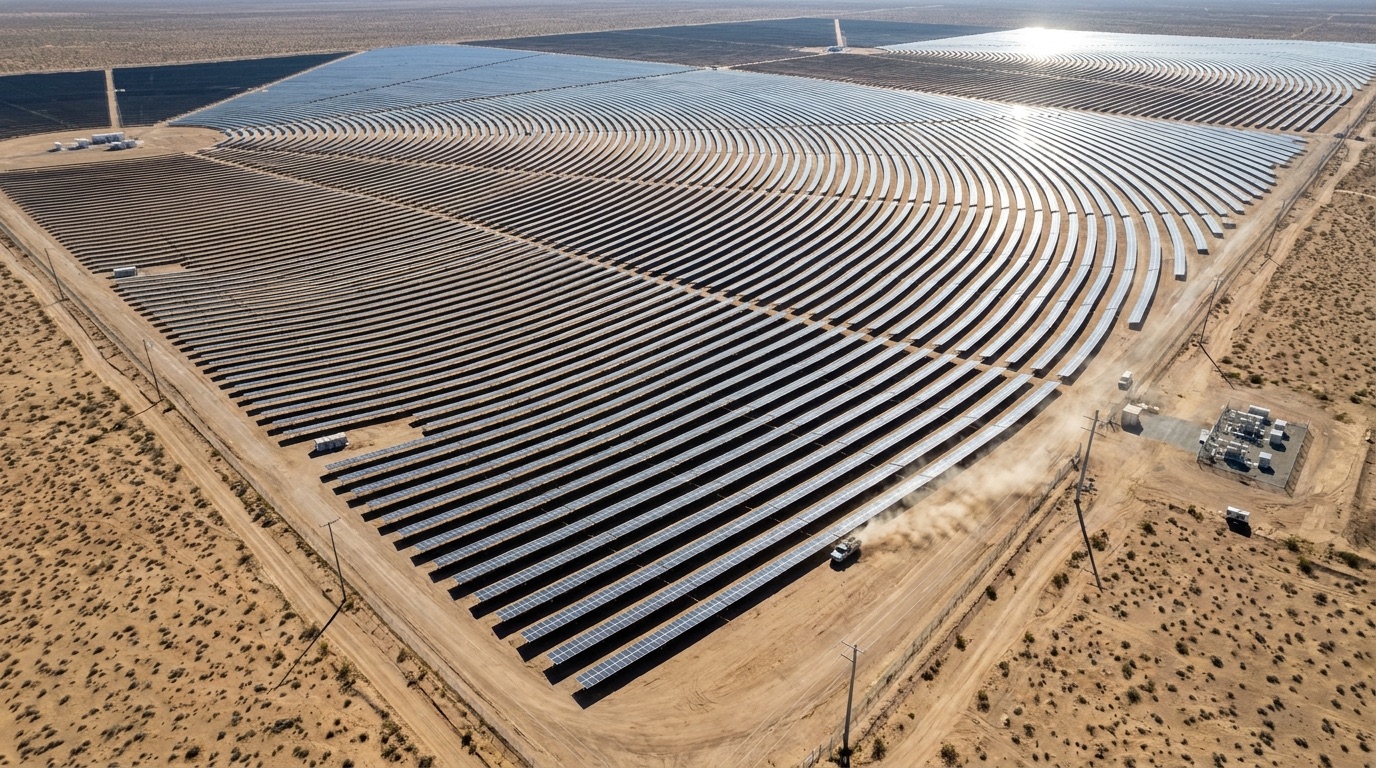
A utility-scale solar farm is fundamentally a land and grid project. The economics turn on three things: the quality of the resource, the cost of connecting to the network, and how productively the land is used over thirty years. Meridian develops projects that treat all three with equal rigour.
We take projects from greenfield through to energised, covering land assessment, development approval, grid connection, EPC delivery and long-term operation. The aim is a low levelised cost of energy (LCOE) and a project that earns its place in the landscape rather than displacing what was there.
Land assessment comes first
Before any commitment, we assess the land for what makes a farm viable: solar resource and irradiance, slope and aspect, flood and bushfire exposure, soil and ground conditions, and proximity to a connection point with capacity. We overlay planning constraints, native vegetation and cultural heritage so the development pathway is understood early rather than discovered late.
- Solar resource, terrain and ground-condition analysis
- Distance and capacity at the nearest network connection point
- Planning, environmental and cultural heritage overlays
- Land tenure, access and grid-easement assessment
Agrivoltaics and dual land use
The strongest projects keep the land productive. Agrivoltaics co-locates generation with agriculture, most commonly grazing sheep beneath and between the rows. The panels provide shade and shelter that can improve pasture retention and animal welfare, while the livestock manage ground cover and reduce mowing and fire-fuel load.
This dual land use changes the conversation with landholders and communities. Instead of taking a paddock out of production, the farm layers a second income stream on top of the first, and single-axis tracking rows can be spaced to keep grazing and machinery access practical.
Grid connection and the NEM
Connection is where utility projects live or die. We manage the connection process with AEMO and the relevant network service provider, including the modelling and studies required to meet performance standards in the National Electricity Market. Marginal loss factors, curtailment risk and constraint exposure are assessed up front because they drive revenue as much as generation does.
We design for the realities of the NEM, including the value of co-locating battery storage to firm output, capture price spreads and provide network support where the connection allows.
EPC delivery and long-term operation
As an integrated developer and EPC, we control quality from procurement through commissioning, using bankable Tier-1 modules and proven central or string inverters sized for the site. After energisation, our operations team manages performance, vegetation and dual-use grazing under a long-term plan, so the asset and the land both keep performing for decades.
Frequently asked
Good solar resource and flat, stable ground matter, but the decisive factors are usually proximity to a network connection with spare capacity and a workable planning pathway. We assess all of these in the land assessment before any commitment.
Yes, that is the point of agrivoltaics. The most common dual use is sheep grazing between and beneath the rows, which keeps the land in production, manages ground cover and adds a second income stream alongside the lease or generation revenue.
We do, end to end. That includes the application, modelling and performance studies with AEMO and the network service provider, plus assessment of marginal loss factors and curtailment risk so the connection economics are clear before construction.