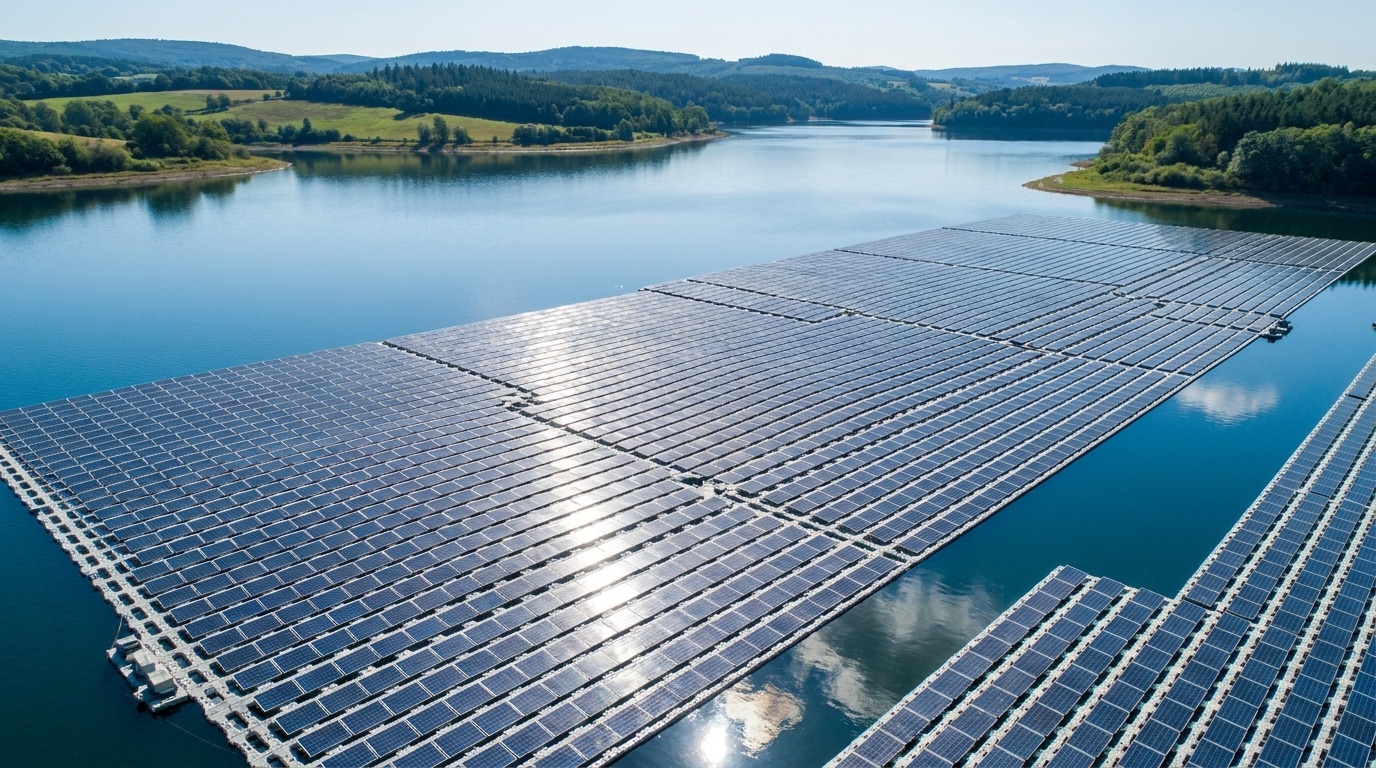
Australia has no shortage of sunlight, but good flat land near grid connection is increasingly contested between energy, agriculture and conservation. Floating solar, or floatovoltaics, sidesteps that contest entirely by mounting panels on the surface of an existing water body. The land stays in production; the water does double duty.
Meridian designs floating arrays for the water assets most sites already own: irrigation dams, water-treatment reservoirs, quarry voids, tailings storage and pumped-hydro ponds. These surfaces are usually unproductive, securely fenced and close to existing infrastructure, which makes them some of the most sensible solar real estate in the country.
The land-use case
The central argument for floating solar is what you do not consume. A megawatt of ground-mount array can occupy a couple of hectares of land that might otherwise grow crops, carry stock or hold native vegetation. Put that same megawatt on a reservoir and the paddocks stay productive. For agricultural operations, mining sites and utilities, this turns an idle water surface into a generating asset without sacrificing a single hectare of usable ground.
A cooling bonus
Water does more than free up land; it cools the panels. Solar modules lose efficiency as they heat up, and an array sitting just above a large body of water runs measurably cooler than the same panels baking on a hot roof or paddock. That typically lifts energy yield by several per cent over the year, a free dividend that comes with the siting.
The benefit runs both ways. Shading the water surface sharply reduces evaporation, which on a working irrigation or town water supply is a serious saving in a dry country. It also suppresses algal blooms by cutting the light and heat that feed them, improving water quality at the same time.
- Keeps arable and grazing land in full production
- Cooler operating temperature lifts annual energy yield
- Cuts evaporation losses on irrigation and supply reservoirs
- Reduces algal growth and helps protect water quality
Anchoring and mooring
The engineering that matters most in floating solar is keeping the array where it belongs through wind, waves and changing water levels. We design buoyant pontoon platforms and a mooring system, anchored to the bed, the bank or both, that holds position while allowing the whole array to rise and fall as the reservoir fills and draws down. Anchoring is sized to local wind loads, fetch and water-level range, and the layout leaves access for maintenance and water management.
Cabling is routed above the waterline and corrosion-rated for a permanent marine-style environment. The result is a structure built to ride the water for decades, not a roof array dropped onto a raft.
An asset that respects the property
Floating solar is a land-use strategy as much as an energy one. It lets a property generate clean power while keeping its most valuable resource, productive ground, entirely intact, and it improves the underlying water asset at the same time. For owners weighing competing demands on their land, that combination is hard to beat, and it strengthens rather than encumbers the value of the holding.
Frequently asked
Calm, permanent or near-permanent water bodies work best: irrigation dams, treatment and supply reservoirs, quarry voids, tailings ponds and pumped-hydro storages. We assess surface area, depth, water-level variation and exposure to wind before scoping a design.
Yes. The cooling effect of the water keeps panels at a lower operating temperature than ground or roof arrays, which typically raises annual energy yield by several per cent compared with the same modules on land.
Panels sit on engineered buoyant pontoons held by a mooring and anchoring system sized to local wind and water-level conditions. It keeps the array in position while letting it rise and fall as the water body fills and empties.