Charge at home, intelligently
Accredited installation of smart AC and DC chargers with dynamic load balancing, solar diversion, and app scheduling.
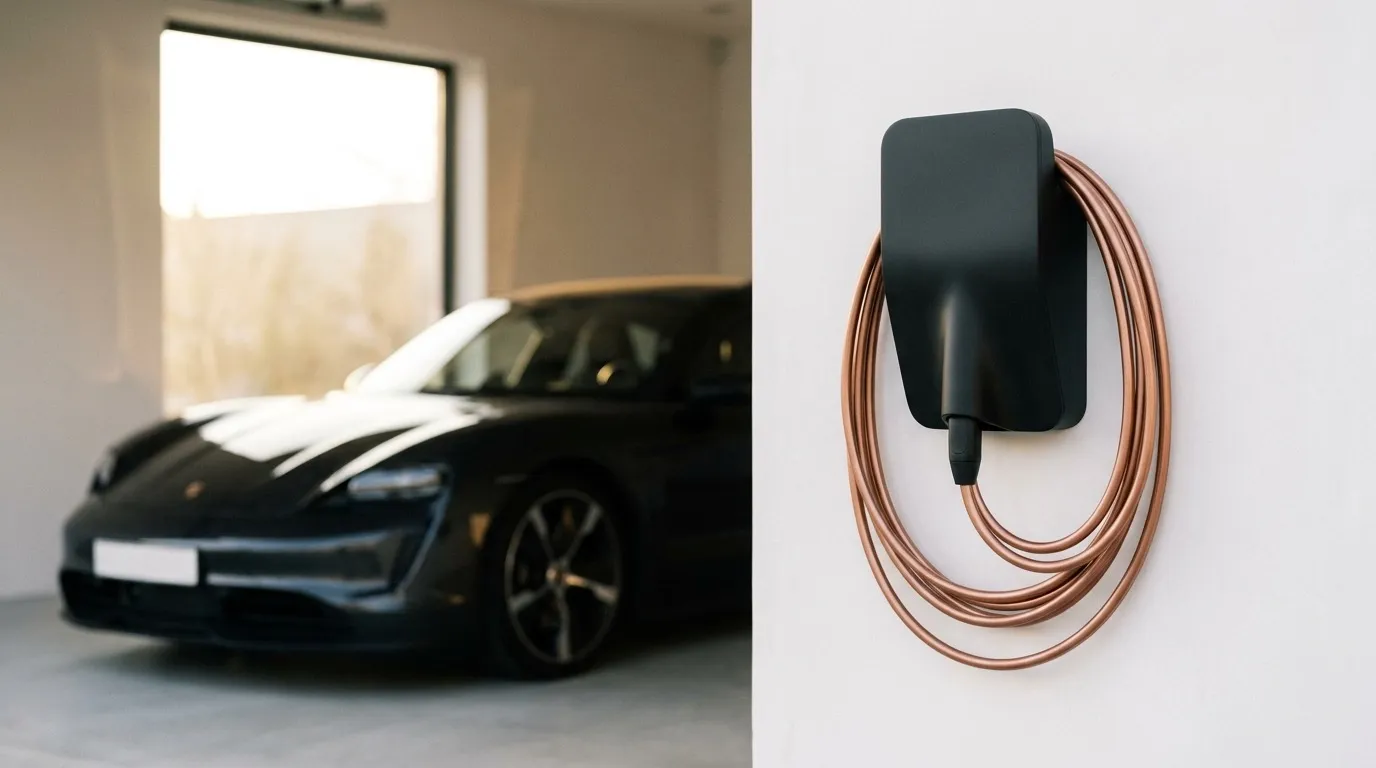
Australia's transition to electric vehicles is accelerating, and for Melbourne households and businesses that are already driving electric or planning to make the switch, the quality of the home charging installation is one of the most consequential decisions in the ownership experience. A well-specified and correctly installed EV charger adds genuine daily convenience — consistent overnight charging, smart scheduling to take advantage of off-peak tariffs, and the ability to prioritise surplus solar generation rather than exporting it to the grid at a fraction of what it costs to import. Lumen & Wire installs smart AC home chargers and fleet charging solutions across Melbourne, as an accredited electrician with the Clean Energy Council.
The market for EV charging equipment has matured significantly. The generation of chargers now available in the 7 kW to 22 kW AC range — compatible with the Type 2 inlet fitted to virtually all current EVs sold in Australia — are connected devices with sophisticated load management, energy monitoring, and solar integration capabilities that were unavailable even three years ago. Selecting the right unit for your circumstances, installing it correctly with appropriately rated cabling and protection devices, and configuring it properly are all areas where professional guidance makes a real difference to the outcome.
Home EV Charger Installations
For most Melbourne homes on a single-phase 63 A supply, a 7 kW (32 A) single-phase wall-mounted charger is the appropriate choice, capable of delivering approximately 40 km of range per hour of charging. Homes with three-phase supply can install 11 kW or 22 kW units, which charge proportionally faster — useful for households with high daily driving distances or multiple vehicles. We assess your existing supply capacity and switchboard headroom before recommending a charger rating, and we'll tell you honestly if a supply upgrade is needed to support the installation safely.
- Dedicated circuit from the switchboard with appropriately rated cable and RCBO protection
- Smart chargers with Wi-Fi or cellular connectivity for scheduling, energy monitoring, and remote access
- Solar-aware charging — configured to prioritise surplus PV generation before drawing from the grid
- Dynamic load management to prevent the combined EV and household load from exceeding supply capacity
- Tethered or untethered (socket outlet) configurations to suit your vehicle and preference
- Clean Energy Council accredited installation with Certificate of Electrical Safety issued on completion
Solar Integration and Smart Scheduling
For households with rooftop solar, integrating the EV charger with the solar system's export monitoring unlocks a genuinely compelling capability. Rather than exporting surplus generation to the grid at the prevailing feed-in tariff — which in Victoria has declined substantially in recent years — a solar-aware charger diverts that energy into your vehicle's battery. The effective cost of that energy is zero beyond what you've already paid for the solar system. Most smart chargers achieve this through CT clamp monitoring of grid import and export, with the charger modulating its draw in response to available surplus. We configure this functionality as part of the installation, and we verify it's operating correctly before we leave.
Smart scheduling is the other key feature that makes a home charger far more useful than a simple socket outlet. The ability to programme charging to begin at midnight to take advantage of off-peak tariff periods, to set a departure time and target state of charge, and to override the schedule when needed via a phone app or OCPP-compatible home automation system are all features available in the current generation of equipment. We configure these settings to your tariff and usage pattern during commissioning.
Commercial and Fleet Charging
For businesses transitioning vehicle fleets to electric, the electrical infrastructure challenge is more complex. Multiple simultaneous charging sessions can impose significant demand on a commercial supply, and the commercial tariff structures applied to peak demand make unmanaged charging expensive. We design fleet charging installations with dynamic load management as a core feature — the system allocates available amperage across active sessions in real time, preventing demand peaks while ensuring every vehicle charges to the required level before its next deployment. We work with OCPP-compatible charging management systems that provide session logging, cost allocation, and remote management across multiple sites.
At a glance
EV Charger Installation — your questions answered
Not necessarily, but we need to assess your existing board before confirming that. A 7 kW EV charger requires a 32 A dedicated circuit with RCBO protection, and your switchboard needs a spare way and sufficient main switch capacity to accommodate the additional load. Many Melbourne homes have boards with adequate headroom for a single EV charger without modification. If the board is at capacity or lacks appropriate protection devices, we'll factor the upgrade into the scope and cost before proceeding.
Technically yes — most EVs include a Mode 2 cable that allows charging from a standard 10 A household outlet at approximately 2.4 kW, delivering around 15 km of range per hour. For occasional top-ups it's a usable backup, but as a primary charging method it's slow, and standard power points are not rated for the sustained draw that EV charging represents over an 8 to 10 hour overnight session. A dedicated wall-mounted charger on its own circuit is the correct long-term solution for any regular EV user.
The Clean Energy Council's EV Charging Accreditation program recognises electricians who have demonstrated competency in EV charging system design and installation. It's the primary accreditation recognised by vehicle manufacturers and some incentive programs in Australia, and it signals that the installer understands not just the electrical requirements but the specific characteristics of charging systems — including solar integration, load management, and network connectivity. All our EV charger installations are carried out by CEC-accredited electricians.
Most solar-aware charger configurations don't require direct communication between the charger and the inverter. Instead, a current transformer clamp is installed on the grid connection at the meter or switchboard, and the charger reads the import or export signal in real time to adjust its draw. This approach is inverter-agnostic — it works regardless of your inverter brand and doesn't require any modification to your solar system. Some ecosystems do offer tighter integration through proprietary protocols, which can improve response speed, and we'll discuss the options available for your specific equipment during the design consultation.
Related services
Residential Wiring
Full and partial rewires, new circuits, and meticulous cable runs for renovations and new builds.
Learn more
Switchboard Upgrades
Modern switchboards with individual RCBO protection, surge defence, and headroom for future loads.
Learn more
Lighting Design
Architectural lighting schemes, layered control, and high-CRI fittings that transform a space.
Learn moreNeed ev charger installation done properly?
Talk to a licensed Lumen & Wire electrician for honest advice and a clear, itemised quote — with no obligation.