Heavy power, engineered for uptime
Three-phase distribution, motor control centres, VSDs, and PLC integration built for the duty cycles and safety of industrial sites.
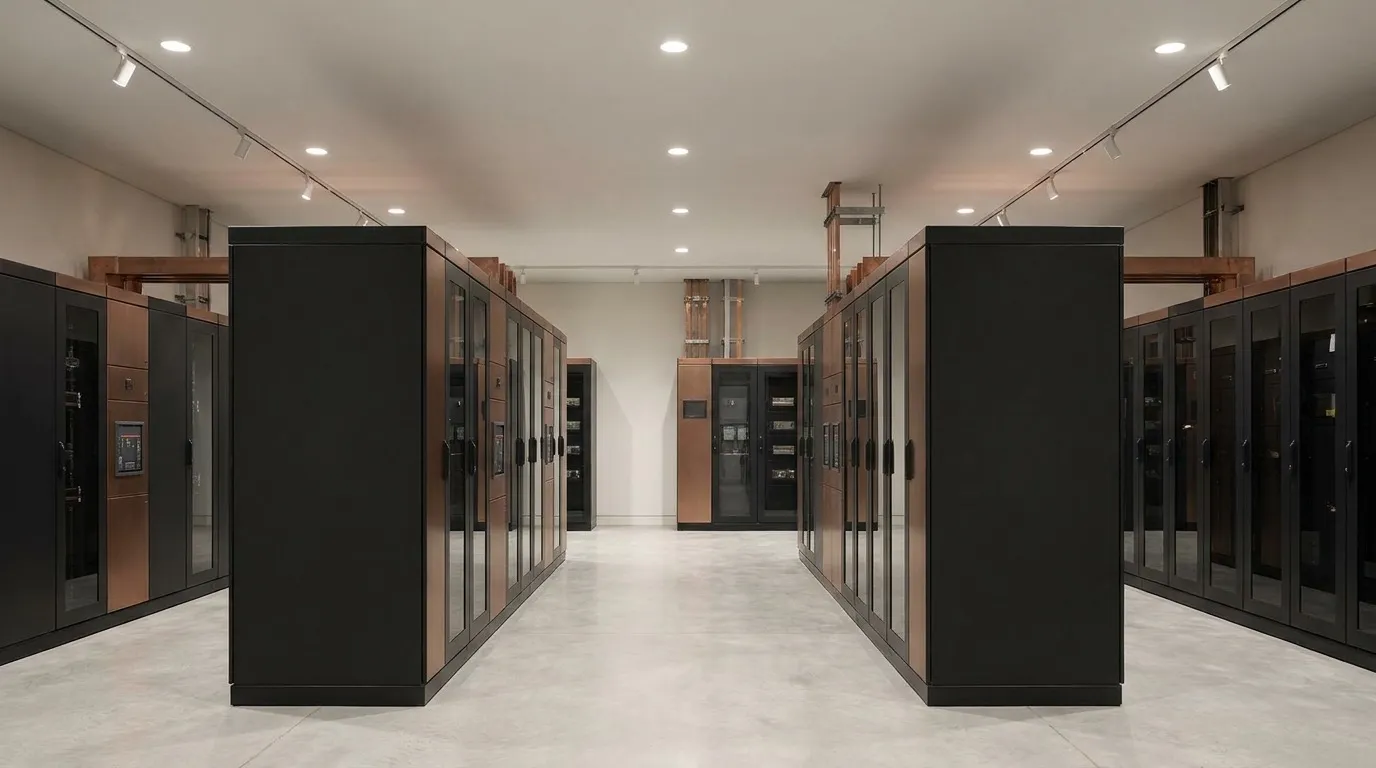
Industrial electrical work operates in an environment where the consequences of failure are measured not in inconvenience but in production loss, equipment damage, and — at the extreme end — serious injury to personnel. At Lumen & Wire, our industrial division approaches every project with an understanding of that environment: the unforgiving duty cycles of manufacturing equipment, the criticality of motor control circuits that keep continuous processes running, and the legal and ethical obligations that attach to electrical work on machinery under both AS 60204.1 and Victoria's Occupational Health and Safety Regulations.
We hold experience across food processing, cold-chain logistics, light manufacturing, packaging, water and wastewater infrastructure, and commercial kitchens operating at industrial scale. In each context, our work begins with a thorough review of equipment schedules, existing electrical single-line diagrams, and the client's operational constraints — because a factory that cannot afford an unplanned outage of more than four hours demands a different installation methodology than a greenfield facility being commissioned from scratch.
Three-Phase Power and Distribution
Three-phase 415V distribution is the backbone of Australian industrial facilities, and getting it right requires more than connecting conductors to the correct terminals. Lumen & Wire designs and installs three-phase distribution systems with careful attention to load balancing across phases, fault level calculations that confirm protection devices will interrupt correctly under worst-case fault conditions, and cable sizing under AS/NZS 3008.1.1 that accounts for the derating factors relevant to industrial cable tray, conduit bunching, and high-ambient environments such as boiler rooms, cold stores, and roof-mounted tray.
Motor control centres are built and commissioned with the same documentation discipline we apply to commercial switchboards: wiring diagrams, termination schedules, component data sheets, and test records are produced during construction and delivered with the installed equipment. Variable speed drives are commissioned in accordance with manufacturer requirements and integrated into the control scheme with appropriate input filtering where supply impedance or harmonics are a concern — a step that protects the VSD investment and prevents the interference issues that can affect upstream metering and adjacent sensitive equipment.
- Three-phase 415V distribution design with load balancing and fault level calculations
- Motor control centre (MCC) construction, wiring, and commissioning
- Variable speed drive (VSD) installation, parameter configuration, and input filtering
- PLC and SCADA field wiring: I/O terminations, earthing, and cable segregation
- Machinery safety circuits to AS 60204.1 — safety relay, light curtain, and E-stop integration
- Uptime SLA maintenance programmes with documented inspection and test schedules
PLC, SCADA Integration, and Machinery Safety
Modern industrial facilities rely on programmable logic controllers and SCADA systems to coordinate process equipment that would be impractical to manage with conventional relay logic. While Lumen & Wire does not write PLC programs or develop SCADA software, we execute field wiring to the standard that control engineers depend on: correctly segregated I/O and power cables, shielded instrumentation wiring with single-point earthing, clearly labelled terminal strips that correspond exactly to the wiring schedules, and field terminations that are mechanically secure and correctly torqued. The quality of field wiring determines how quickly a control engineer can commission, fault-find, and modify a system over its operational life.
Machinery safety is an area where our work intersects directly with client obligations under the OHS Regulations 2017. We install and verify safety relay systems, guard interlocks, light curtains, two-hand controls, and emergency stop circuits to the requirements of AS 60204.1, and we work with risk assessments provided by the machine designer or safety engineer to ensure that the electrical implementation achieves the required performance level. We issue a Certificate of Electrical Safety for all prescribed work and can provide detailed test records for inclusion in the machine technical file.
At a glance
Industrial Electrical — your questions answered
A direct-on-line or star-delta motor starter connects a motor to supply voltage at full frequency, giving fixed speed operation and high inrush current at starting. A Variable Speed Drive (VSD) converts the supply to a variable frequency output, allowing motor speed to be controlled continuously — which is essential for process control applications and delivers significant energy savings on pump and fan loads where torque requirements vary with speed. VSDs also provide soft-start behaviour that reduces mechanical wear. The selection depends on whether speed control is required and on the economics of the energy saving over the drive's service life.
Yes. We offer documented annual and biannual maintenance programmes that include thermographic scanning of switchboards, inspection and torque-checking of main connections, testing of RCDs and protection relays against setpoints, VSD parameter verification, and emergency lighting compliance testing where applicable. Each visit produces a written report against the previous baseline, allowing deteriorating connections or components to be identified and rectified before they cause unplanned downtime. Maintenance schedules can be structured to align with planned production shutdowns.
We carry out field wiring integration with most major PLC platforms including Siemens, Rockwell Allen-Bradley, Schneider Modicon, and Beckhoff, working from I/O schedules and wiring diagrams provided by the control engineer or OEM. Our scope covers the physical wiring, termination, labelling, and continuity verification; the control engineer handles program modifications and I/O configuration. We attend commissioning to support loop-check activities and address any field wiring discrepancies identified during testing.
The primary standard for electrical equipment of machines in Australia is AS 60204.1 (Safety of machinery — Electrical equipment of machines), which is adopted from the international IEC 60204-1. This standard covers requirements for control circuit design, conductor sizing, enclosure protection levels, protective bonding, and safety function implementation. In Victoria, compliance with relevant standards is referenced through the OHS Regulations 2017 and the Electrical Safety Act 1998. Where machinery is imported, it may also be subject to the requirements of the relevant ACMA framework and Australian market compliance obligations.
Related services
Commercial Electrical
Fit-outs, distribution, and tenancy works for offices, retail, and hospitality, delivered on programme.
Learn more
Data & Network Cabling
Structured Cat6A and fibre backbones, racks, and certified comms rooms for reliable connectivity.
Learn more
HVAC Electrical
Power, controls, and BMS integration for heating, cooling, and ventilation across any building.
Learn moreNeed industrial electrical done properly?
Talk to a licensed Lumen & Wire electrician for honest advice and a clear, itemised quote — with no obligation.